• Responding to email notices you receive.
    **************************************************
    In short, DON'T! Email notices are to ONLY alert you of a reply to your private message or your ad on this site. Replying to the email just wastes your time as it goes NOWHERE, and probably pisses off the person you thought you replied to when they think you just ignored them. So instead of complaining to me about your messages not being replied to from this site via email, please READ that email notice that plainly states what you need to do in order to reply to who you are trying to converse with.

  • IMPORTANT! PLEASE READ!! About the Google Adsense ads being displayed

    =====================
    Posted 08/15/2025
    =====================


    Yeah, I know. They are a pain in the butt. But they pay the bills to keep my server running. Just a fact of life, I am afraid.

    Want to get rid of them? Simple. Just become a Contributor level member or above and they will be gone. -> Please click HERE."

    Is that too much for me to ask of you to keep this site running? Well, sorry about that. I too wish I could get everything for free. But alas.....

    =====================
    Addendum: 01/10/2026
    =====================


    Google Adsense ad revenue for December, 2025 was just $30 over the cost of the lease for the server running this site. So, in effect, the money providing the incentive for me to continue running this site is coming SOLELY from the paid memberships and sponsorships here. Which honestly ain't much....

The elusive "pure" BT cribo

herbivorous

New member
Joined
Dec 12, 2004
Messages
26
Reaction score
3
Points
0
Age
43
Location
Galt, CA
A few weeks ago there was a very heated debate on the other forum about what does and does not actually constitute a "pure" blacktailed cribo...I own two yearlings myself: a female that I purchased from Chris Raden (beautiful girl) and a male that I purchased from a shop in Ohio. The female's tail is jet black, while the male's tail has more of a grey coloration. So there are a couple of questions I've got for you folks that might be more learned than I:
1) Does anyone know exactly where I could find the specific descriptions of the BT and Unicolor cribos, like scale counts, etc? Do folks in academia consider there to be a substantial difference between the two, or are there just two extreme forms of the same animal with a gradient in between? I've seen "pure" examples of both and several shades of "mixed" blood (much more common); as near as I can tell, the only consistent visual difference between the two besides tail coloration is that unicolors are longer and more heavily bodied than blacktails. Are there any others?
2) Do any of you guys either currently work with "pure" BT cribos or know anybody that does besides Chris Raden?
Robert
 
Robert,
For me the quest has been to find pure Unicolors. The problem lies in the fact that unis and bts overlap a bit in their ranges. About all I can tell you is don't breed anything that looks like an intergrade, no "brown tails". Lot's of folks work with BTs. Ask Jeff. I also have a pair of hatchling BTs from Chris. And from what I can see, they differ greatly from my Unis in that they are a much darker brown color, and the tails are almost solid black. Where as my Unis are a golden olive color, with a slight greyish color shift in the tail. There are some pur Bts out there, but good luck finding some pure Unis. From what I can gather, there isn't much difference in these two subs, ecxept for tail color. Personally, I'm not convinced that there are two full fledged subspecies, but rather several color phases of the same subspecies. BUT<.....with that said, I will still only breed animals that are clearly, visibly, identifiable as BTs with the same, and visa versa with Unis. If there is any doubt in my mind, I won't breed. Since academic herpetologists believe that there are two seperate subs here, I will try and breed with that in mind. And will try to keep breeding animals that are clearly Uni with animals that are clearly Uni, and the same with BTs. And I won't breed anything that l'm not sure of. So in short, I guess,...just don't breed brown tails. That's about all we can do for now. Just keep brown tails for pets. Good Luck!
T.
 
Personally, I've seen "blacktails" that range in ground color from bright gold to olive to brown...the trouble is that all the ones I've seen in the flesh in CA are imports with the brown tail coloration (and relatively bad attitudes). And I've been pretty much everywhere looking for them. If you run across any that you don't want, drop me a line.
Robert
 
I might have a very young one to part with later on. The pair I have are siblings, and I'd rather have unrelated. Yes, I see them advertised here and there, fairly frequently. Someone needs to contact the importers, and ask them to stop sending us browntails. I think if they would concentrate their search efforts to the easternCarribean portion of the range, they would find blacktails with actual black tails. Then go to the western/Pacific side, and find us some true Unicolors. That would be nice!!! Who is doing the importing? Please find out and let me know how to contact them!
T.
 
Why the confusion?

Regarding the confusion/debate about "Uni's" and "B.T.'s", I think people may be confusing marketing with taxonomy. Those of you who breed what are clearly identified as black tails and unis, (as opposed to the slang term "browntails") is there much variation amongst siblings? Do phenotype dark black tails typically produce dark blacktail hatchlings? This is curious, and it sort of reminds me of a time when people thought striped "cal kings" (L.g.boylii) and banded were separate species...and of course they were found to be only one, different phenotypes. Color as a "splitting" feature can decieve us, it seems more consistent taxonomic features are needed to settle this debate.
 
VICtort said:
Regarding the confusion/debate about "Uni's" and "B.T.'s", I think people may be confusing marketing with taxonomy. Those of you who breed what are clearly identified as black tails and unis, (as opposed to the slang term "browntails") is there much variation amongst siblings? Do phenotype dark black tails typically produce dark blacktail hatchlings? This is curious, and it sort of reminds me of a time when people thought striped "cal kings" (L.g.boylii) and banded were separate species...and of course they were found to be only one, different phenotypes. Color as a "splitting" feature can decieve us, it seems more consistent taxonomic features are needed to settle this debate.

Good post Vic....I have talked with a guy who runs a serpentarium in Costa rica. I showed him a pic of my "brown tail" and he told me it looked like the typical BT, in fact he has some displayed that look very similar to my male.

As far as me breeding my "brown tails" that may be everyone's preference not to have one in their collection or to have them as pets. Are you going to tell me not to breed my BCI because one is lighter than the other? Or one has a striped tail? I am not into marketing anything. If I get a few healthy babies out of my pair and I sell them, there must be a demand for "brown tails" right?

I think both of my animals are beautiful and YES I would like to produce some with jet black tails but until we get some definite proof that my "brown tail" is not a black tail then all I have to say is.... oh well. I guess I won't be in the elite BT breeding club.
 
I'm not blasting the "brown tails"...I'm not sure whether I'm convinced that the two are different enough to warrant separate subspecific status or if "blacktails" and "unicolors" are just two extremes in the same animal. It seems that the majority of "wild type" imports that I've seen have been the "brown tail" variety, so it makes sense that these would be represented in the serpentarium in Costa Rica. Trouble is, that doesn't answer the question of whether the brown tails really are intergrades or not. As for me, I prefer to breed as "pure" blacktailed animals together as much as possible in the absence of the definitive answer, but I wish you lots of luck with your cribos this year. Even if they are hybrids, they are awfully cool, and everybody needs a cribo in their lives.
Robert
 
Very good posting from all, on a touchy subject. I have a pair of adult unicolors. And to tell you the truth, I don't know any way to definitively identify them as such, other than color, and the breeder's word. And the same holds true for black tails. I saw a picture of the big adult black tail the guy from that serpentarium was holding. It looked pretty darned black to me.

The problem here, {I think}, is that the Field work has not yet been done. But we have what I would call a blended species. We have one subspecies, with a wide degree of color variation across the native range. {i think} If that is the case, then I see no need to worry about breeding what to what. Unis to BTs, or brown tails. That's like breeding a red faced couperi, to a black faced couperi. Same species. No cross breeding involved. Just different markings. Right? But if we start breeding like that, what will happen to the genetics. I'll tell you. Eventually, all we will have is a bunch of brown tails. You won't be able to find true black tailed BTs, and it's already hard enough to find a pure unicolor. So until someone goes down there, and does the actual Field work, I would suggest that we all try and refrain from breeding anything that is not clearly identifiable, as unicolor, or black tail. At least within reason. These two subs share a narrow strip of land, and the ranges overlap. So there is going to be some intergrades in nature. But if we are not extremely careful, we will be left with nothing but intergrades in captivity. Brown tails should only be bred to brown tails. Black tails should only be bred to black tails, and unicolor should only be bred to unicolor. If we breed brown tails to anything but brown tails, we are just muddying up the genetic waters, and eventually, mud is all we will have. Pure unicolor cribos are extremely difficult to find in captivity. Breeding brown tails will only make that more difficult. So let's just be extremely careful, at least until more conclusive Field surveys have been done. We have to do our best to conserve what we have. Bringing in new, pure Unicolor blood seems to be just about impossible. So it seems wise to protect what we have! I know, it is difficult to find an unrelated, healthy adult pair, of either sub. And I know everyone wants to make some babies. Me included. But we have to pay attention to detail on this one if we want to protect the genetic integrity of these subs. We may find, later on, that it's all the same darned thing. But for now, we just don't know. And the most compelling drive for caution is always, the unknown.
T.
 
Hey Robert-

I know you weren't blasting my breeding on KS but a couple of other elite breeders were. I am new to Cribos and I understand about producing phenotypes to match the subs descriptions, etc. The manner in which people replied to my thread really got under my skin a bit. There was no need for the elitists to be so condescending towards me for putting two snakes together, it's not like they were an Eastern and a Texan.

I too am not convinced that the subs aren't one in the same. I also happen to think there is nothing wrong with "brown tails", if they are coming out of the wild then what's the big deal if I have one or even sell one? What will I sell them when they hatch? Not sure but more than likely melanurus.

I think Vic's post hit the nail on the head. After seeing what Dry people are loooking for I probably won't be matching up the pair again and will look for a darker tailed male for future breedings.

I appreciate the debate and info on this subject.

Take care-

Brett
 
Anthony-

That last post makes great sense. I will be looking for a "black tail" to hook up with my female in the future.

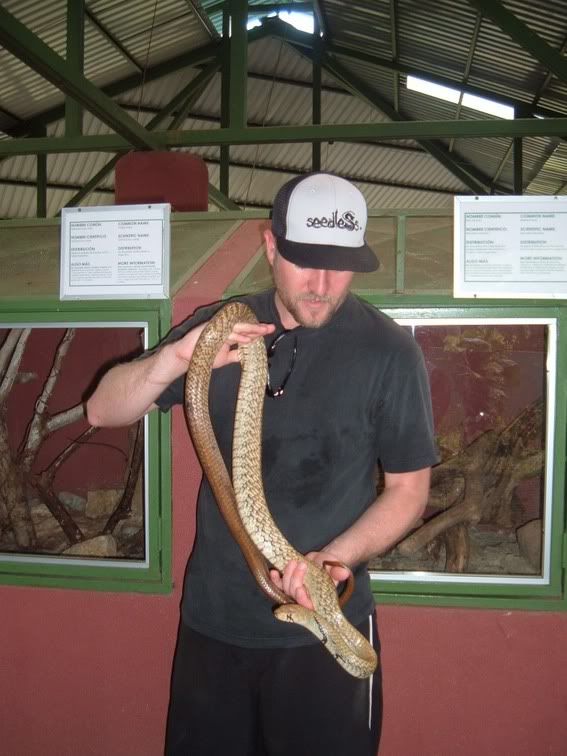
BTW- This is Quetzal's female BT. Yes his male has a pretty dark tail. Maybe I should send my female down to Costa Rica...LOL
CostaRica189.jpg

CostaRica190.jpg

And the pair with Quetzal and Monica, pic courtesy of Parque Reptilandia. The male is obviously the big one.

Take care-

Brett
 
Excellent thread! Excellent pics!! Now can someone post some good Unicolor pics? I think this is one subject which deserves much more investigation. We should all at least keep track of our breeding results, and share them here. It would seem that the only way for us to be sure, would be to go down south and have a looksee. Any body want to go snake huntin? Call this Quetzal up, and see if he would like to host an expedition.

The other way we might learn something, is with carefull attention to breeding detail. Let us each strive toward breeding animals which display similar coloration characteristics, and see if we only get babies with similar color characteristics. If we breed animals that look like black tails, and they only throw babies with black tails, and we breed animals that look unicolor, and they only throw babies that look unicolor, then maybe we'll know something. If, on the other hand, my pair of Unis produce some brown tails, or black tails, well then I guess it's back to square one. But I do think this is one subject we should all keep in mind when acquiring, and breeding Cribos. I just think it would be wise for all of us to breed blacks with blacks, brown with browns, and unis with unis. And let us know what your babies look like. That's probably the only way we'll figure it out.

Does anyone know how to contact the folks who are importing black tails, and unicolors??? Seriously,...That's who we need to talk to!!!


And fyi,...don't worry about folks getting on your case. Everybody takes a beating around these forums once in a while. Just dust yourself off, and get back in there. Remember,...it's all about the snakes. Always.

And if any of you guys ever want to come hang out with me, and see what my snakes look like first hand,...no problem. Just say the word.
T.
 
Actually the last time I spoke via e-mail with Quetzal he said he was going to some Islands off Honduras to go look for some type of Cribo, I will have to look up the e-mail to figure out what he was exactly talking about. He also host's expeditions into the forest to look for herps on advance notice. Great people with a lot of knowledge and they know quite a bunch of interesting people. Their zoo is definitely worth visiting if you are ever in Costa Rica.

Here is the e-mail I found from Quetzal. I know he isn't the Drymarchon melanurus authority but he does live down in Costa Rica and he does get out in the field often.

Hey Brett, your guy looks like a typical melanurus to me, probably of Honduran origin because that is the only country that allows export of wild melanurus. Where did you get it? because the one guy who ships out of Honduras is a friend and I know who he mostly ships to in the states and maybe we can trace it that way. Speaking of Honduras, we are going up there right after Christmas to look for those little grey island cribos we talked about. Wish us luck!
Quetzal
Parque Reptilandia
Costa Rica


If my melanurus does lay eggs and they do hatch I will definitely share the results. I more than likely will be holding all of them back for some time to see what they turn out to look like and to get them feeding.

Take care-

Brett
 
Exellent!

That's great! We will definitely need to watch this. I also wonder about the possibility of {three} subspecies, instead of two, or one. Here's a big question for Quetsal,...Does he have any good pictures of a primo unicolor? You see I'm racking my brain from the other side of this equation. If we could definitively see what a true Uni looks like, and how often, and where they occur, it would be of great benefit to all. We may be dealling with three subs here,...blacks, browns, and uniolors. But at this point it's all just conjecture.
I would be grateful for any light he could shed on this subject! Thanks a bunch,
T.
 
The Genuine Article

Well, regardless of the "true" specific status of "real" blacktail cribos, I managed (after an exhaustive search) to find an imported male that fits the description of a "pure" blacktail...I'm not sure where exactly he is from (no import data), but by the looks of him, he's got to be one of this year's hatchlings (he's only around 2.5 ft long right now), and although he is a trifle skinny, he is nice; bright gold with a shiny black black tail. I'll post pictures of him after he's taken a few more meals and is better acclimated. :eatpointe
 
Hey robert-

Doy have a female to pair the male with? Would yu consider a loan with my female for next year? She has a jet black tail. She just laid 15 eggs so I should get another decent clutch next year......I am not too far from you either.
 
Brett-
I do have a female BT that will be two years old this year that I got from Chris Raden as a hatchling, but I don't see any reason why Vegas couldn't be used to breed two females in a season. The trouble is that I don't think he'll be big enough next year to breed. I don't know how old he is, but I'd guess he's a decently sized almost yearling. Right now he's pushing 3ft, almost as big as my '05 indigos. If he's big enough, I'd be glad to do a loan thing, but I don't want him to be lunch for your female.
Would it be possible to come see your cribos sometime? There aren't a lot of folks around here that keep them, and its always fun to compare notes.
Congratulations on the eggs. That's really, really cool. I'd be interested to see what the hatchlings look like. Good luck with the incubation. May all your eggs contain twins. :eatpointe
 
Back
Top