• Responding to email notices you receive.
    **************************************************
    In short, DON'T! Email notices are to ONLY alert you of a reply to your private message or your ad on this site. Replying to the email just wastes your time as it goes NOWHERE, and probably pisses off the person you thought you replied to when they think you just ignored them. So instead of complaining to me about your messages not being replied to from this site via email, please READ that email notice that plainly states what you need to do in order to reply to who you are trying to converse with.

  • IMPORTANT! PLEASE READ!! About the Google Adsense ads being displayed

    =====================
    Posted 08/15/2025
    =====================


    Yeah, I know. They are a pain in the butt. But they pay the bills to keep my server running. Just a fact of life, I am afraid.

    Want to get rid of them? Simple. Just become a Contributor level member or above and they will be gone. -> Please click HERE."

    Is that too much for me to ask of you to keep this site running? Well, sorry about that. I too wish I could get everything for free. But alas.....

    =====================
    Addendum: 01/10/2026
    =====================


    Google Adsense ad revenue for December, 2025 was just $30 over the cost of the lease for the server running this site. So, in effect, the money providing the incentive for me to continue running this site is coming SOLELY from the paid memberships and sponsorships here. Which honestly ain't much....

Square tails?

OrganicBoas

Member
Joined
Dec 21, 2005
Messages
137
Reaction score
2
Points
18
Age
50
Location
Las Vegas, NV
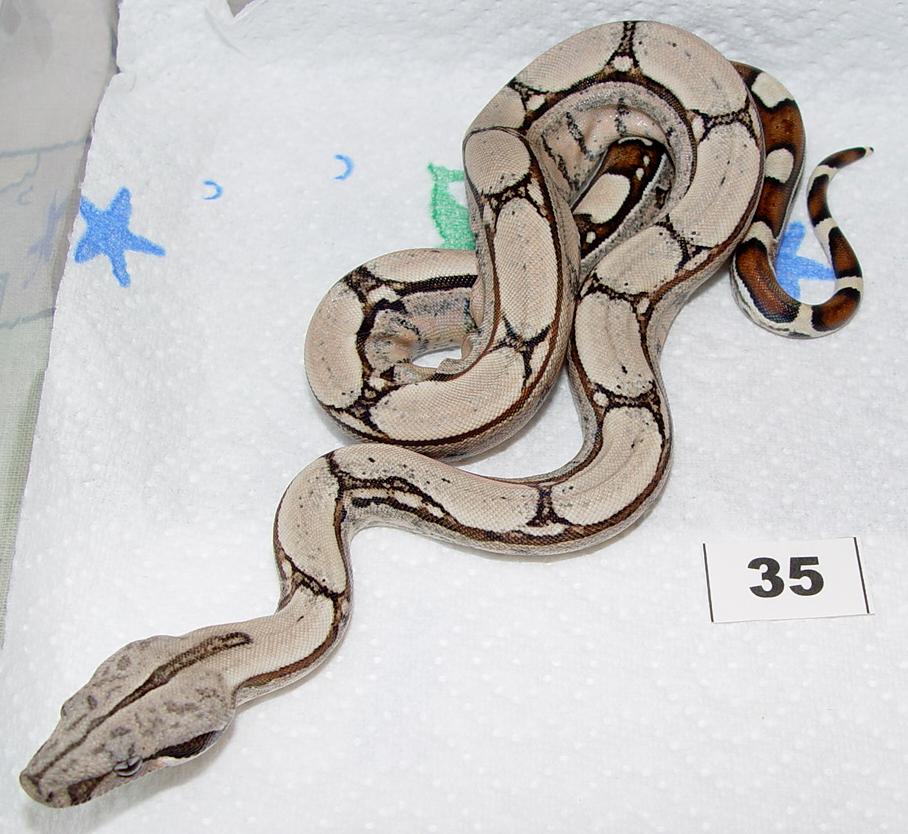
A bit ago on Kingsnake I saw a post about square tails. I went to the site but can't remember where it was or who it was who's breading them. They were claimed to be a combination of ladder tail/arabesque/pastelish (without the spotting normally seen with arabesques). Anyone know more about these guys and their possibilities? Is it a combination of genetic co-dominant traits or a single trait that makes them this way?

- Damian
 
sqb35.JPG
 
sure is
so what do you think art morph or selective
i would want to say selective breeding
 
sure is
so what do you think art morph or selective
i would want to say selective breeding
Eric,
It's definately genetic. Kahl is selling hets for $500. How's that for riding the fence? I'd love to have one... or four.
 
books on morphs

clearly i need to hit the books on boa morphs
what is a good book that determines morph or not

and how do you determine if a pattern or coloration is a morph and not a just
coincidences
the more you learn the more you realize you dont know squat
thanks for the help
Eric

i did find kingsnakes guide to boa morphs ,but i have not had a chance to look at it yet
it should help
 
ericfire said:
clearly i need to hit the books on boa morphs
what is a good book that determines morph or not

and how do you determine if a pattern or coloration is a morph and not a just
coincidences

i did find kingsnakes guide to boa morphs ,but i have not had a chance to look at it yet
it should help

I'm not an expert...so with a grain of salt: One of the ways to tell- breed the snake to a non-sibling and see if the variation shows up in the young (would then be considered a co-dominant trait). If the trait didn't show up you could breed the young together to find out if it's a recessive trait. If you start with snakes which are siblings and have the same variation, it would be a different story unless you knew what their lineage was. Somebody I'm sure could add much more...

Honestly the kingsnake one is way out of date. I suggested a re-vamping in the boa forum. But it didn't happen. Here is a better one.

http://www.classreptilia.com/boa_morphs.htm

Art Klass said:
That is truely a spectacular boa!! Is it yours? Damn that's nice.

I wish.... It's sweet!! I found it at albinoboas.com. I think it is a german or dutch? The way he described it was as a recessive trait... But this is completely different than the arabesques which is co-dominant (right?) Or possibly it just doesn't show up in the co-dominant form, and the "hets" look like normals?

And what about it being pastelish too? I'm just wondering if it's a couple seperate traits or one trait (the squaretail trait laughing) that's making it this way. The F2's are supposedly on the way.

Also..Somehow I find it strange kahl is selling het's for these traits for $500. An arabesque goes for a 1500+ let alone what these squaretails have in addition. Not doubting him...Just wondering at the low price.

- Damian
 
Also, somebody correct me on my bungling of genetics explanation to eric. There's probably other possibilities I didn't mention.

- Damian
 
Sorry for bombing this thread... Just found some more info:

- Damian

from albinoboas.com under squaretail info:

As it seems now, the color of the sq.tails leaves itself intermediately that means all the babys will have the coloration but a bit lighter than the parents if you breed a sq.tail to a normal. Quit the same as it is known from the Kubsch pastels. The pattern seems to be recessive, and becomes visible only if its homozygoes .

This year we try to breed F2, time will tell how they will look like.
 
That is an awsome boa no doubt. I would say it would have to be bred to find out what's going on though.
Now, I thought Arabesque was dominant, but I may be off on that. But even if codominant..............is there such a thing as het for a dominant/codominant gene(s)? I thought it either expressed itself, or not present.

Rick
 
As far as I know- co-dominant if the trait is received from one parent and dominant if it receives the trait from both.

Also I've heard of co-dominant/dominant traits which only show up when the allele is received from both parents (homozygous/dominant) but don't show up when the allele is received from just one (heterozygous/co-dominant).

Again..This is my understanding of it. Not many chiming in here, so take it with a grain of salt.

- Damian
 
here we go... from paulh here at faunaclassifieds:

I don't really get the difference between co-dominant and dominant in pastels, doesn't co-dom mean that it is made up of several genes to make the phenotype? Jaguars are considered co dom because more variation have been seen to come out of the gene. Pastels x normal you get 50 50, but isn't that because they only carry one of the paired genes, there is super pastels but i haven't seen any pics, do they look different then normal pastels or can you only tell they are super when you breed them out and get all pastel babies? Just wondering that, and if so wouldn't that make pastels dominate not co dom.

Unfortunately, many herpers have misunderstood the definitions of dominant, codominant, and heterozygous.

There are three possible pairings of genes at the pastel gene locus (location in the ball python genome). There may be a pair of normal genes (homozygous normal), a pair of pastel mutant genes (homozygous pastel), or a pastel mutant gene paired with a normal gene (heterozygous pastel).

Here are the definitions of dominant, codominant, and recessive mutant genes as used in standard genetics:

If a mutant gene is paired with a normal gene and the organism looks normal, then the mutant gene is recessive to the normal gene, making it a recessive mutant gene. Example -- the albino mutant gene in ball pythons.

If a mutant gene is paired with a normal gene and the organism looks like an individual with a pair of the mutant gene, then the mutant gene is dominant to the normal gene, making it a dominant mutant gene. There are no really good examples of a dominant mutant gene in snakes. Salmon in the boa constrictor and striped in the California king snake are dominant mutant genes, but both homozygous and heterozygous individuals show considerable variation in expression of the mutant appearance.

If a mutant gene is paired with a normal gene and the organism does not look normal but does not look like the individual with a pair of the mutant gene, then the mutant gene is codominant to the normal gene, making it a codominant mutant gene. Example -- the tiger mutant gene in reticulated pythons.

Most pastels available have a pastel mutant gene paired with a normal gene, making them heterozygous pastels. These are usually incorrectly called codominant pastels. NERD and others, I think, have produced some pastels that look distinctly different from the heterozygous pastels, at least as hatchlings. You might check the NERD web site for pictures. I don't know offhand whether any are old enough for breeding yet. Anyway, these are considered to be the super pastels, or homozygous pastels. They are incorrectly referred to as dominant pastels.

Pastel is either a dominant or codominant mutant gene. If the distinction in appearance between homozygous pastel and heterozygous pastel holds up, even if only as hatchlings, then it is a codominant mutant gene. If a significan number of homozygous pastels can only be identified through breeding tests, then pastel is a dominant mutant gene which shows variable expressivity.

Pastel (heterozygous pastel) x normal --> 1/2 normal, 1/2 pastel (heterozygous pastel). The normal snake produces sex cells carrying only the normal gene. Half of the heterozygous pastel's sex cells have the pastel mutant gene, and the other half of the heterozygous pastel's sex cells have the normal gene. If a normal gene is paired with a normal gene, the baby is normal. If a pastel gene is paired with a normal gene, the baby is heterozygous pastel.

Clear as mud?

Sorry, I know nothing about jaguars.

from the thread: http://www.faunaclassifieds.com/forums/archive/index.php/t-59015.html

- damian

 
Back
Top