• Responding to email notices you receive.
    **************************************************
    In short, DON'T! Email notices are to ONLY alert you of a reply to your private message or your ad on this site. Replying to the email just wastes your time as it goes NOWHERE, and probably pisses off the person you thought you replied to when they think you just ignored them. So instead of complaining to me about your messages not being replied to from this site via email, please READ that email notice that plainly states what you need to do in order to reply to who you are trying to converse with.

  • IMPORTANT! PLEASE READ!! About the Google Adsense ads being displayed

    =====================
    Posted 08/15/2025
    =====================


    Yeah, I know. They are a pain in the butt. But they pay the bills to keep my server running. Just a fact of life, I am afraid.

    Want to get rid of them? Simple. Just become a Contributor level member or above and they will be gone. -> Please click HERE."

    Is that too much for me to ask of you to keep this site running? Well, sorry about that. I too wish I could get everything for free. But alas.....

    =====================
    Addendum: 01/10/2026
    =====================


    Google Adsense ad revenue for December, 2025 was just $30 over the cost of the lease for the server running this site. So, in effect, the money providing the incentive for me to continue running this site is coming SOLELY from the paid memberships and sponsorships here. Which honestly ain't much....

Cape House Snake or Brown House Snake - how do I tell which one I've got?

Ssthisto

New member
Joined
Jun 28, 2004
Messages
55
Reaction score
5
Points
0
Location
West Yorkshire, England
I recently acquired an adult female house snake – she’s definitely either a Cape (L. capensis) or a Brown (L. fuliginosus) … but I don’t know how to tell which species she is.

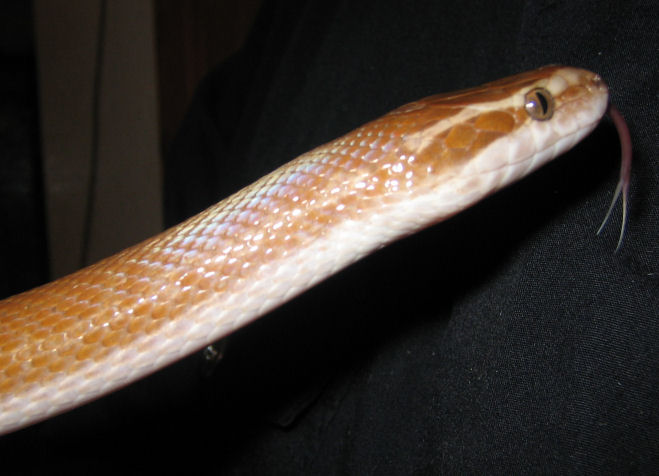
I’ve read some things stating that Capes have eye stripes that break at the back of the skull and that Browns have stripes that continue unbroken down the neck – but I’ve also seen photos of a clutch of animals from eggs with good fertility – who show both traits. Ours has broken eye stripes that stop at the base of the neck and do not continue from there, and she has very, very minimal markings generally. Our female, Cinnamon (so called because she looks like the cinnamon phase animals I’ve seen photos of) is a former rescue animal, so we don’t know what locality she came from or whether she herself was captive bred.

Is there a reliable way of distinguishing Cape House snakes from Brown House snakes, other than breeding an unknown-species animal to a member of each of the two species and seeing which one produces viable hatchlings?
 
Unfortunately, all that link told me is that yes, I've got either a Cape or a Brown - because the outward colour/shape of the two species, based on those photos, are the same. It doesn't help that THOSE photos go against what I'd read on another site - in the photos on that link, it's the Capes that have an eye stripe that continues down the neck before breaking, and the Browns that have the eyestripe that breaks at the base of the skull. Cinnamon looks very much like the first photo of the Cape - but she also looks like the first and third photos of the Browns.

Cape House Snakes were originally classified as Lamprophis fuliginosus - until they discovered that animals from the Cape localities were not cross-fertile with the animals from further north - they produce very poor, small clutches and the offspring that do make it tend to be infertile themselves. Then they were renamed to Lamprophis capensis.

That's why something like scale count differences or a dichotomous key would be useful... because I don't really want to have to test Cinnamon against WC males of known locality/species and making her lay at least one clutch of "doesn't work" eggs.
 
ventral scale count, if its under 200, its definately not Fuliginosus, if its over 228 its definately not capensis.
if its between 200 and 228 then it will be hard to tell.

the eye markings, the capensis and fuliginosus both have pair of eye markings, howeverer the line not running above the eye, the lower line only runs from eye to snout on capensis but goes pass eye on fuliginosus, this is the lower line not the upper line.

I will take pics to show you ok.

Mike
 
check out my sight , there some nice cape and brown house snake pics on there, http://northeastexotics.net

but I will try to get some close ups on the the sides of the heads of both species ok. i have a number of examples of each species to use for verification.
 
Thank you, Michael.

How about I post this one:

cinnamon-headclose.jpg


Any clues?
 
Capensis

really nice, it should get huge if its a female.
the lower eye line seems to go past eye but it should have been thicker, it just fades away, that is a capensis. the line isnt apart of the upper labials on fuliginosus like it is seen on capensis.

beautiful specimen you have there, show us a full body shot.
 
That's weird, because someone else has said "oh, she's definitely a nice Fuliginosus" ... so I'm back to being 1-all rather than knowing for sure. We're still waiting for a shed so that we can do a scale count - is it from under the chin to the vent, or under the chin to the tailtip? She is, as far as we're aware, fully grown - she's four years old and just over three feet long.

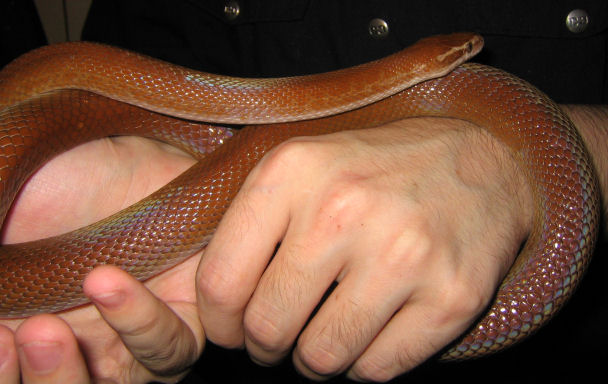
Here's a full-body shot:

cinnamon-fullbody.jpg
 
IBsmokin said:
ventral scale count, if its under 200, its definately not Fuliginosus, if its over 228 its definately not capensis.
if its between 200 and 228 then it will be hard to tell.

the eye markings, the capensis and fuliginosus both have pair of eye markings, howeverer the line not running above the eye, the lower line only runs from eye to snout on capensis but goes pass eye on fuliginosus, this is the lower line not the upper line.

I will take pics to show you ok.

Mike

I've just done a ventral scale count on a fresh shed.

229 ventrals from under chin to vent.

Guess that means she's definitely a Fuliginosus?
 
Now I'm really confused. I got THIS little guy:

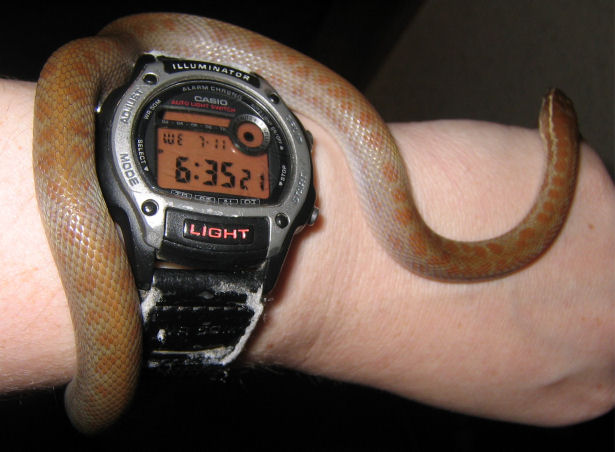
pepper-inhand.jpg


As a six-inch-long hatchling. When I got him, he was BLACK. When I fed him before I left last week to do my school display trip, he was dark brown. When I got back, he looked like the photo above.

I'm starting to think someone broke into my house, misplaced my little black house snake and replaced him with this guy!

He's pretty... but is HE a fuliginosus?
 
The Cape House Snake in the western Cape do not get very big. My guess is about 75 cm tops.

1. The Brown House Snake = Lamprophis Fuliginosus

2. The Cape House Snake = Lamprophis Capensis

These snakes are often called "brown house snakes" which simply causes greater confusion between the two species. Within the species of L. Capensis there are several "phases" which are tied to geographic region. The two most common phases are Zululand (which are generally dark in colour and get the largest of any phase and species) and Transvaal (which also grow larger then most house snakes and are generally quite light in colour).

Like L. Fuliginosus, L. Capensis is highly variable in colour and pattern. Many have a spotted or chain like pattern while some are striped. Some are basically a solid colour.

Ssthisto in my opinion it is a Lamprophis Fuliginosus


The African House Snake Blog is an informational resource that explores all Species and Phases of the genus Lamprophis.

http://africanhousesnake.blogspot.com/2006/08/why-wont-these-house-snakes-breed.html
 
Snakes Inc,

Thanks for posting a link to my blog. Be aware though that I was not completely sqare on all the species (specificly L. maculatus) when I started it. I have since set up a new blog and a new website.

On species ID I have started to build out a Species guide that is located here,

http://housesnakes.net/species-guide.php

I have been working with Lamprophis now for about three years, any specific questions just fire away.
 
Back
Top