• Responding to email notices you receive.
    **************************************************
    In short, DON'T! Email notices are to ONLY alert you of a reply to your private message or your ad on this site. Replying to the email just wastes your time as it goes NOWHERE, and probably pisses off the person you thought you replied to when they think you just ignored them. So instead of complaining to me about your messages not being replied to from this site via email, please READ that email notice that plainly states what you need to do in order to reply to who you are trying to converse with.

  • IMPORTANT! PLEASE READ!! About the Google Adsense ads being displayed

    =====================
    Posted 08/15/2025
    =====================


    Yeah, I know. They are a pain in the butt. But they pay the bills to keep my server running. Just a fact of life, I am afraid.

    Want to get rid of them? Simple. Just become a Contributor level member or above and they will be gone. -> Please click HERE."

    Is that too much for me to ask of you to keep this site running? Well, sorry about that. I too wish I could get everything for free. But alas.....

    =====================
    Addendum: 01/10/2026
    =====================


    Google Adsense ad revenue for December, 2025 was just $30 over the cost of the lease for the server running this site. So, in effect, the money providing the incentive for me to continue running this site is coming SOLELY from the paid memberships and sponsorships here. Which honestly ain't much....

SFD (Snake Fungal Disease) General Discussion.

Fangthane

Tuck Frump!
Joined
Jul 25, 2005
Messages
2,320
Reaction score
444
Points
0
Age
49
Location
Apache County, Az
This thread is for the specific discussion of SFD, carried over from an off-topic discussion on the BOI.

Again, this is meant to discuss all things related to Snake Fungal Disease - diagnosis, treatment, cause, possible preventative measures, ramifications for the herp community, etc - without referencing anything BOI-centric - specific transactions/buyers/sellers.

Some literature on the subject:

http://www.northeastparc.org/products/pdfs/NEPARC_SnakeFungalDiseaseFAQ.pdf

https://www.nwhc.usgs.gov/disease_information/other_diseases/snake_fungal_disease.jsp

https://www.ncbi.nlm.nih.gov/pubmed/26745835
 
Thank you for posting this. I have done some searches, but from all that I've seen, the mode of transmission is unknown. Hopefully future research will bring an answer, before snakes are increasingly affected.
 
First I heard about SFD was in timber rattlesnakes in the NE. Highly contagious, found in communal species like timbers, that overwinter in dens. There are lots of threads about SFD on the field herp forums. Field herpers now bring bleach with them so whenever they handle a wild snake, they disinfect their equipment afterwards. The most knowledgeable folks on SFD are herp vets and field herpers who have encountered it. To many herpetoculturists, it is more unknown.
Still hoping Joe's animals do not have SFD, but several professionals (vets, research folks) have seen his photos. Based upon their experience and knowledge, they believe it is highly likely it is SFD. But we shall see. Joe has nothing to hide. He will post the results when he gets them. Even if proven wrong.
 
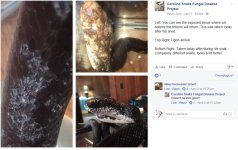
When doing some more research on this I found this Facebook group:
Carolina Snake Fungal Disease Project

Interesting stuff. If you search for "Oscar" and "2016-0016" you'll find info about him. He's an eastern black rat snake that had a case of SFD bad enough earlier this year they were considering euthanizing him. I've attached a before/after picture from one of the group's photos.

Also noteworthy was a post on Sep 9 about a gravid eastern king snake with SFD that they collected. She laid eggs, which were incubated, and apparently the babies developed SFD both in the egg (these were stillborn with SFD lesions), or the lesions showed up shortly after pipping.
 

Attachments

  • oscar_sfd.jpg
    oscar_sfd.jpg
    173.8 KB · Views: 570
One of the interesting, or mysterious things about SFD is its relationship with the more common, and much less lethal, hibernation fungus that we've probably all seen on wild snakes. or even snakes we have brumated / hibernated ourselves.

In one recent study something like 40 of the snakes in a given study area (N=82 I think) showed signs of 'water blisters' or "hibernation blisters" and of them 75% tested positive for SFD. And the researchers suggested this was a low estimate.

So its starting to seem that *maybe* the same fungal species (o_O.) is present in both mild cases and severe / lethal cases. Maybe its a secondary infection?

But if it is the cause, why is it so often shed off with no serious repercussions but sometimes wipe out a big hunk of the population? I don't think anyone knows.

(The study is paywalled but I may be able to provide an illegal Russian link)
 
The latest published data shows the spread of SFD. Note the cases in western US, Europe and Australia now. These are from captive animals. It has only been found in the US and I think one Canadian site.
 

Attachments

  • Screen Shot 2016-11-23 at 6.38.47 PM.png
    Screen Shot 2016-11-23 at 6.38.47 PM.png
    217.4 KB · Views: 538
When doing some more research on this I found this Facebook group:
Carolina Snake Fungal Disease Project

Interesting stuff. If you search for "Oscar" and "2016-0016" you'll find info about him. He's an eastern black rat snake that had a case of SFD bad enough earlier this year they were considering euthanizing him. I've attached a before/after picture from one of the group's photos.

Thanks to this information I spent a great deal of time reading their posts, and I contacted them on the specifics of treatment if SFD is confirmed (or what they did for Oscar that has been successful so far).

Their recommendations are to soak the affected snake daily in chlorohexidine diluted in a warm bath, then to follow up with a vet to get immune building vitamins that can be injected into the snake's food. They used vitamins A, E, C, and B. They also injected vitamin B-Complex SQ into Oscar. The fungi apparently doesn't grow in temperatures above 98F, so it helps to keep the enclosure as dry and warm as is tolerated as the fungi thrives in moisture, and to wipe the snake off with a towel after soaks.

The above is choppily combined from several messages we exchanged, and I took some liberties with phrasing, but that is what they found helped Oscar to recover. I thought I'd add this for those who may wind up with a positive SFD diagnosis that want to begin some form of treatment for any captive snakes showing symptoms.
 
I would be careful with remedies that have no evidence behind them. Just because this one snake recovered doesn't mean the treatment worked, or even helped. Injections are potentially problematic, especially for high strung snakes like some Nerodia.

Not saying there's is not a good intervention, just would like to see a little more supporting evidence.
 
Joe, I agree completely. Any and all treatments should be discussed with a qualified veterinarian and tailored to best work for the individual animal. I was just curious about Oscar's treatment in particular and figured I'd share the information just in case anyone wanted to address the options with their vet.
 
I would be careful with remedies that have no evidence behind them. Just because this one snake recovered doesn't mean the treatment worked, or even helped. Injections are potentially problematic, especially for high strung snakes like some Nerodia.

Not saying there's is not a good intervention, just would like to see a little more supporting evidence.
I agree, but I don't think there is a ton of research - yet - on treatments that do and do not work, or even if the treatment has to be tailored to the species. For instance, if SFD entered a collection and a species like a Brazilian rainbow boa were infected, the high heat and dry conditions described as a treatment would kill the critter long before it killed the fungus. For the water snakes, if you want to increase vitamin intake is there a good way to someone inject or "gut load" the vitamins into their feeders so that you're not stressing the snake?

Another consideration is antiseptics. I noticed that bleach is mentioned a lot for disinfecting equipment and field tools, but I prefer not to use it in my snake enclosures unless they have a long time to dry even after I rinse them. It would be nice to know alternatives like F10SC or even a UV-C light are effective, and the concentration needed to kill the spores.

Speaking of the spores, is it even known if they're only ground-based or can they go airborne?
 
For the water snakes, if you want to increase vitamin intake is there a good way to someone inject or "gut load" the vitamins into their feeders so that you're not stressing the snake?

This is one thing that I'm very interested in discussing with my vet. Most of those vitamins serve to boost the immune system, which I feel could lead to more efficient healing. The only drawback I can think of is the food item itself - if the snake is a rodent eater, it seems pretty straight forward. I've never tried to inject anything into a f/t fish, but I doubt it would be as agreeable.

I noticed that bleach is mentioned a lot for disinfecting equipment and field tools, but I prefer not to use it in my snake enclosures unless they have a long time to dry even after I rinse them. It would be nice to know alternatives like F10SC or even a UV-C light are effective, and the concentration needed to kill the spores.

I've been looking for information on this and can't seem to find any - bleach seems to be the only rock-solid solution. Hopefully as more research is done we'll learn more. It may also help to see if there's any information on similar fungus spores and how those react to those (or any) alternatives.

Speaking of the spores, is it even known if they're only ground-based or can they go airborne?

All I can say to this is that I hope they're strictly ground based. :eek:
 
I've been looking for information on this and can't seem to find any - bleach seems to be the only rock-solid solution.
The BBC article in post #10 mentions using rubbing alcohol as a disinfectant, most likely the 90% rather than 70% solution. It's not as cheap as bleach or F10 but that's what I'd use inside the enclosure, as it would take very little time to dry out and air out.
 
This is one thing that I'm very interested in discussing with my vet. Most of those vitamins serve to boost the immune system, which I feel could lead to more efficient healing. The only drawback I can think of is the food item itself - if the snake is a rodent eater, it seems pretty straight forward. I've never tried to inject anything into a f/t fish, but I doubt it would be as agreeable.

There is one area of vitamin addition with snakes that is often overlooked in the US side of the reptile keeping hobby and has only relatively recently begun to be studied in comparison of in situ versus in captivity and that is circulating levels of D3 and the metabolites of D3. Tests on several different reptiles in the wild have shown that if given the opportunity they will behaviorally modify their circulating levels of D3 and its metabolites through basking.

Ferguson, Gary W., et al. "Voluntary exposure of some western‐hemisphere snake and lizard species to ultraviolet‐B radiation in the field: how much ultraviolet‐B should a lizard or snake receive in captivity?." Zoo biology 29.3 (2010): 317-334.

Acierno, Mark J., et al. "Effects of ultraviolet radiation on plasma 25-hydroxyvitamin D3 concentrations in corn snakes (Elaphe guttata)." American journal of veterinary research 69.2 (2008): 294-297.

Ramer, Jan C., et al. "Vitamin D status of wild Ricord's iguanas (Cyclura ricordii) and captive and wild rhinoceros iguanas (Cyclura cornuta cornuta) in the Dominican Republic." Journal of Zoo and Wildlife Medicine 36.2 (2005): 188-191.

Considering D3 solely as a vitamin really undersells its position in the metabolic process as it acts much more like a hormone and impacts multiple systems in the body. D3 is important in the proper function of the immune system so the ability of the snakes to regulate their levels of D3 can be an important resource for the animals to deal with immune threats.

Another vitamin that is important and overlooked is vitamin E (tocopherols) as the levels of vitamin E in the body are the result of what they consume in their diet and since both A and E are derived solely from the diet you need to watch the ratios of A:D3:E in the diet as ratios out of the 10 to 1 to 0.1 can result in conditional deficiencies. Deficiencies in these vitamins can also cause issues such as immune function deficiencies but modifying them is best done through an analysis of the diet.
with respect to E see

Dierenfeld, Ellen S. "Vitamin E deficiency in zoo reptiles, birds, and ungulates." Journal of Zoo and Wildlife Medicine (1989): 3-11.


I've been looking for information on this and can't seem to find any - bleach seems to be the only rock-solid solution. Hopefully as more research is done we'll learn more. It may also help to see if there's any information on similar fungus spores and how those react to those (or any) alternatives.

Keep in mind that this pathogen was only recently separated out from the CANV (Chrysosporium anamorph of Nannizziopsis vriesii) which is one of the reasons if you search for SFD you only get much more recent articles as a real analysis has to also consider those prior articles where it diagnosed as the other closely related pathogen so disinfectants that work for CANV should work just fine for this species.

In the one article that specifically tested SFD and disinfectants, bleach, ETOH, and quaternary ammonium disinfectants all worked on them and if you don't want to use bleach quaternary ammonia disinfectants like Roccal-D should be fine.

here is a free access link to the above article (can't say for how long the link will work)

https://www.researchgate.net/public...a_the_Causative_Agent_of_Snake_Fungal_Disease

some comments

Ed

 
Speaking of the spores, is it even known if they're only ground-based or can they go airborne?

The fungus is able to persist long-term in suitable conditions without the presence of reptiles. See ALLENDER, Matthew C., et al. "The natural history, ecology, and epidemiology of Ophidiomyces ophiodiicola and its potential impact on free-ranging snake populations." (2015)

link to article (currently free access but could change)

http://wwx.inhs.illinois.edu/files/...hiodiicola_Allender_et_al_Fungal_Ecol2015.pdf

some comments

Ed
 
But if it is the cause, why is it so often shed off with no serious repercussions but sometimes wipe out a big hunk of the population? I don't think anyone knows.

Where has it wiped out a big hunk of the population? Do you have a reference for this claim?

some comments

Ed
 
Anecdotal evidence, but I have heard the same (drastic reduction in population) from Park Rangers at Lake Carlyle, which is within the heart of the very limited range of this species in central/southern Illinois.
 
Tim, I've been to that population in IL many times. They were going to (maybe did build) a bicycle path right above a major overwintering area. There is a lot going on there. I also highly doubt that most field hepers disinfect their boots/hooks on a regular basis. Heck I've been field herping for a long, long time and I've yet to see that being widely practiced on a regular basis. The fact is field herpers probably do help spread the disease from site to site.
 
I have not read this entire thread, I apologize in advance.

Question:
Are people attributing the spread of SFD to "wild" specimens entering into otherwise sanitized protected CB collections?
 
I have not read of any confirmed cases of wild snakes infecting captive snakes. The only exception I know of is <a> case of wild caught adult Nerodia giving birth to young which are then shown to be positive for the disease. We dont know if the babies were infected from their surroundings or if they were born with it - contracted it from infected females that birthed them.

Also - why did my attempt to update this situation on the Board get blocked?


I have not read this entire thread, I apologize in advance.

Question:
Are people attributing the spread of SFD to "wild" specimens entering into otherwise sanitized protected CB collections?
 
Last edited by a moderator:
Back
Top