• Responding to email notices you receive.
    **************************************************
    In short, DON'T! Email notices are to ONLY alert you of a reply to your private message or your ad on this site. Replying to the email just wastes your time as it goes NOWHERE, and probably pisses off the person you thought you replied to when they think you just ignored them. So instead of complaining to me about your messages not being replied to from this site via email, please READ that email notice that plainly states what you need to do in order to reply to who you are trying to converse with.

  • IMPORTANT! PLEASE READ!! About the Google Adsense ads being displayed

    =====================
    Posted 08/15/2025
    =====================


    Yeah, I know. They are a pain in the butt. But they pay the bills to keep my server running. Just a fact of life, I am afraid.

    Want to get rid of them? Simple. Just become a Contributor level member or above and they will be gone. -> Please click HERE."

    Is that too much for me to ask of you to keep this site running? Well, sorry about that. I too wish I could get everything for free. But alas.....

    =====================
    Addendum: 01/10/2026
    =====================


    Google Adsense ad revenue for December, 2025 was just $30 over the cost of the lease for the server running this site. So, in effect, the money providing the incentive for me to continue running this site is coming SOLELY from the paid memberships and sponsorships here. Which honestly ain't much....

Natural breeding conditions Fiji boas Candoia Bibroni

Helenthereef

New member
Joined
Jan 19, 2008
Messages
3,340
Reaction score
246
Points
0
Age
68
Location
Fiji Islands South Pacific
Thought I'd play snake geek for a while and post some details of natural breeding conditions for Fiji Boas, Candoia bibroni bibroni. May well apply to other Candoia species, as they all come from very similar habitats.

Please note that I am keeping these snakes in fairly natural conditions, using rather different techniques than most herpers who keep exotic species. I am not advocating keeping snakes in this way for those of you who regularly trade snakes and keep large numbers.

However, I think that what I see is the closest to observing them in natural conditions I can get without spending my life in the bush, and I figure some of this might be useful to anyone thinking of brumating/cooling etc to breed Candoia.

So, I keep 5 snakes (2 females, 3 males) in one large tank with multiple ground hides, two large water bowls and many climbing branches. They are not fed in this tank (they have their own feeding tubs) but they live together year round.

They are at natural temperatures and humidity in my very open air living room. On very cold winter nights I give them slightly warm belly heat, not enough to warm the entire tank, which has open mesh sides.

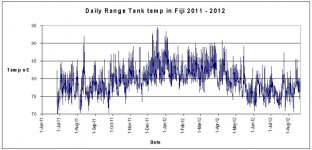
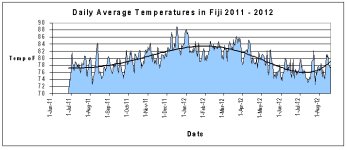
I have a temperature logger in the tank, and here is the record of their normal temperatures over the last year (Southern hemisphere, so winter is July/ August, Summer Jan/ Feb)

First graph is the average daily temperatures over the year, the black line shows the yearly trend. Normal yearly range is between 76 and 82oF with hot days reaching 88, cold days reaching 72.

Second graph shows the temperature every 4 hours, shows the extreme maximum (95oF) and minimum (70oF) temperatures sometimes reached.
 

Attachments
  • Temp graph.jpg
    Temp graph.jpg
    99.5 KB · Views: 122
  • Daily temp graph.jpg
    Daily temp graph.jpg
    93.8 KB · Views: 89
Last edited:
I'm posting this now because they have just started to mate, the second time I have experienced this. This year it started on 24 August, last time it was 10 August, so it's basically after about 2 months of temperatures between 76 and 78oF.

The female who mated in mid August 2010 gave birth at the very end of May 2011, so gestation was longer than the 9 months expected - actually over 10 months.

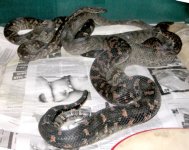
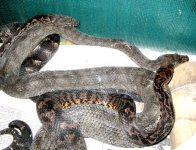
They mate with multiple males - in this case there are three males vying for her favours today. They do not seem to have any aggression between the males, they actually almost seem to take turns to line up with her.

Please forgive the untidy newspaper in these photos - They were due for a clean out when they decided to have an orgy, and they have been messing up the paper somewhat. The female is currently about 1,500 gms, 1m 50cm long; the three smaller males all between 750 - 850 gms, 1m 30cm long.
 

Attachments

  • Mating group.jpg
    Mating group.jpg
    198 KB · Views: 110
  • Threesome.jpg
    Threesome.jpg
    255.4 KB · Views: 111
What I'm finding very interesting is the breeding ages.

The large female here was wild caught three years ago, came to me when she was a similar length (1m 50cm) but only weighed 800gms. She mated in August 2010, gave birth in May 2011 and did not mate in August 2011 at all.

The males were born in August 2006, so mated for the first time when they were 4 years old (but this was the first adult female they had ever met, so it was their first chance...). In August 2010 the males fasted for 3 months - all 2 of the cold months June/July, and during mating in August.

In August 2011 they showed no inclination to mate, and did not go off feed, so I presume this was all to do with her hormones, ie she was not receptive after giving birth that year.

This year the males are 6 years old, they all stopped eating for about 1.5 months, and she is obviously back to being VERY attractive after 2 cold months.

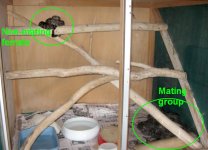
However - I have a second female in this tank, now also about 6 years old, weight 1,100 gms, 1m 30cm long. She showed no inclination to mate in 2010 or 2011 and same thing this year. In fact she is currently perched on the highest branch, as far away from the orgy as possible to get. The males show no interest in her either.

So, I'm left wondering what the natural mating age for the females is. Only time will tell I suppose.

In this pic you can see her very definitely disassociating herself from the riot in the corner....
 

Attachments

  • Mating tank.jpg
    Mating tank.jpg
    62.7 KB · Views: 111
I'm intending to let the group of 3 males 1 female play for a day or two, watching them closely to make sure everyone is OK, and then separate out the female and whichever male seems to be being the most successful.

In August 2010 I had a tragedy after leaving 4 males mating with a single female while I was away for the weekend, and came back to find her dead. Not certain why, but suspect she may have been accidentally strangled in the melee, so not risking that again.

Anyway, will post more as we go, hope this is of interest to some, sorry it was a long one....
 
Thanks, all, glad you're interested.

Last night one of the males had dropped out of the race and gone under one of the hides, actually just saw he's in blue, so probably not in best mating condition, so there were 2 males with her overnight. This morning my paranoia kicked in, so I decided to separate them out.

I have 2 other males in a separate tank, so we did a good clean out and rehousing exercise this morning.

Now I have the female, and the male she seemed to be actually getting closest to, getting busy in the smaller tank, and all the others in the main tank together. The second male who had been trying to mate is a bit distracted, but otherwise everyone seems to be settling down fine.

However, as I moved them, I did give the female a good check over, and she is noticeably swollen, with a distinct bulge in the latter half of her belly. The pic below is of the other female when she was mating at the same time of year in 2010, but this one looks exactly the same. I'm presuming this is ovulation, would appreciate confirmation from more experienced breeders.
 

Attachments

  • Lilith ovulating 2010.jpg
    Lilith ovulating 2010.jpg
    263.1 KB · Views: 97
Back
Top