• Responding to email notices you receive.
    **************************************************
    In short, DON'T! Email notices are to ONLY alert you of a reply to your private message or your ad on this site. Replying to the email just wastes your time as it goes NOWHERE, and probably pisses off the person you thought you replied to when they think you just ignored them. So instead of complaining to me about your messages not being replied to from this site via email, please READ that email notice that plainly states what you need to do in order to reply to who you are trying to converse with.

  • IMPORTANT! PLEASE READ!! About the Google Adsense ads being displayed

    =====================
    Posted 08/15/2025
    =====================


    Yeah, I know. They are a pain in the butt. But they pay the bills to keep my server running. Just a fact of life, I am afraid.

    Want to get rid of them? Simple. Just become a Contributor level member or above and they will be gone. -> Please click HERE."

    Is that too much for me to ask of you to keep this site running? Well, sorry about that. I too wish I could get everything for free. But alas.....

    =====================
    Addendum: 01/10/2026
    =====================


    Google Adsense ad revenue for December, 2025 was just $30 over the cost of the lease for the server running this site. So, in effect, the money providing the incentive for me to continue running this site is coming SOLELY from the paid memberships and sponsorships here. Which honestly ain't much....

Carnivorous Plants

I'm thinking I will shy away from the pitcher plants, as there is probably more likelihood that are green anoles will get killed in them than the other types. I actually think the sundews will be more useful around here for the mosquitoes and gnats then the flytraps. But the flytraps are just so intriguing looking that I HAVE to get some of them.

Interestingly enough, I found out that a major relocated flytrap population is located not far from here (maybe 30 to 40 minute drive) near a town called Hosford. I'm not sure what sort of protected status it will have, though, since the flytraps are probably considered a non-native invader. I was reading an account about a similar colony somewhere in California that was completely destroyed by the "authorities", because of it's non-native status.

There are spots around here where the little red colored round leafed sundews literally cover the ground bordering the roads. I just recently started paying attention to them. To bad I don't have any sort of natural bog area (I think) on our property, otherwise there would probably already be a healthy bunch of them living here. We have a stream on the north end, but it's rather heavily wooded, and not likely a very good habitat for carnivorous plants. But there are sections on our property that we've never even seen yet, so who knows? One of these days I guess I'll have to go looking...
 
I love that third one in your first group of pictures. Definitely one on my list.
That's a Cephalotus follicularis, really cool pitcher native to Austrailia. The Nepenthes are must-have's too, IMO.

I'm thinking I will shy away from the pitcher plants, as there is probably more likelihood that are green anoles will get killed in them than the other types
There are plenty of anoles here, too. I've never seen an anole victim in any of my plants. I've seen ants, moths, flies, beetles, etc .... never any native lizard.

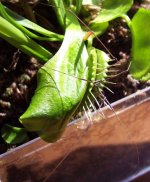
Here's what's visible after a harvestman evidently ventured too close :)
 

Attachments

  • venuslunch.jpg
    venuslunch.jpg
    50 KB · Views: 167
Yeah. Nepenthes are definitely on my list when I can set up a green house with a small pond in it for moisture (as I live in the desert). Also, I have been waiting on one place to get Ceph's in for a while now. As soon as they have them in stock I will be purchasing some. They are so cool...

Oh, and my leaf pulling has two leaves growing out on it now, they are so tiny and cute! Really excited about it, since one of the horticulture professors here at NMSU swears up and down the VFT's are hard to grow....
 
There are plenty of anoles here, too. I've never seen an anole victim in any of my plants. I've seen ants, moths, flies, beetles, etc .... never any native lizard.

Ah well, then OK. Connie and I went to a local nursery and they have some pitcher plants there, so I wound up picking up one.

Hope we get some rain to fill up that tray I set up and I can start on the second one. Got some VFTs and sundews on order. I guess I'm going to have to pick up a couple of gallon jugs of distilled water next time we go to the grocery store.

I'm thinking that when I get the sundews nice and established, I can set a block of Octenol mosquito attractant next to them to help bring in the meals for them. :hehe: Just seems to be something REAL satisfying and highly appropriate about having plants that will feed on those bloodsuckers trying to feed on us. And if I can get the VFTs to tackle the yellow flies when they show up, that will be just GREAT!
 
Took some pics of the initial carnivorous plants we have. They are still in their original pots, as the tub we set up still needs more rain water to fill it before it will be ready to transplant the plants into it. Getting rain today, so maybe that will be enough. Otherwise will have to dip into the distilled water supply we have.

pitcher_plant_01.jpg


pitcher_plant_02.jpg


pitcher_plant_03.jpg


pitcher_plant_04.jpg


pitcher_plant_05.jpg


sundew_frazier_island_01.jpg


sundew_frazier_island_02.jpg


vft_generic_01.jpg


vft_generic_02.jpg


The flytrap has been inside for a few months, and really needs to be outside in the sunlight. Got them all just sitting on the porch right now to acclimate them to stronger light before putting them into direct FULL sun.

I sure do hope that they find mosquitoes to be tasty. :)
 
Looking good, the Sarracenia is either S. leucophylla or a hybrid with that species in it. There is never a reason to cut off flowers in my experience. If a flytrap or most others die after flowering there was another problem to begin with and the plant was not long for the world. Back when I was actively growing CPs, I always allowed all my plants to flower when it was the season. I grew mine outdoors in trays of water in southern California.
 
Looking good, the Sarracenia is either S. leucophylla or a hybrid with that species in it. There is never a reason to cut off flowers in my experience. If a flytrap or most others die after flowering there was another problem to begin with and the plant was not long for the world. Back when I was actively growing CPs, I always allowed all my plants to flower when it was the season. I grew mine outdoors in trays of water in southern California.

Yes, it is labelled (Tarnok), so I believe that means "Sarracenia leucophylla 'Tarnok'".

I'm trying them outside in a tub with medium set into the ground to see how that works out. Nearly all the pics I have seen tend to show them living in very moist (actually WET) areas, so I've got the medium (peat moss and perlite) relatively wet. There are drain holes in the sides of the tubs to keep the medium from getting completely flooded.

I considered the technique of trays of water with pots sitting in them, but I think I would have a SERIOUS problem with mosquitoes that way. The skeeters are already quite a problem, but having areas of standing water available to them to readily breed in might not be a real good idea around here.

As for the flowers, most people say that you should cut the flowers if you want the plant to put more of it's resources into leaf production instead of seed production. But so far I haven't really found accounts of the plants dying after setting seed.

Ah well, just something to play around with. They will either live and thrive, or not.
 
The Id on your plant makes sense, That species in general is one of my favorite of the genus although I have never had that particular clone. Considering where you live your technique should work well. Mosquitoes are a very real issue with water trays but I solved the problem by just letting my trays go dry every other day or so. As long as the soil remained wet the drying trays caused no problem. I finally did have to go with an RO unit to keep up with my water needs though.
The only Cps that die after setting seed are a few of the annual Drosera and Genlisea, as mentioned before generally if the plant is in good health they will do fine. Left to their own devices though you may not get seed anyway due to the need for cross pollination or the design of the flowers which prevent selfing, Sarracenia for example will not self with out help. The Drosera on the other hand will potentially go crazy.
The California bog mentioned earlier was the Albion bog owned by the Nature Conservancy. It had quite a population of non native species which have in theory now all been removed.
 
Very nice, Rich! S. leucophylla & hybrids thereof have always been some of my favorites, too. The photo I posted previously (with the Aug. flower) is a leucophylla hybrid.

I agree with allowing the trays to dry out for a day or so, as well. That has always worked fine for me with no mosquito problems resulting.

Careful, carnivorous plants, like herps, are addicting! :)
 
Well, that would be a non starter if I would have to manage the trays with water every day or three. If I can't go away for a week or so at a stretch without them dying, they will just have to go to plant heaven.

If that tub tends to dry out quickly, then this whole thing will just be a bust anyway. I guess a lot will depend on the frequency of rains this time of year. May tends to be the driest month here, then moving into Summer which tends to be dry but with widely scattered flooding. April has had more rain than typical, so I'm hoping for the best.

I would like to grow these things, but not prepared to dedicate my life to it. Heck, I had quite enough of that with the corn snakes for close to 30 years. One of the reasons I decided to retire the reptiles was because Connie and I were hog tied down by that stuff, so I'm certainly not going to allow PLANTS to do the same thing.
 
Just got in a few more plants to play with. Got an assortment of 7 flytraps, but only 2 sundews. Wish I had gotten a few more sundews, especially the thread types. Oh well, I'll see how these all do for me and go from there.

vft_10.jpg


vft_11.jpg


vft_12.jpg


vft_13.jpg


sundew_10.jpg


sundew_11.jpg


sundew_12.jpg


sundew_13.jpg
 
Well, I think I'm doing better with the sundews than I am with the flytraps. The flytraps don't seem to actually be taking the full sun as well as I was led to believe. I put the new ones out to catch full morning sun and be shaded in the afternoon, but the morning sun burned some of them pretty badly.

The sundews out in my mini-bog seem to be doing just fine in full sun nearly all day long. One of them is getting a lot of red color to it and flowering. I haven't put the two newer ones out there as I was afraid they might get damaged by the sun.

I've got the flytraps sitting on the porch to catch some brief dappled sun in the morning, hoping they will bounce back. Maybe they just need to be better acclimated before tossing them into full sun.

Here's pics of the two original flytraps that are out in the mini-bog exposed to full sun most of the day.

vft_burnt_01.jpg


vft_burnt_02.jpg


I'm leaving them there so I can see what happens. Maybe they'll bounce back and the new growth will be better able to withstand the sunlight.

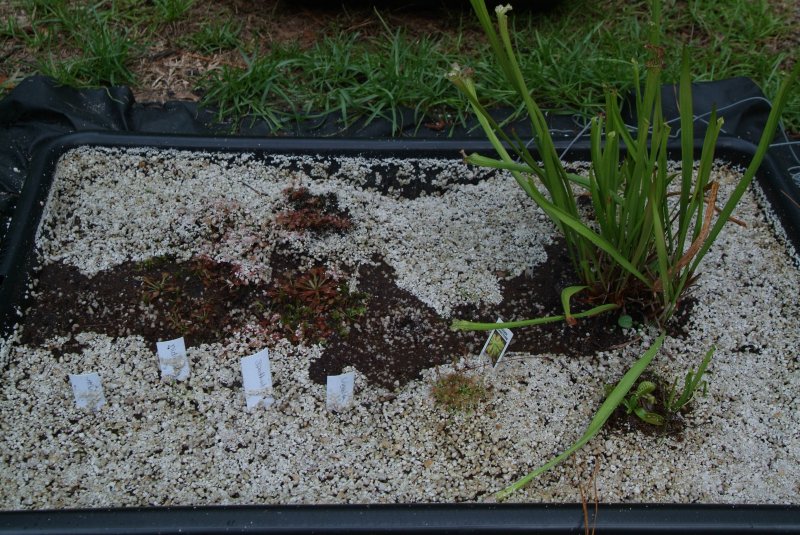
Here's a pic of the mini-bog Connie and I set up. Nothing fancy, to be sure.

mini_bog_01.jpg


The two sundews there look like they are doing just fine, I guess..

sundew_outside_01.jpg


sundew_outside_02.jpg


Of the newer flytraps that got burned from that half day of full sun, these look the worse for wear.

vft_burnt_03.jpg


vft_burnt_04.jpg


Of course the largest of the bunch was one that got really zapped by the sunlight. But hopefully they will bounce back for me.
 
They did indeed get a bit burned but they look as if they should come back given some TLC, the flowering Drosera also looks a bit over exposed but nowhere nears as bad. The second elongate Drosera looks like D. adelae.
 
Yeah, maybe I should try to propagate some from seed to see if that will work out a bit better. Perhaps these greenhouse raised plants are a bit more fragile than I had hoped for.
 
Well, I went and put a piece of fairly wide meshed burlap over top of the plants in my mini-bog to try to filter the sunlight a bit. I may move a couple of the others into the bogette to see how they fare there. Got the newer ones on the porch to just catch a bit of morning sunlight, but they still look pretty puny from their short stint in FULL sun.
 
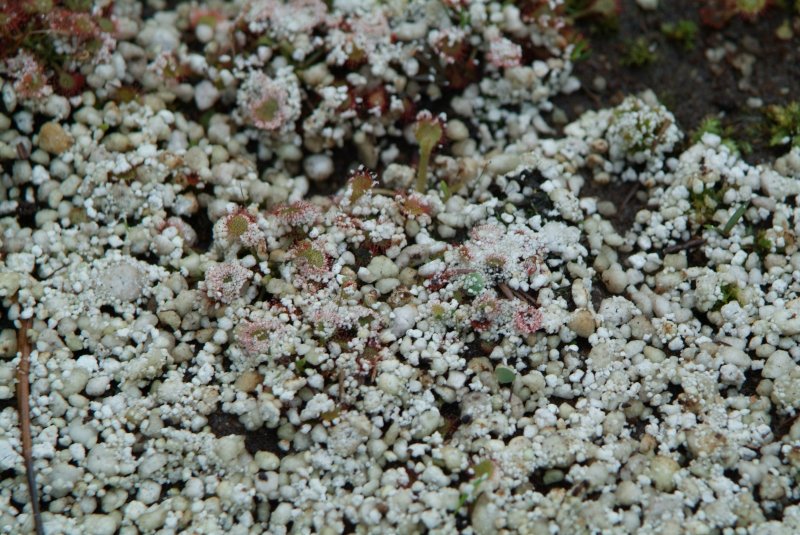
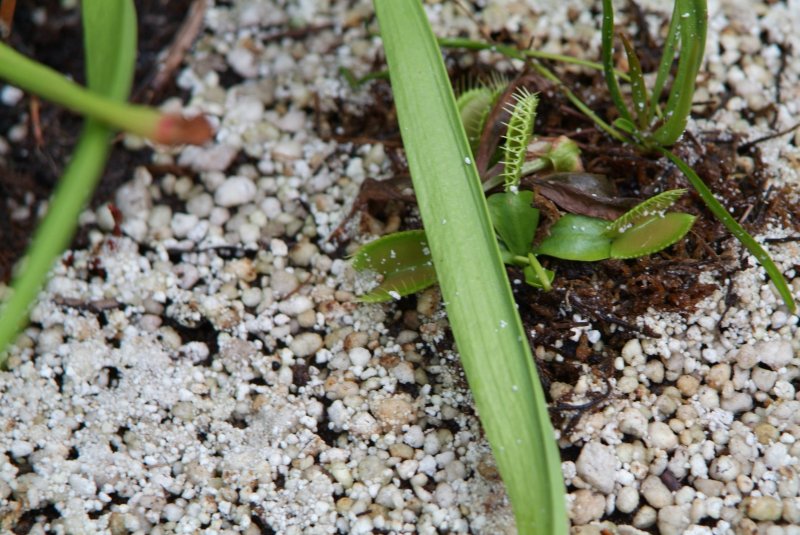
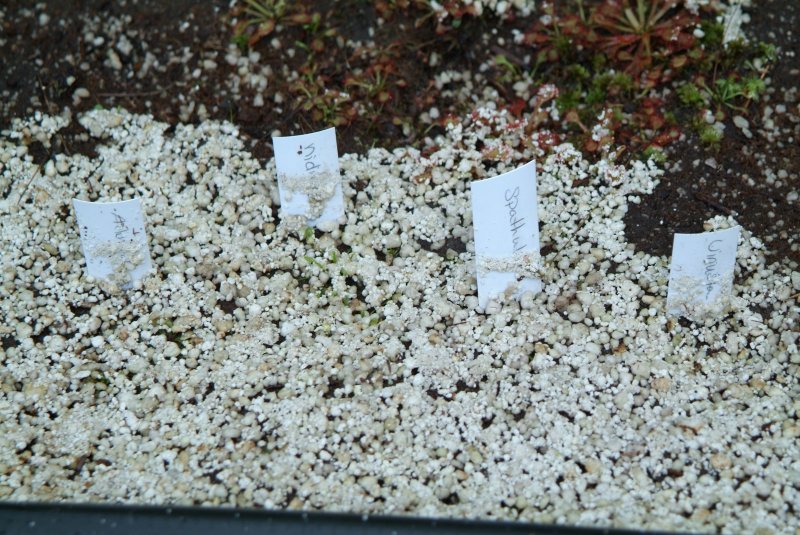
Well, I'm not real crazy about this perlite stuff I'm using with the insectivorous plants in my mini-bog. We got a good amount of rain yesterday, and apparently my drain holes aren't doing the job and the water level got up higher than I had hoped for in the tub. And that darn perlite junk apparently floats to the surface.

So all that while crap got stuck all in the sundew traps and made a heck of a mess of them. Also got some into a few of the venus fly traps. I used a water bottle to try to spray the perlite off of the plants, but only was partially successful. Two of the fly traps shut on the perlite when the water spray evidently triggered them.

Guess I need to change something in the way I am doing this. This evidently isn't working out as well as I had hoped.

perlite_mess_01.jpg


perlite_mess_02.jpg


perlite_mess_03.jpg


perlite_mess_04.jpg


perlite_mess_05.jpg
 
I was never a big fan of perlite for this very reason. I either used pure sphagnum moss or a 50/50 mix of peat and 20 grit silica sand.
 
Yeah, I see that now.... I'm going to be putting a second tub in the ground and using a mix of peat moss and sand in that one. I'll pull the plants out of the above tub and rinse them off and set them into the new tub.

I also drilled more holes to drain excess water so it will run off faster.

Does anyone use vermiculite along with peat for these plants?
 
I am sure a few do, but I do not know anyone currently who does. Certain groups want a bit more drainage, such as Mexican Pinguicula and it works well for them. However those are species you generally don't grow outdoors. Only in a greenhouse or indoors under lights where the perlite does not have that issue. In my drier southern California outdoor environment I needed a heavier moisture retaining mix which was the reason I went the route I did.
 
Back
Top