• Responding to email notices you receive.
    **************************************************
    In short, DON'T! Email notices are to ONLY alert you of a reply to your private message or your ad on this site. Replying to the email just wastes your time as it goes NOWHERE, and probably pisses off the person you thought you replied to when they think you just ignored them. So instead of complaining to me about your messages not being replied to from this site via email, please READ that email notice that plainly states what you need to do in order to reply to who you are trying to converse with.

  • IMPORTANT! PLEASE READ!! About the Google Adsense ads being displayed

    =====================
    Posted 08/15/2025
    =====================


    Yeah, I know. They are a pain in the butt. But they pay the bills to keep my server running. Just a fact of life, I am afraid.

    Want to get rid of them? Simple. Just become a Contributor level member or above and they will be gone. -> Please click HERE."

    Is that too much for me to ask of you to keep this site running? Well, sorry about that. I too wish I could get everything for free. But alas.....

    =====================
    Addendum: 01/10/2026
    =====================


    Google Adsense ad revenue for December, 2025 was just $30 over the cost of the lease for the server running this site. So, in effect, the money providing the incentive for me to continue running this site is coming SOLELY from the paid memberships and sponsorships here. Which honestly ain't much....

COLOR fading

Dan Lubinsky

New member
Joined
Jun 3, 2004
Messages
462
Reaction score
0
Points
0
Age
74
Location
Lake Worth, FL
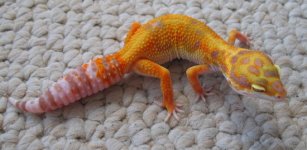
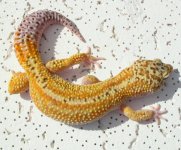
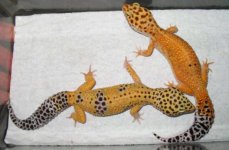
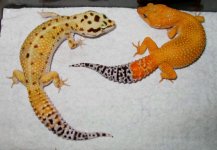
Why do some lines fade out as they age while others intensify ? We're all familiar with the "here's a picture of him when he was younger" ads. The animal on the left, purchased at 20 grams in Daytona two years ago was screaming orange, body and tail. The three year old on the right was a nice juvie but gets more intense with age. The siblings follow suit and all receive the same food, heat, etc. so it's definitely genetic and not cultural. It seems to carry thru in the albinos also, to what extent I'll see this year but some of you guys are years ahead and probably already know. Of course breeding stress, etc. play a part but these observations go beyond that. Any thoughts ??
 

Attachments

  • IMG_0201.jpg
    IMG_0201.jpg
    68.9 KB · Views: 190
  • IMG_0180.jpg
    IMG_0180.jpg
    64.5 KB · Views: 175
I have absolutely no idea about it. I just can confirm this. My red stripe female was freaking awesome when I bought her. Now her "red stripes" turned into "black" stripes. I hope that she can throw some goods genetics to her babies anyhow.

Simon
 
I've noticed that also, Simon. The Redstripes seem to have a pretty complex mix in their background. My personal take on it after hatching a few hundred of them is that the more hypo ones, especially if they have orange head patterning/spotting tend to hold their color better after the first year. Here's a three year old, not nearly as orange as he was as a juvie but not bad. Some of them look like a regular spotted stripe as adults, thus a bunch of outcrossed hets we're working this season to improve that. Also, concerning the tangs not just the baldies hold their color - that would make things too easy.
 

Attachments

  • 131_3154.JPG
    131_3154.JPG
    107 KB · Views: 189
  • IMG_0017.jpg
    IMG_0017.jpg
    67.2 KB · Views: 186
I agree 100% Dan, but I'm not sure what the reasoning would be. I'm working with several different tangerine bloodlines and some of them repeatedly get brighter with age, while others lose intensity. I personally think it has something to do with how much refinement has been put into the bloodline (line breeding for more tangerine...versus crossing with hines hypo or other lines). I have crossed a few bloodlines, using two great looking parents, and the resulting offspring weren't as impressive as hoped...but if I kept things within the same bloodline (ex. UG x UG, Albeys x Albeys) I'm usually really happy with the results. I'd like to hear what others have experienced.

Great thread Dan!
 
So true Paul, but don't you love it when you breed two bland hets and get killers. You know after the first full breeding season if they wil do "the fade", sometimes even before that at around 50 grams. Now if we can get some amel fatties that hold color - that's a tough one.
 
Now do you mean they have reached their full potential then faded? I thought they all did that. LOL Good thread, and I hope you found whatever will make the color stay the longest!
 
I know Jeff at JMG is working on some Red Stripes so that they retain their peak colors even after breeding without developing dark spots. We were talking about this last month, so far he had a few females that were holding their color very well. It would be something to do away with the fading.
 
Hi,

the gecko where the color faded, looks like a line breed hypo, the other one looks more like a genetic Hypo, but one cannot realy tell...I mean just look at The Urban geckos Tangs...they are line breeds as well, but baldies with super nice orange.
But it seems to me, that urban tangs loose there color as well, and get more pattern. That's not the case with the genetic Hypos (Ray Hine Line).
Some females can change color after the first clutch because of hormones (same with humans...womens haircolor can change, after they born a baby!)
 
Anyone also realize that some shedding problems can possibly be linked to genetic problems? I have two clutchmates that both have shedding problems. Most of my geckos shed flawless, but I always know which toes I have to pick when they shed, because they ALWAYS get it stuck. Same size humid hides and are kept at the same temps etc etc *shrugs* :)
 
Interesting subject..... I have noticed that my tangs seem to get much nicer as they get older, but like Paul said, it might have something to do with breeding within the same blood line..... I have also noticed that some bloodlines seem to spot up as they get older or during and after breeding..... Whats up with that???

rhac, if I am not mistaken, UG hypos originated from Rays genetic hypo line....
 
rhac, if I am not mistaken, UG hypos originated from Rays genetic hypo line....
no they are not. His carrottails are from Ray Hine. I asked him about his tangs and he told me, they are linebred.
I have also noticed that some bloodlines seem to spot up as they get older or during and after breeding
well, those are in my opinion the line breed lines. I only work with Ray Hine Hypos (because I'm from europe and we do not have that much line breed hypos ), and no one of my breeders gets more spots as they get older. The Ray Hine Hypos only get spots in the area where the band were when they were young. But I often see Hypos on forums that have spots in areas where they did not have grey (black) bands. So in my opinion thos Hypos who get more spots as they get older, are line bred hypos, the others are genetic hypos.
the only time when genetic Hypos can get spots, is after you bought them from big breeders. I keep my Leos in big terrariums with cool areas, so some of the Hypos I bought as baldies from ray hine, got some spots on head, after i put them in my terrariums, because the temperature is not that high. that's the same think with the white areas on albinos. If you cool them down, the white areas get brown.
BUT, my genetic hypos never lost color.
 
My urban gecko hypo tangerine female has always been very bright, until she started laying eggs. Now her color seems to have faded slightly and the orange coloring is almost an orange-brown. I'm hoping after the breeding season she'll return to her normal color again. I might get that nekton stuff, but I'm not sure I want to...
 
rhac said:
no they are not. His carrottails are from Ray Hine. I asked him about his tangs and he told me, they are linebred.

All tangs are linebred.... The tang color is not "genetic".... The hypo carrottails are genetic..... Thats where UG got the hypo base for his animals....
 
All tangs are linebred.... The tang color is not "genetic".... The hypo carrottails are genetic..... Thats where UG got the hypo base for his animals....
no...not at all. In the genetic Hypos the orange/yellow color is conected to the Hypo gene.
Sorry, if I pointed that out wrong, but his Hypo tangs are line bred and his hypo carrottails are genetic. But his Hypo carrottails where not the hypo base for his animals, if I do remember right, he told me, that his Hypo Tangerine Line and his Carrottail Line are two different lines and he never mixed them.
 
spotty redstripes

I asked JMG about fading and spotting in redstripes recently in an email when I was deciding whether or not to buy one from them (I did). In his reply he said that he sees less fading and spotting with the paler redstripes with light yellow.
 
All I know is that my little girl from you dan is getting birghter every shed :hehe: I think that you let a hold back slip throught the cracks :hehe: Anyways, I've noticed that some fade and some dont. My male seems to have stayed the same. My first female got slightly darker though. I think its genetics. But what would cause such a phenomenon? lol. Hopefully as captive breeding goes on you guys will figure out all the guesswork and I wont have to. Then I can pick up where you left off after your gone :hehe: Not that I want any of you to go anywhere...
 
Since I take pics at least once per month of' my babies-I have some comparison shots as my red stripe has grown
I thought that this would fit right into this thread

Here is Blaize a red stripe from Dan that I dearly love
I think that she just continues to get prettier as she gets older
and I think that she is just awesome and I just love her color and stripe

Thank you again Dan
:D

a recent pic-taken yesterday

blaize29oj.jpg


Feb 7th

blaizegoodone8ee.jpg


blazieinhand20hx.jpg


Dec 20th

blaizesave24qt.jpg


Nov 8th

blaizegoodone0rq.jpg


Oct 14th

blaize11wr.jpg


Oct 5th

blazie21gf.jpg


Sept. 29th-arrival day

blaize10io.jpg
 
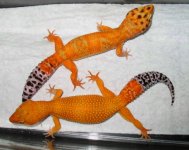
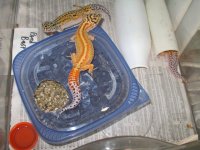
The most indepth explanation of the mechanism of color is the section in Tremper/DiVosjoli's excellent book, chromatophores and all that good stuff. I didn't see much on why some lines would intensify and some would fade. As far as some of the Redstripes turning darker, the outcrossings do show some promise. Here are two breeding females, same age and amount of clutches. The better one had no black body spots and some orange in the head patterning when younger, that seems to go along with what Jeff at JMG said and what I've observed. With a shot of "intensifying" tang they should improve greatly ( looks good on paper, we'll be hatching out some from about twenty outcrosses this season). The second pic is of a three year old Urban tang that was intense orange before breeding and a six year old tang that's held her color.
 

Attachments

  • IMG_0204.jpg
    IMG_0204.jpg
    119.2 KB · Views: 82
  • IMG_0205.jpg
    IMG_0205.jpg
    65.7 KB · Views: 83
One more thing, when I acquired the original pair that produced the "non-faders" in the mid-90s, they were orangeish (obviously not anywhere near what we see today) with brownish smudgy spots as opposed to distinct black spots. That's pretty clearly seen in that last pic.
 
Very interesting thread!!! I love the progressive photos, Sandra and Dan... they really do say a lot. Your geckos are lovely - even the faded ones!
 
Back
Top