Karen Hulvey
New member
Scientists stumble upon unclassified mammal
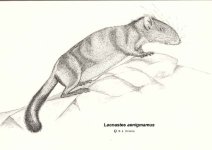
NEW YORK (MAY 11, 2005) -- A team of scientists working in Southeast Asia have discovered a long-whiskered rodent with stubby legs and a tail covered in dense hair. But don't call it a squirrel. Or a rat. Because it's actually more like a guinea pig or chinchilla. But not quite. In fact the new species, found in Laos by scientists from the Wildlife Conservation Society (WCS) and other groups, is so unique it represents an entire new family of wildlife.
The new species is described in the recent issue of the journal Systematics and Biodiversity by authors from WCS, The Natural History Museum in London, University of Vermont and WWF Thailand.
Called Kha-Nyou by local people, the species was discovered by WCS researcher Dr. Robert Timmins in a hunter's market in Central Laos. WCS is working in Laos to help enact an aggressive program designed to halt illegal wildlife trade where poaching has devastated animal populations.
"It was for sale on a table next to some vegetables. I knew immediately it was something I had never seen before," said Dr. Timmins. A trip to the market, he said, made it clear that "in Laos, pretty much everything gets eaten." Dr Mark Robinson, working with WWF Thailand later discovered other specimens caught by hunters, and also identified bone fragments in an owl pellet. Based on morphological differences in the skull and bone structure, coupled with DNA analysis, the authors estimate that the Kha-Nyou diverged from other rodents millions of years ago.
"To find something so distinct in this day and age is just extraordinary. For all we know, this could be the last remaining mammal family left to be discovered," Dr. Timmins said.
Very little is known about the Kha-Nyou, other than it seems to prefer areas of limestone outcroppings and forest cover, and it appears to be a nocturnal vegetarian. It also gives birth to one offspring at a time, rather than a litter.
Dr. Timmins, who also discovered a new species of striped rabbit from the same region in 1999, warns that habitat protection and regulations to reduce unsustainable commercial hunting are vital to safeguarding remaining populations of the Kha-Nyou and a gallery of other unusual species.
"Skeptics might say that if we are still discovering such amazing new animals, why are people worried about wildlife loss; but of course it is an indication of how little we know, and a window onto what we could be losing without ever knowing," said Dr. Timmins.
NEW YORK (MAY 11, 2005) -- A team of scientists working in Southeast Asia have discovered a long-whiskered rodent with stubby legs and a tail covered in dense hair. But don't call it a squirrel. Or a rat. Because it's actually more like a guinea pig or chinchilla. But not quite. In fact the new species, found in Laos by scientists from the Wildlife Conservation Society (WCS) and other groups, is so unique it represents an entire new family of wildlife.
The new species is described in the recent issue of the journal Systematics and Biodiversity by authors from WCS, The Natural History Museum in London, University of Vermont and WWF Thailand.
Called Kha-Nyou by local people, the species was discovered by WCS researcher Dr. Robert Timmins in a hunter's market in Central Laos. WCS is working in Laos to help enact an aggressive program designed to halt illegal wildlife trade where poaching has devastated animal populations.
"It was for sale on a table next to some vegetables. I knew immediately it was something I had never seen before," said Dr. Timmins. A trip to the market, he said, made it clear that "in Laos, pretty much everything gets eaten." Dr Mark Robinson, working with WWF Thailand later discovered other specimens caught by hunters, and also identified bone fragments in an owl pellet. Based on morphological differences in the skull and bone structure, coupled with DNA analysis, the authors estimate that the Kha-Nyou diverged from other rodents millions of years ago.
"To find something so distinct in this day and age is just extraordinary. For all we know, this could be the last remaining mammal family left to be discovered," Dr. Timmins said.
Very little is known about the Kha-Nyou, other than it seems to prefer areas of limestone outcroppings and forest cover, and it appears to be a nocturnal vegetarian. It also gives birth to one offspring at a time, rather than a litter.
Dr. Timmins, who also discovered a new species of striped rabbit from the same region in 1999, warns that habitat protection and regulations to reduce unsustainable commercial hunting are vital to safeguarding remaining populations of the Kha-Nyou and a gallery of other unusual species.
"Skeptics might say that if we are still discovering such amazing new animals, why are people worried about wildlife loss; but of course it is an indication of how little we know, and a window onto what we could be losing without ever knowing," said Dr. Timmins.