• Responding to email notices you receive.
    **************************************************
    In short, DON'T! Email notices are to ONLY alert you of a reply to your private message or your ad on this site. Replying to the email just wastes your time as it goes NOWHERE, and probably pisses off the person you thought you replied to when they think you just ignored them. So instead of complaining to me about your messages not being replied to from this site via email, please READ that email notice that plainly states what you need to do in order to reply to who you are trying to converse with.

  • IMPORTANT! PLEASE READ!! About the Google Adsense ads being displayed

    =====================
    Posted 08/15/2025
    =====================


    Yeah, I know. They are a pain in the butt. But they pay the bills to keep my server running. Just a fact of life, I am afraid.

    Want to get rid of them? Simple. Just become a Contributor level member or above and they will be gone. -> Please click HERE."

    Is that too much for me to ask of you to keep this site running? Well, sorry about that. I too wish I could get everything for free. But alas.....

    =====================
    Addendum: 01/10/2026
    =====================


    Google Adsense ad revenue for December, 2025 was just $30 over the cost of the lease for the server running this site. So, in effect, the money providing the incentive for me to continue running this site is coming SOLELY from the paid memberships and sponsorships here. Which honestly ain't much....

Okeetee corns

Clay Davenport

Cerebral Nomad
Joined
Feb 19, 2002
Messages
3,526
Reaction score
184
Points
0
Location
Asheville NC
As I've stated before, I'm not one who is on the cutting edge of cornsnake culture, so I thought I would bring up this topic to some of you who are.

Concerning the use of the Okeetee label, what is acceptable to you? I see, especially lately, literally dozens of ads for "okeetee" corns. In my opinion this term has been bastardized to a most unfortunate degree and to a point where it ceases to hold any value.
I believe the term to designate a locality of corn, not just a look or specific phenotype. I realize one of the points likely to be raised would be what would define the boundary limits of the Okeetee region. The purpose of this thread though would not be to deifne what constitutes the locality itself, but what would be the acceptable use of the label in general.

We can say Okeetee refers to the hunt club, Jasper county, or whatever, but I see lately most every normal cornsnake for sale labeled Okeetee. To me this is just wrong. The vast majority of cornsnakes in collections have no form of reliable collection data whatsoever. When you're working with 20th generation snakes and working to create new morphs, it's just not a priority with cornsnake breeders. Just because a line of corns with exceptional traits has been selectively bred from parents originating from who knows where, I don't think they deserve the label Okeetee. Even if a specimen from the middle of the hunt club was bred to a Florida native, I wouldn't call the offspring Okeetee, because they no longer are.

Even though I have never been strongly into corns, I have always appreciated the true locality okeetees. Perhaps it's just the symbolic value of them, I don't know. But to me they are what is unique among all the many dozens of morphs, and the beauty of a top quality specimen, in my opinion surpasses all of the "man made" mutations by far.
I am fortunate enough to be adding 2 pairs of F2 corns to my collection that are verifiably traceable directly to the hunt club through both sets of parents and grandparents. It is my intention to maintain the purity of the line. Perhaps selectively breeding to accent the traits, but limiting any breeding to only specimens known to originate from the same area. I suppose this has caused this issue to resurface with me lately.
I am of the thinking that the term is used so loosely for no other reason than to increase the potential sales of the offspring.
How many verifiable 100% okeetee lines do you know of in captivity? Lines which have never been bred with any corns not originating from the area of Jasper County. Very few from what I can tell, but yet there are thousands of "okeetee" corns for sale annually.

So among you more serious corn breeders like Rich and Darin etc, what is your opinion of the broad use of the okeetee label?
 
"Okeetee"

Well, it's just a label, and an unfortunate one, if you ask me. Just as is "Miami Phase". In reality, they have no meanings. For several reasons.

Let's ask this lead in question: Is ANY corn snake that was captured on the Okeetee Hunt Club considered an Okeetee Corn?

So let's continue on with this.

At what arbitrary point in any direction would a corn snake captured there no longer be considered as an "Okeetee Corn"?

At this arbitrary point, if a snake is heading away from the center of the Okeetee Corn range, will it cease to be an Okeetee Corn when it crosses that point? And on the other hand, if a corn snake is reaching that point heading towards the center of the range of the Okeetee Corn, will it be a normal corn until it crosses that point? At which time it then becomes an "Okeetee Corn"?

How about a corn snake from another area that was dropped right into the middle of the range for the "Okeetee Corn". Does it become an "Okeetee Corn" as soon as it touches the ground there? If not, suppose this one snake goes on and breeds with the *true* Okeetee Corns in that area. Are the resulting offspring Okeetee Corns or not?

In another line of thought, suppose two genuine died in the wool Okeetee Corn snakes are captured and you take them home and breed them. You get a clutch of eggs that hatch out and from those babies, you naturally pick out the best ones to keep for yourself. You then grow them up and breed them, again going through this process of keeping the best ones. Once you have removed those animals from their natural environment and impressed YOUR natural selection on the direction of the resulting appearance of subsequent generations, when does the Okeetee label no longer apply to those *natural* *true* Okeetee Corns?

I have seen MANY examples of "Okeetee Corns" recently that I would bet BIG money are nothing at all like those animals that Carl Kauffeld wrote about in 1957.

So what is an Okeetee Corn? Beats me. Unless you collected the animals yourself directly from the Okeetee Hunt Club, there should be some doubt about the accuracy of the claims that some people may make on the animals they are selling to you. Although this is certainly not an attempt to disparage ALL collectors in southern South Carolina, but if anyone believes that at least SOME of them would not lie about the location their animals were actually collected in, in order to gain a premium price for them, then I do believe they are being extremely naive.

From my own personal standpoint, I draw the line at being anal about locality. I have tried to be reasonably certain that the original stock I got was at least told to me to be from the Okeetee area by people I would have reason to believe for no other reason than lack of disputing evidence.

And yes, I have outcrossed these "Okeetees" into other genetic lines for one reason or another. And I still call the animals that result from those matings that have a reasonable resemblance to what a textbook example of a commonly accepted "Okeetee Corn" should look like, as "Okeetee Corns".

So my requirements for an animal I sell to be called an "Okeetee Corn" is that it must have some direct lineage to the original animals that were sold to me as "Okeetee Corns", and in appearance must be reasonably a cut above what I would just consider as a run of the mill normal looking corn snake. Both conditions must exist before I would put that label on their deli cups.
 
I realize that there will always be debate as to exactly what defines the area that could be considered okeetee. With the exception of insular localities, the same can be said of most locality designations. That issue will most likely never be agreed upon by everyone.
I perhaps take the name too seriously for the times we have come to. To me it is the bloodline, and the purity of it. Any selective breeding done within a group of actual locality animals cannot negate the locality. It's a poor comparison, but I look at it as the corns you have bred for several generations are still corns, but should you cross one of those with a cal king, no amount of back breeding to corns can make them a genuine cornsnake again.
Any snakes bred in captivity are seperated from nature, so it is impossible to breed what is "natural". The bloodline however can be maintained regardless of selective breeding.

The same situation exists with chondros for example. Serious chondro keepers know that 99% of all locality labels for those snakes are basically BS. There are chondros in collections with true verifiable locality data, but they are exceedingly rare. There still exists many who are completely trusting in those labels and will adamantly insist that their sorong chondros are absolutely pure locality animals.
Anyone with ethics selling chondros at least do the courtesy of adding "type" to the locality label. With okeetees though, there are those who label any "normal" corn okeetee.

The corns I plan to acquire are definate okeetees, descended on both sides only from stock collected on the roads bordering the hunt club. It seems to me though that few people value that anymore. Perhaps it's the common usage of the term that has caused blanket skepticism, or maybe people just don't care about locality corns anymore like they do with some other species.
Maybe it's pointless to put the effort into preserving such a bloodline. I kind of like the idea that they'll be around though, perhaps not as Kauffeld saw them, but of the same pure bloodline regardless. After all one can selectively breed for the nicest traits while still remaining within the known locality gene pool.
 
In my opinion, a snake has to have that okeetee "look" AND be able to trace its lineage back to the hunt club for it to be a true okeetee. Corns with the look but lacing the heritage are what Kathy Love designates her "classic corns." I like a distinction being made, but it's purely a matter of personal preference. The true locality purist says my definition is not good enough, and I understand that.

However, neither opinion will ever amount to much in the industry, because people call their animals whatever in the world they want to, and, unlike other species, almost anyone can breed their animals and advertize their normals as okeetees. Further, Rich is right that there are those who will lie about where they got their breeding stock, so even trying to get pure locality stock is harder to do.

As to you analysis about introducing outside strains and then never being able to remove the influence, it is a point well taken. However, there have been a LOT of multi-het cornsnakes and mutation corns dumped on the hunt club grounds itself in years past. So, I suspect that the pure locality okeetee with no mutant genes cultivated by man is quickly becoming an idea to be chased with no fruition.
 
As Darin has pointed out, there probably is no such thing as a truly pure Okeetee corn snake any longer, anywhere. Actually not even from just about any locality at all.

Back in the early 80s I was an idealistic fool that felt that selling my corns was "dirty". But since I was producing far more of them than I could ever hope to keep (HAH! I wish I had been able to see the future back then!), I had limited options as to what I could do with those babies. So what seemed the "right" thing to do was to release these into the wild as kind of a headstart program. So that's what I did, for several years.

I released corns anywhere from New Jersey on down to South Florida. And yes, I have released corns into the Okeetee area as well. And I know for a certainty that I am not the only one whom has done that in the past. And who knows how long before that time someone else might have been doing the same thing.

So unless someone has their original stock from as far back as the early 70s or even before, and has not outbred them even once, I seriously doubt anyone can truly claim to have a *pure* Okeetee corn snake.
 
I myself have debated this subject with myself and with friends. I have been wanting to add a pure as possible pair of Okeetee's to my collection for the last year or two, however, for reasons mentioned above, I have not pursued it. Darin did have some decent Okeetee's listed for sale about a week ago that i was looking at.

I believe that a lot of people are simply labeling what they have for sale as an Okeetee. With every ad I see, I will look to see if there is a picture. The pictures that I have seen hardly look like the Okeetee's that I would be interested in. The value of these animals has dropped considerably as well. I'm not necessarily referring to the dollar amount, but the value or attraction that these animals once held in people's collections. If I were to aquire a very nice pair of Okeetee's that physically displayed what an Okeetee should look like and then selectively bred them. How would I be able to market my off spring? As Clay mentioned every Joe Blow has his high orange normals listed as Okeetee's. The market has been so watered down that it might be hard to convice some novices that this is what an Okeetee should look like.
 
Oh, man, I can't believe I'm doing this

Where to start?

I breed only a handfull of snakes, my favorite being Okeetees (I hope that word turns red when I post this.:) ) I have hunted the club. So has forum member John Albrecht (who, incidentally called me last night to let me know (and rub it in) he was road-cruising it!:bawling: He isn't who I got my initial stock from, but he keeps better locality data than anyone I know on the collection spots. I'm not naive enough to assume that because the sellers live in Ridgeland, that I got locality animals. I've gotten to know the men themselves.

Secondly, as far as people turning snakes loose there and that diluting the blood, hogwash! :kill: First, how many people would really turn tons of morphs and hets loose? I believe you, Rich; just how many could grow to adults and pass on their genes? Snakes lay all those eggs just to have two hatchlings survive to breeding age to maintain population. And the animals there are evolved to that climate, food, etc.
Then there is the matter of what amount of diluting could really be done? There are an awful lot of cornsnakes down there.

Even if I completely lose that arguement, bottom line is this:
I have turned down some beautiful snakes from Rich and Kathy's stock that would really improve my lines. I didn't buy them because I'd no longer be offering the product that most folks that I sell to want. Snakes with verifiable lineage to the Okeetee Club. You can suggest that only the one I caught myself is pure, or that I was suckered and misled, or even that the snakes living there are no longer valid because so many people have dumped thousands of hatchlings there (which I doubt), but the bottom line is that I am doing the best I can to maintain what I feel should have the name Okeetee.
I'd be happy to include photos or a link to my animals.
 
Can someone post a pic of a true Okeetee???

I just recently bought two lots of corns. 21 Okeetee corns from one breeder. 11 Normal corns from another breeder. Now, to my untrained eye, the Okeetees, as a group, have a brighter color. Although, individuals from both lots look VERY similar. The breeder of the Okeetees told me that they get brighter with every shed and that when they reach adulthood they should be a very nice orange and red.

I want to be sure that when I sell these corns that I label them correctly. After just being around here for a few weeks I KNOW that I don't want anyone thinking I'm trying to scam.

I also have an adult corn snake that has a high degree of orange color. Can someone post a pic of an Okeetee and a "Normal" corn for comparison?

Thanks,
Dennis
 
SnakeMover,
I believe it was Darin in a past thread that said if you ask three people that question you'll likely get three different answers. The reason is people have different beliefs as to what constitutes an Okeetee.
My position is if the breeder you got the okeetees from cannot genuinely trace his stock back to the area of the hunt club in Jasper County, then you just have 21 more normal corns because they are not deserving of the okeetee label.
As far as posting pics for comparison to tell whether yours is an Okeetee, that makes little difference in my eyes. I don't care what the snake looks like, it's either descended from the Okeetee reigon or it isn't. If you don't know with certainty that it is, then it isn't an Okeetee. Some disagree with the strictness of my useage, but Okeetee is a locality, not a look. An ugly corn picked up on the hunt club is an okeetee regardless, that just can't be argued, the label refers to a place.
Just as every gray band you find on Juno road doesn't look the same, neither does every corn in Okeetee look magnificent.

As far as being labeled a scammer if you sell those snakes as Okeetees, that's unlikely to happen. It's so common to throw that name around today, people automatically assume they're not locality and those who do produce the real okeetees are forced to prove it all the time.
People like me will consider it ethically wrong if you sell corns of unknown descent as Okeetees, because you really have no idea what they are and it's highly unlikely that they really are from that stock. But as far as considering you a scammer, I would not, just one who doesn't respect the value of the term, and I definately wouldn't be buying any of them.
 
this can be a PITA

Clay wrote:
"Okeetee is a locality, not a look. An ugly corn picked up on the hunt club is an okeetee regardless, that just can't be argued, the label refers to a place."

So, we're back to Rich Z's question..
"At what arbitrary point in any direction would a corn snake captured there no longer be considered as an "Okeetee Corn"?"
(Sorry, I don't know how to do that lined quote thing.)

And, how do you know if the person who sells the Okeetee picked up a wild "real" Okeetee from that region or if he happened to pick up one of Rich's released snakes?

I thought color morphs in corns were about genetics and the "look" of the animal. Locality specific labels open up too many disscrepancies, such as mentioned above. How are you supposed to sort this out? DNA testing?

I'll have to check with the breeder I got the Okeetee's from and see if he has any papers on them. I think he sold the parents to Ron (one of the regulars here) and I'll ask for a picture of them. When I bought them,they were listed as real Okeetee corns. I did a check in the BOI and the breeder was not listed. However, his friend Ron is and is though highly of. That's why I decided to buy them. Hopefully I didn't make a bad choice.

Dennis
 
So, we're back to Rich Z's question..
"At what arbitrary point in any direction would a corn snake captured there no longer be considered as an "Okeetee Corn"?"
We'll always be back to that question, it's a futile debate, and as I said earlier one that CAN be applied to any other non insular locality, but strangely isn't. If you catch a Boa constrictor two feet from the Peruvian border heading away, is it Peruvian? What if you watch it move across the border into Peru then catch it? The same argument applies to all localities, and it's no more useful when used for cornsnakes.
I see it basically as the old standby argument used by many who don't want to hold to the true usage of Okeetee as a locality label.
It will never be agreed upon, there is no answer to that question.
And, how do you know if the person who sells the Okeetee picked up a wild "real" Okeetee from that region or if he happened to pick up one of Rich's released snakes?
Considering the number of corns in that area, and the fact that it is highly unlikely that anywhere near enough of them have been released to have any effect, I disregard that argument as well. We're not talking about people releasing them by the hundreds at the front door of the hunt club.
I thought color morphs in corns were about genetics and the "look" of the animal.
That is true, but Okeetee is not a color morph despite how badly so many people try to make it into one. It is a locality and completely independant of how much black is around the borders of the saddles.
If I hatched some nice speckled alterna from generic parents, should I call them Black Gap? No, and if I did the alterna aficiandos would go nuts. Okeetee is no different than Black Gap in the fact it is a locality label designating where in the wild the parents of the animal were taken. Why is it that people have been so bent on changing the rules for corns? What makes a locality label in cornsnakes mean phenotype in the eyes of many, but not other species.
It's the exact same situation you see in Chondros. There are those who will adamantly insist that their Sorong GTP is a direct descendant from that area, and it gets even worse with the more useless labels of Lereh and Wamena etc. They mean nothing but how they look. The difference is in Chondros, most sellers at least do the courtesy of labeling them "Sorong type" and therefore distinguishing them as a phenotype and not as a definate locality.

This will be an eternal problem with cornsnakes, but no matter how many people wrongly label their normal corns as Okeetees to make an extra few dollars on them, it won't make it correct.
It started as a locality label and that's what it remains, regardless of anyones alterted definition of it.
 
"We're not talking about people releasing them by the hundreds at the front door of the hunt club."

I'm not sure about that. From what I have been told by some who have participated in the practice of releasing the excess hatchlings, I'd say hundreds of captive bred, possible mutation carrying corns HAVE been dumped onto the hunt club, and certainly in the surrounding area and all up and down the eastern seaboard.

I don't like the "okeetee" morph designation. I think it is a real shame that that name was applied to animals, simply because of their "look." However, I have snakes (which I bought as real okeetees), that I have since been unable to prove a genetic line back to the hunt club. I have called them okeetees in the past, and when people call them okeetees, I don't jump out of my skin to correct them. However, before I would sell any snake called "okeetee," I would make very certain that the buyer knew what he was getting: a locality specific okeetee, or a color identified "look-eetee," or something in between that has dubious locality ties.

It's for this reason that I like Kathy Love's designation of "look-eetees" as "Classic Corns." Whether you like her definitions of okeetee versus classic, the fact is that she has tried to draw a distinction so the locality name can stand for something. It is with THAT sentiment that I am in agreement.

What is an okeetee? I don't know . . .what is a bloodred? I think that any time we attach names that are not fitting for that which we are trying to describe, we are in trouble. Why attach a locality name to a coloration? Why attach a color name to a pattern mutation? I mean, is there anything more stupid than talking about an anerythristic bloodred???? I have tried, in vain to get people in the corn community to come up with a different name for the pattern mutation found in all the bloodred morphs (I have even suggested the "Faded Corn"), but there is just no way to fight the historically used terms, wrongly used though they might be. It's just too much like spitting in the wind...no matter how much progress you think you've made, it's going to turn around on you sooner or later!

Words/names do have meaning, but those meanings are determined solely by modern day usage. Gay people in the 50s were happy, and gay people today are homosexual. Nothing changed about that word, "gay" except the usage. So, today, people use the term "okeetee" to refer to the animal's locale origination, but much more often it is used to describe its look. Which one was first? There's no doubt. But if you're asking which one is correct, I have to say that it is whatever definition is most commonly in use int he modern vernacular. You may not like that any more than I do, but I doubt the happy people of the 50s liked the way "gay" went either.

So, what are we going to do? The way I see it, we have two options: We can either try to convince the rest of the corn world to rename the "look-eetees" and leave the okeetee name for the locality specialists, or we can find a different name to refer to the true locale specific snakes.

If we opt for the former, I see nothing but more of the same headache and exasperation ahead of us as a) people who don't care use the term whether we like it or not, b) people who do care refuse to stand up against those who don't), and c) the continual flood of newbies overwhelms the market for years to come, and we never finish educating them about the original errors of okeetee naming.

If we opt for the latter, it will tick us all off royally. But, we will have a much easier time convincing one another about the importance of determining a fitting name for the locality corns. Also, there are fewer of us to spread the word to, and we are not going to constantly be asking questions as to what the distinctions are. Further, from a purely materialistic view :)D), creating a new, locale specific name will do absolutely nothing but cause all of the people too new to understand the locale distinctions between okeetees and look-eetees to perk up and say, "Wow! I really like this 'new' locale corn called _______ !"

I know no one is going to like this idea, but guys, I really do not see a third option. The name "okeetee" whether we like it or not, has been hijacked, bushwacked, and overtaken. It is gone for all practical purposes. We can either bust our heads against a wall that WILL NOT FALL . . .or we can go in a different direction, defining our own terms as we go. It's really our call.
 
A lot of good points in this thread, no matter the differing opinions.

I have been toying with the idea of completely dropping locality names from my offerings. I believe the idea from the beginning was ill conceived. I take blame for the "Miami Phase" label, but I have no idea whom first marketed corns using the "Okeetee" label.

Regardless since the whole idea of a locality animal is pointless, based on the fact that there is no way to set a boundary, why bother using a locality name? What is the purpose? If it doesn't matter what it looks like, since all corns from any given area will look variable, even within a given clutch, and there is no way to adequately define the boundaries and the situations governing when and when not the label will be applied to an animal caught in the general vicinity of "ground zero", what purpose is served by even using such names?

Based on the problems that Hypomelanism is throwing at me right now, I am strongly considering even dropping names that point to a specific genetic trait. That really only leaves names that describe what an animal looks like, and from a marketing standpoint, that probably would satisfy the large majority of what people are really after when they want to buy an animal sight unseen.

But I am sure this will be one hell of an uphill battle, for sure.

Speaking of graybanded kings in relation to locality animals, I once related a story on that other site in the grayband forum that had people really up in arms. This is a true story, however:

Several years ago at one of the Tampa shows when Doug Wagner was running it, I was contacted by someone whom was interested in buying all of my gray bands at setup at the show. Feeding or not. Heck that would be a load off of my shoulders, so yes, I went for it. The guy came by, picked up all 20 or so of them and put them out on his table the entire weekend to try to sell them there. At the end of the show, I walked by his table and noted that he had not sold any of them that I could tell.

I chatted with him for a while commenting that it was pretty tough to not have sold any of them, but the guy just shrugged his shoulders and smiled, saying "Heck it doesn't matter to me. I'll just keep them going until Spring time then run out to Texas with them. There is a place where all of the grayband collectors congregate at and I'll be able to get whatever I want for these things claiming they were wild caught in this and that locality. I do it every year and make a killing."

Maybe the guy was full of BS, but I am certain his plan would have worked. However, if it is true, what does that say about how pure the locality of many graybands are? Unless the person caught the animals themselves, they should be highly suspect.

So, no, I don't give any stock in locality data at all. And I will continue to sell that subset of my corns that fullfill my two requirements to be called "Okeetee":

(1) They have a reasonably close appearance to what someone would expect to get, based on typical descriptions of an Okeetee Corn, and

(2) Some of the ancestry of those animals comes from ancestors that I have gotten from people whom told me they were animals truly from the Okeetee area. And no, I have not verified this, and there is absolutely no way on earth to do so either.
 
So, what does one look like???

Quote from Webslave:
"(2) Some of the ancestry of those animals comes from ancestors that I have gotten from people whom told me they were animals truly from the Okeetee area. And no, I have not verified this, and there is absolutely no way on earth to do so either."

Okay, so based on Webslave's criteria, I'm halfway to having what I could sell as Okeetee snakes. I have a breeder who sold me this lot as Okeetees. I have no reason to believe this person was lying. I'm sure his name would have been all over the BOI otherwise. And, from what you folks have said , there seems to be absolutely NO WAY to verify the original locality of a snake.

Another quote from Webslave:
"(1) They have a reasonably close appearance to what someone would expect to get, based on typical descriptions of an Okeetee Corn"

Now, that brings me to apperance. The breeder said the parents were stunning and very bright. Does an Okeetee have more orange and/or red? Does it have anything to do with the pattern size and shape? What does "bright" mean, as far as colors go? I'd still like to see a pic of what a typical Okeetee looks like. If mine don't seem to conform to that standard, I'll sell them as normal corns. Or, should I use the term "Classic" corn?
I have an adult corn snake here that I bought from a local kid who couldn't afford it anymore. It has a beautiful bright orange and red body. How do I know that that snake didn't originally come from the Okeetee region? Or 2 counties over? Or just across the state line? This whole locality thing seems like a really dumb idea. It's all based on arbitrary points. The only way locality would seem to mean anything is with gealogical boundaries, such as mountain ranges, islands, oceans, etc., not political boundaries. Animals have never seemed to care much for road maps and county lines. :)


Dennis
 
Okeetee pic

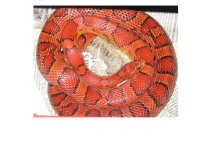
This is an F1 female, just finished her pre-laying shed when I snapped the photo... verifiable Okeetee Club ancestery. Two points:

1) Can you find as pretty of a corn in NC, Ga, Fla? Certainly, although it would be a very pretty find for most corns I've encountered in the wild.

2) Would this corn be as valuable if she were caught in Shelby, NC? Perhaps to some, but I wouldn't want her. Honestly.

It's fine by me that some people have no interest in locality. I find it only slightly irritating that Okeetee has turned into a morph in some keepers eyes. What makes me really frustrated is that so many out there answer "yes" when asked if their snakes are locality, when they are het for ten different traits! But it makes me furious that someone would take assorted normals to a collection "hot spot" and lie and cheat enthusiastic collectors who are only out there hunting to establish verifiable locality data. Believe me, it's a lot easier to spend the $50 bucks than to hunt snakes ( even if you don't factor in bad luck, chiggers, fire ants, barbed wire, bad weather, rattlers, no tresspassing signs, etc., ad nauseum!)
 

Attachments

  • 99female.jpg
    99female.jpg
    106.8 KB · Views: 199
AAARRRGGGHHHHHH!!!!!!!!!!!!

I hate being new at things and having to learn so much!!! I've been trying for an hour to post pics of my corns and I keep getting the message back that the file is too big! I've tried cropping the hell out of them and I still get the same error.
Can someone give me an email address that I can send these 2 pics to, so you might post them for me? One pic is of a solitary adult corn. The kid I got it from has no knowledge of genetics morphs or locality data. (neither do I for that matter.)
The second pic is of 2 neonates(?) I purchased seperately. One was sold to me as an Okeetee, the other a normal. Which is which???

Help???

Thanks,
Dennis
 
Re: AAARRRGGGHHHHHH!!!!!!!!!!!!

SnakeMover said:
I hate being new at things and having to learn so much!!! I've been trying for an hour to post pics of my corns and I keep getting the message back that the file is too big! I've tried cropping the hell out of them and I still get the same error.
Can someone give me an email address that I can send these 2 pics to, so you might post them for me? One pic is of a solitary adult corn. The kid I got it from has no knowledge of genetics morphs or locality data. (neither do I for that matter.)
The second pic is of 2 neonates(?) I purchased seperately. One was sold to me as an Okeetee, the other a normal. Which is which???

Help???

Thanks,
Dennis

[email protected]
 
let me try another machine...

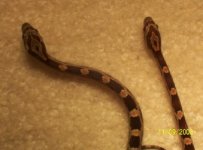
okay, here goes... this is a pic of two babies from different lots. One was sold to me as an Okeetee, the other a normal corn. Which is which?
 

Attachments

  • corns.jpg
    corns.jpg
    30 KB · Views: 183
here's the adult i have

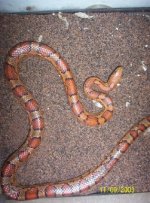
I bought this corn from a local kid who couldn't afford to keep it anymore. He had it for a year and knows nothing aboutit's background. Putting aside locality data, which couldn't be proven anyway, what does this snake look like? Okeetee or normal?

Thanks,
Dennis
 

Attachments

  • corn1.jpg
    corn1.jpg
    57.4 KB · Views: 180
Back
Top