

• Responding to email notices you receive.
    **************************************************
    In short, DON'T! Email notices are to ONLY alert you of a reply to your private message or your ad on this site. Replying to the email just wastes your time as it goes NOWHERE, and probably pisses off the person you thought you replied to when they think you just ignored them. So instead of complaining to me about your messages not being replied to from this site via email, please READ that email notice that plainly states what you need to do in order to reply to who you are trying to converse with.

  • IMPORTANT! PLEASE READ!! About the Google Adsense ads being displayed

    =====================
    Posted 08/15/2025
    =====================


    Yeah, I know. They are a pain in the butt. But they pay the bills to keep my server running. Just a fact of life, I am afraid.

    Want to get rid of them? Simple. Just become a Contributor level member or above and they will be gone. -> Please click HERE."

    Is that too much for me to ask of you to keep this site running? Well, sorry about that. I too wish I could get everything for free. But alas.....

    =====================
    Addendum: 01/10/2026
    =====================


    Google Adsense ad revenue for December, 2025 was just $30 over the cost of the lease for the server running this site. So, in effect, the money providing the incentive for me to continue running this site is coming SOLELY from the paid memberships and sponsorships here. Which honestly ain't much....

Please help identify this parasite

gothra

New member
Joined
Aug 21, 2004
Messages
341
Reaction score
0
Points
0
Age
51
Location
Hong Kong
I have leopard geckos. I did the fecals myself and when I noticed that they had parasites, I took some pics and showed them to my vet. There were 2 types of oocysts found in the fecal, one was a standard pinworm egg and the other one (as shown in the pics below) can't be identified. I was given panacur to treat them. I did another fecal last night (after 3 doses of panacur at 50mg/kg), but looks like the panacur isn't much help in eliminating this unknown type of parasite. Can someone please help me identify it? Or if you have a vet friend, can you please ask for me?

Description: Its about the same size as a pinworm egg. Its nucleus can split into 2 or 3 perfect circlular nucleus (I witnessed the nucleus making change last night). I checked Dr. Klingenberg's book and chart, they mostly resemble a pinworm egg; could it just be another type of unknown pinworm egg that requires a bit more time to eliminate?
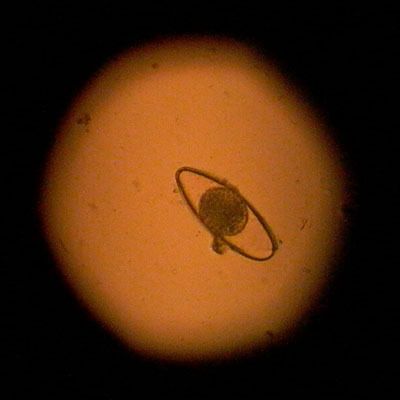
070131_1nucleus.jpg

The above parasitic egg has ONE circular nucleus, then after about 5 minutes, it looked like its nucleus is about to spawn another circle (see below pic:
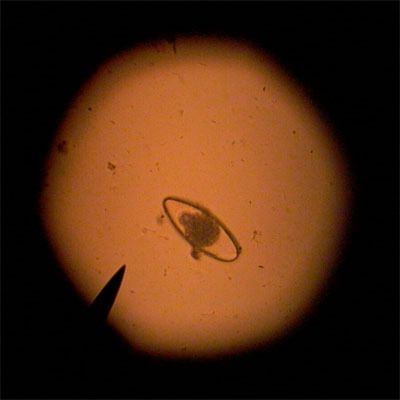
070131_s-nucleus.jpg


I also found others with 2 or 3 nucleus (mostly 2 nucleus):
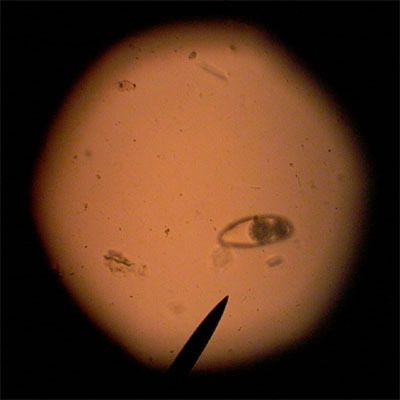
070131_2nucleus.jpg


070109_hook.jpg

(this pic was taken on another day)

Any idea what they could be? I started treating them with panacur since 9th January, but still found quite a few of them last night, in fact, I found more of these than before. But the standard pinworm eggs seems to have been taken care of. Thanks.

(Sorry about the quality of the pics).
 
They look like pinworms to me. Sometimes you can see the breakdown of that central core and it makes it look weird. Continue the panacur
 
I hope they are just pinworms and nothing unusual! Can the core break down into 2-3 perfect circles?
 
I'm pretty sure I read somewhere about insect specific pinworms that commonly infect feeders like crickets and mealworms. If your leos are otherwise healthy, you may want to look into this more. I think Marcia may have posted something about it awhile back. If this is the case, your leos would eat parasitized insects and pass the parasite eggs contained in them. Maybe the shape is different on these because they are a species that parasitizes insects, that would also explain why the pancur doesn't eliminate them. If this is the case, they would be harmless.

-Alice
 
One more thing, they don't look quite as football shaped as I remember pinworms, but that seems to be the closest when I look on-line. I don't have my books with me but, I'll look through them tomorrow. It also looks like they may be operculated on one end??? The breakdown you're seeing is the dividing embryo.

-Alice
 
Bonnie, I sent the photos to my vet, and he identified them as oxyurid (pinworm) oocysts. If you are seeing oocysts in your fecal tests, then the gecko is infected and a few rounds of Panacur should do the trick... keeping in mind that they shed on a 10-14 day cycle.
 
Thanks everyone! I'll keep giving them panacur for a few more rounds, and hope it can eliminate the parasite. My geckos do not show any clinical signs of parasitic infection, they are eating fine, active and is even on the over weight side. I found out about the presence of parasitic eggs during "routine" checks which I haven't done for almost a year! Its good to find out about potential problems before its out of control.

Thankyou for your help!
 
Back
Top