• Responding to email notices you receive.
    **************************************************
    In short, DON'T! Email notices are to ONLY alert you of a reply to your private message or your ad on this site. Replying to the email just wastes your time as it goes NOWHERE, and probably pisses off the person you thought you replied to when they think you just ignored them. So instead of complaining to me about your messages not being replied to from this site via email, please READ that email notice that plainly states what you need to do in order to reply to who you are trying to converse with.

  • IMPORTANT! PLEASE READ!! About the Google Adsense ads being displayed

    =====================
    Posted 08/15/2025
    =====================


    Yeah, I know. They are a pain in the butt. But they pay the bills to keep my server running. Just a fact of life, I am afraid.

    Want to get rid of them? Simple. Just become a Contributor level member or above and they will be gone. -> Please click HERE."

    Is that too much for me to ask of you to keep this site running? Well, sorry about that. I too wish I could get everything for free. But alas.....

    =====================
    Addendum: 01/10/2026
    =====================


    Google Adsense ad revenue for December, 2025 was just $30 over the cost of the lease for the server running this site. So, in effect, the money providing the incentive for me to continue running this site is coming SOLELY from the paid memberships and sponsorships here. Which honestly ain't much....

Ringer - 8 out of 10, Het Pied?

CombatWombat

New member
Joined
Mar 19, 2014
Messages
104
Reaction score
10
Points
0
Location
Acushnet, MA
Hey everyone, I was hoping you could all help me answer a question regarding a visual het?

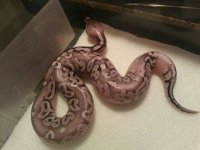
So I know a ringer isn't a true sign of being a het pied. a ringer is generally non-genetic and nothing to do with whether or not the snake is heterozygous for pied.

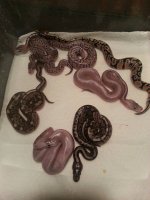
BUT when it shows up on 8 out of 10 babies that are produced in one clutch. Does this rule apply? It appeared on Sterling Pastels, Pewters, and a Cinnamon.

The parents were sold as is Blonde Pastel and Pewter. I don't know if it's something with the cinnamon gene or it's a sign of a het.

Any answers would be greatly appreciated. Photos of the ringer on a sterling pastel and the majority of the full clutch attached.

Thank you
 

Attachments

  • 11115995_811793928903719_1637862869_n.jpg
    11115995_811793928903719_1637862869_n.jpg
    49.3 KB · Views: 187
  • 11229368_688051067973610_6977258193490020998_n.jpg
    11229368_688051067973610_6977258193490020998_n.jpg
    80.3 KB · Views: 203
I have noticed that het pied animals have differing patterns and/or brighter colors than their normal counterparts. Without breeding the ringers, it is impossible to confirm if they are truly het pieds, and I'm not sure if anyone has actually done a breeding experiment to address this. However, if I produced those snakes, I would certainly hold back the ringers, because I think they have the most likely chance to prove out.

Great clutch, by the way!
 
I have noticed that het pied animals have differing patterns and/or brighter colors than their normal counterparts. Without breeding the ringers, it is impossible to confirm if they are truly het pieds, and I'm not sure if anyone has actually done a breeding experiment to address this. However, if I produced those snakes, I would certainly hold back the ringers, because I think they have the most likely chance to prove out.

Great clutch, by the way!


Thank you very much. I love the cinnamon gene.

Once I get them up to breeder size so a few years down the road. I'll breed the one with the most pronounced patterning to a pied. The worst that can happen is a het pied and even then, those can be produced for sure later down the line. It's all just a waiting game.
 
Animals either form anus first or mouth first. Without doing any sort of research, I would bet that snakes form anus first simply because any time we see a ringer it's in the exact same spot around the vent. My theory on ringers is that it's just an issue that happened during formation of the fetus either in the mom or in the egg after laying. I would guess that either the incubation temps or mom temps were too high or too low, and that's why almost the whole clutch has the same issue.
 
Also, I have het pieds that are super dark and some that are super light. I haven't noticed any reliable indication that they're het. Albinos and hypo in the other hand, I'd argue are generally lighter in color.
 
maybe it's simply a common thing that pops up in pewters?

(mine, white patch and light ring around the entire tail area, not het pied)
BlackPastel5_15b_zpst32q8x4c.jpg
 
Back
Top