• Responding to email notices you receive.
    **************************************************
    In short, DON'T! Email notices are to ONLY alert you of a reply to your private message or your ad on this site. Replying to the email just wastes your time as it goes NOWHERE, and probably pisses off the person you thought you replied to when they think you just ignored them. So instead of complaining to me about your messages not being replied to from this site via email, please READ that email notice that plainly states what you need to do in order to reply to who you are trying to converse with.

  • IMPORTANT! PLEASE READ!! About the Google Adsense ads being displayed

    =====================
    Posted 08/15/2025
    =====================


    Yeah, I know. They are a pain in the butt. But they pay the bills to keep my server running. Just a fact of life, I am afraid.

    Want to get rid of them? Simple. Just become a Contributor level member or above and they will be gone. -> Please click HERE."

    Is that too much for me to ask of you to keep this site running? Well, sorry about that. I too wish I could get everything for free. But alas.....

    =====================
    Addendum: 01/10/2026
    =====================


    Google Adsense ad revenue for December, 2025 was just $30 over the cost of the lease for the server running this site. So, in effect, the money providing the incentive for me to continue running this site is coming SOLELY from the paid memberships and sponsorships here. Which honestly ain't much....

Rubber Boa Substrate

Toby_H

New member
Joined
Aug 2, 2010
Messages
56
Reaction score
2
Points
0
Location
St Louis, MO
Simple question: What are some of the best substrates for Rubber Boas?

Important detail: Why? What qualities do these substrates have that make them better than others?

While they may not need it, I like having natrualistic enclosures aroudn the house. So I am putting together a 30 gal with a styrofoam background, some sections look like rocky outcrops, other sections look like trees...

There is a live tree/plant in it...

I'm a huge fan of water features, but I decided not to do one on this enclosure... trying to keep it simple this time...

Right now I am using a blend of 50% crushed walnut & 50% Coco Fiber. Unless anyone convinces me of something better I plan to use the same blend in their new enclsoure.

I feed one Boa in the enclosure and remove the other one to feed in a seperate enclosure. Rubber boas are nest robbers so it is easy to make a "nest" with pinkies in it where the Rubbers will eat, making ingesting substrate nothing more than a minor risk.

The Coco/Walnut looks nice, holds moisture well yet doesn't remain saturated. I just don't want to miss out on something better while stickign with my first choice....
 
You've probably already come across this, but this is what Ryan Hoyer has to say on his site, rubberboas.com:
As suggested for other snakes, do not use cedar shavings as it is toxic. Aspen, or other small wood chips are suitable. Sand, artificial turf, sterile soil, and paper are suitable alternatives. Small wood chips, reptile sand, or other absorbent materials are good in that feces may be easily scooped up and discarded. Paper is handy in providing an easy to clean cage lining, but do not provide a comfortable home similar to natural settings. In choosing the substrate, consideration should be given to the possibility of accidental ingestion of substrate that could cause damage to mouth or impact the digestive system. In the wild, small amounts of material (grass, dirt, etc) are normally ingested when eating. It becomes a problem when large pieces, sharp objects, or large quantities are ingested along with the prey. This could cause damage to the snake resulting in death. If the substrate used is not appropriate for eating on, move the snake to a clean location when feeding.

I've kept rubber boas in very fine pine shavings (almost sawdust) without issue, but I've never had any for very long periods of time. It sounds like what you're using is working well for you. I'd probably stick with it. Good luck with them, rubber boas are so cool.
-Josh
IMG_9548.JPG
 
The mix you're using sounds fine. the important thing is not to keep it too wet though. I have encountered far more problems with damp, poorly ventilated conditions than with dry, well ventilated (although not drafty) conditions. If you would like to add one, a moist hidespot may be appreciated, but in my opinion it is not necessary. I used to have a 20L tank with a pair of rubber boas on my desk as a display tank (although I now keep them in appropriately sized boxes). One thing I noticed that you may want to integrate into your display tank is that the boas loved to press up between a piece of bark fit mostly flush against the glass. This allows you to view the boas without disturbing them, as well as providing them a dry hidespot above the substrate. As you probably already know, these guys are very good climbers, and I enjoyed keeping varying heights of bark against three sides of the cage, which I would often find them perched on top of.
 
Thanks for the input guys...

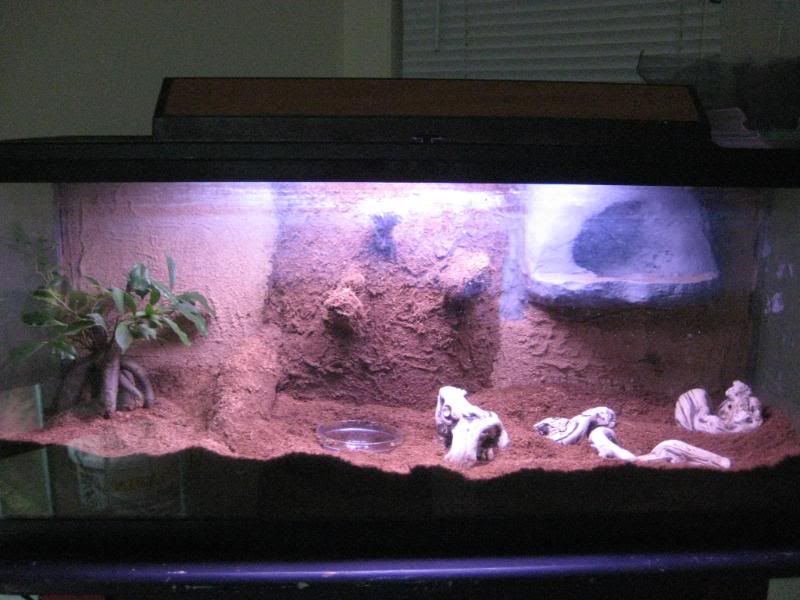
Here is the finished display tank

IMG_0064.jpg


It is a 36" x 12" @ 17" tall 30 gallon aquarium with a screen top. The background is 1"~4" of carved/melted styrofoam covered first with grey Drylok, then layered with silicone to adhere Ecco Earth (pulverized coconut shell) or crushed walnut shell (appears as sand). The rocky outcrop in the upper right side is just Drylok coated styrofoam.

The substrate is about 75% Eco Earth (pulverised cocohut shell) and about 25% crushed walnut shell.

The plant is some random cool looking house plant I bought. I searched several extensive 'dangerous plant' lists for it's latin name and it seems safe. The female spends about 50% of her time in that tree. Sometimes entwined in it's exposed roots, sometimes climbing in int's leaves & branches.

The wood chunks are commercial 'driftwood' pieces that have been bleached, rinsed and baked. I went through all fo that trouble as I wanted them to have the 'washed out' look.

The light is a simple 24" daylight aquarium lamp (not UVB). There is no form of heat on the tank what so ever, as I keep my home fairly warm.

I have been surprised how much these guys climb and am very glad I gave them an environment that allows them to do so.

I mist the cage heavily once or twice a week allowing it to dry quite a bit between mistings. I've heard fairly mixed reviews about humidity/moisture needs of this species. I surely do not keep it wet enough to allow any type of skin rot to occur. I also mist one side heavily and the other side lightly to allow some diversity within the environment.

Both snakes get along great and often spend time together both exploring as well as lounging. Yet each snake has it's preferred areas (female in the plant, male in or under the driftwood). But best of all both snakes move around a good bit during both day and night.

It took a while (6 weeks or so) for them to both get regulated, but both snakes are now eating very well. 3~5 I put frozen/thawed pinkies in a piece of driftwood that has a hollowed out section every 3~5 days. The male is quick to raid the nest but doesn't eat much per feeding. The female takes her time getting there but will eat as much as is available. I watch very carefully until the male has had his fill to ensure both snakes do not have opposite ends of the same pinkie (as she is big enough to swallow him in such a situation).

Starting this spring I will likely begin howing them seperately and trying to replicate their 'natural' cycles of both light, temperature, moisture and food. This si not a 'breeding project' per se, but I would like to give them the chance to spawn.


Any comments or suggestions on my care is welcome...

I've kept "exotic" pets for a very long time but this is my first time with Rubber boas.
 
Your setup sounds fine. I use aspen shavings for simplicity and it's easy to clean, but I have a very large collection, I do daily spot cleanings. The only disadvantage of your setup is it might be hard to see the snakes waste and a possible place for bacteria to grow. I do not mist my charina, as I do not think they need real high humidity depending on what locality they are from. I keep adults in a 32 qt sterilite container with a 4" diameter by 3" deep water bowl. I have never had a bad shed. I have kept them off and one for about 15 years, one in my collection I have had since '98, and she was adult when found. I now have 5 adults and 4 2010 neonates.
 
Back
Top