Kate,
Tyrosine is a non-essential amino-acid that is one of the building blocks for the pigment, melanin. Tyrosinase is the enzyme which serves as the starting point for the tyrosine to be activated in an animal.
It is my understanding that all amels (of the "regular" variety) are tyrosinase negative animals, that is they produce no melanin at all. These animals have been called "complete albinos" in years past. Tyrosinase positive animals, however, (once called "partial albinos") are those which produce some melanin, or at the very least, have the genetic capacity to do so.
These animals are trickier to identify than the T- animals, because of the distribution factor of the melanin which may or may not produced in the T+ animal. It is entirely possible for a T+ animal to look identicle to a T- animal. However it is also possible for a T+ animal to have patches (over a minority or a majority of the snake's body) which show melanin in every way that a normal animal would. If it has albinistic patches with melanistic patches it is T+, but if it is totally albinistic, it COULD be either T+ or T-.
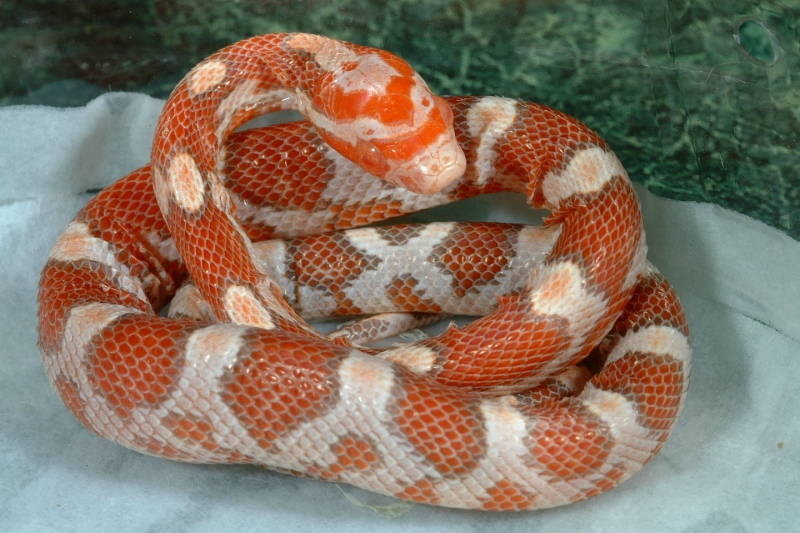
So, has anyone every produced a T+ corn? I would think so. Like I said, Rich's snake that appears to be both amelanistic AND hypomelanistic, seems to be T+ by definition. Here's a pic:
It may also be that any piebald or paradox corn is also a "brand" of T+ corn. Who knows?
I think this is great topic for discussion, but I agree with those who have stated that the cornsnake world really doesn't need another confusing genetic issue right now. Bloodred doesn't seem too "out there" for me, but Hypo is going to be a HUGE mess for years to come, I fear!
The following is a site dedicated to the existence of T+ dobermans, so it deals with mamalian issues for the most part. However, it is still a good read on the issue of albinism in general.
http://www.geocities.com/~amazondoc/albinism/
Have fun with this!