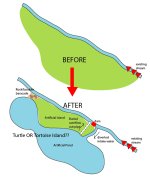
1. Can tortoises swim? If I put them on this island are they just going to take off?
Some can. Many can. Some individuals cannot or will not. Burmese brown/blacks, redfoot & yellow foot tortoises, and some hingebacks will swim readily. They will cross water barriers pretty easily. While some sulcata and Testudo (ex: Russians, Hermann's, and marginated) tortoises can swim, many will not feel comfortable if not touching bottom. Leopards and stars may swim (or bob about). One of the Aldabras I had years ago would wait until the mouth of the sulcata burrow would get flooded from a downpour. Then she would go into the temporary pool and have some splish-splash time to herself. I have kept a lot of stuff over the years as well as observed many individuals in nature. I knew one old wild Hermann's male that was (literally) dense and he would walk across the bottoms of spring-fed streams to go from bank to bank. The rest in that area never seemed to cross them at all. I am sure many of those which did not swim could have done so if necessary due to a flood, but they were not strongly inclined without that sort of motivation.
2. What do you think the odds are of my turtles (future ones) taking off too? There is no other water around except this "little stream" and the pond I would make.
Depends on the turtles and if they recognize the water you want them in to be home. Also, some females really tend to roam quite a bit for nesting site selection. This will depend on the ground and the individual turtle.
3. Should I get native Nebraska turtles if they are basically going to be wild?
They are among your options, assuming they are legal. I do not know the NE laws on native turtles.
4. If native, should I go catch some or attempt pet grade turtles outside to live?
I might start with juveniles for them to establish there and possibly some adults you can afford to lose if they decide to go on walkabout.
5. Do turtles hibernate in the winter? Do I need to make some kind of place for them to go? This is Nebraska freezing cold winters.
There are species which brumate, so it will depend on the species. If you have earth/soil/sand/litter present or any combination, they will usually figure it out themselves. Some aquatics will hibernate/brumate below the water and some above the water. If you are leaving them out there and the legality meshes, you have some options that could work well.
6. Tortoises I think I can bring to our out building for the winters?
You can do that or let them go into the ground on their own, assuming hardy brumating choices.
7. Thoughts on good hardy torts or turtles?
This list is going to be non-exhaustive, but I want to toss some decent options out there for you. Again, check the legality on natives and so forth.
Turtles- Painted turtles are an attractive and very weather-tolerant group. Northern redbellies get larger and are similarly durable. They start out eating small prey items and, like many slider-cooter-like turtles, will transition to eating aquatic vegetation more as they mature. Spiny softshells can tolerate a wide range of temperatures. Common snapping turtles are very durable, too, but they tend to dominate their spaces and reproduce rapidly, so I would add only one meaty juvenile if you decide to add one to your mix in a diversified pond. If valuable ornamental fish will be involved, skip the snapper (and maybe skip the softshells). If fish can have acceptable losses, no big deal to include one. Over a few short years, the snapper will be a dragon in the water. You can also add a number of different very hardy musk and/or mud turtle species. They are small. They mostly walk around the bottom to search for food. European pond turtles from many parts of the range can handle your area's climate, too. You could have success with box turtles, wood turtles, Blanding's turtles, and spotted turtles, but they could also just take off (assuming these are legal to begin with when you look them up); I would start with juveniles of these if you want them to have a chance of recognizing the area as "home" in terms of their individual territory ranges. Some introduced adults stay put if they have a good thing going and some may always try to return to the place they originated from. I cannot predict which way that will go and these would be bigger losses if they left.
Tortoises- My default for most people seeking a new pet tortoise is the Eastern Hermann's tortoise. Affordable, hardy, attractive, of manageable size, and personable. You can also work with Russians, some Greeks, and marginateds for brumation-capable options, but I think the Hermann's fit the idea best. Maybe several Hermann's tortoises and a few marginated tortoises (they are sympatric). You could also pick something from one of the larger species such as a sulcata, but you would need to provide heated indoor winter accommodations for those sorts of animals and that will likely mean 6-7-8 months of that every year (which is a PITA that I can attest to). For Hermann's and marginated tortoises, you can leave them out entirely to handle things themselves or bring them into a more secure dedicated hibernaculum of your own design (or some in each).
8. I don't plan on filtering the water at all, it will be stream fed, any issues?
As long as the stream does not experience something crazy like a chemical spill, I would not be worrying.
9. Any one tried this before?
People have. I know people who have in PA back when I was a kid. They pretty much tossed in a bunch of things and then saw whatever would stick.
I think it is important to stock the body of water with a variety of unthreatened native (or acceptable non-native) climate-tolerant fishes, invertebrates, anurans, and plants before adding adults of your turtle species. Aquatic insects will colonize on their own. You can also transfer water samples from desirable ponds to your pond-like portion to establish a variety of different tiny aquatic organisms. Try to pick species that would not create issues if they were to migrate from your space to downstream space. In spring of year one, add these various food web pieces and your juvenile turtles. If you want to add select adult turtles (like adult female painted turtles and adult musks/muds) in year two, feel free or you can just wait for the little ones to mature over time.
This is a start. Not everything will always work, but this can give you a framework to adjust from to wherever you end up taking it.