Christina.Fox
New member
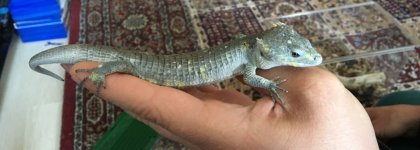
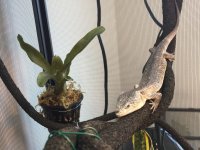
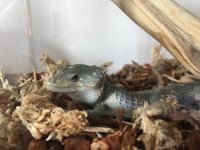
My boyfriend and I adopted this abronia lythrochila from a reptile convention about 4 months ago, and about 3 months ago, he developed the yellow spots you can see in the pictures, practically overnight (there are pictures before and after). We were checking on him regularly--one day they weren't there, another day they were! When we first took him home, he refused to eat for several weeks, but around the time that these yellow spots showed up, he was eating regularly, and was active.
We took him to the vet, and they took a bacterial and fungal culture. He came back positive for a bacterial infection, and we gave him antibacterial injections every 3 days for 3 weeks, making sure to keep him in sanitary enclosures. We finished the antibacterial course about a month and a half ago, but the spots are still there! (It's worth noting that he has shed at least once during this time).
We took him back to the vet, and she ran a test for yellow fungus (as happens in beaded dragons), which also came back negative.
Does anyone have ANY idea what this might be?? His energy and feeding levels have dropped a bit in the last few weeks, but not markedly. This change seems more likely to be related to the seasons.

Our most recent hypothesis is that the spots are a result of too much D3. We have a leopard gecko as well, so we were dusting the crickets we fed to our abronia with the same Calcium + D3 that we use for the leopard gecko. However, as we've been thinking, because our abronia gets a TON of sunlight and is active during the day, the added D3 might be too much for his system. In the 2 weeks, we've started dusting with calcium (no D3) about half the time we feed him, and not dusting at all the other half of the time. So far, no change, though…
Has anyone had this issue before? Our other hypothesis is that it's some other vitamin/mineral deficiency. We gut load our crickets with endive and dandelion greens, as well as dry cricket food (Mazuri, just switched to Josh’s Frog’s cricket gut load).
Other information:
- The lizard is about 2 years old, bred in captivity
- We were using a MistKing, but it was too much wetness, so now we heavily mist all the surfaces and plants once a day, sometimes with additional light mists throughout the day
- We keep his enclosure next to the window, and also use a Sunray fixture. He gets a LOT of light.
- Ambient temperatures: Top 84 F, Middle 68 F, Bottom 65 F
- He eats about 7 crickets every other day
- We use NeHerp's Version 2 Vivarium Substrate (for tropical/subtropic/temperate vivariums), covered with a layer of New Zealand Sphagnum moss to keep humidity up, over a drainage layer of hydroballs and bio-drain.
- We have an exo-terra dripper plant for him to drink fresh water
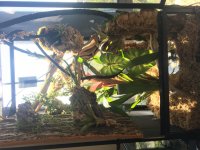
I've included a picture of his enclosure as well.
We took him to the vet, and they took a bacterial and fungal culture. He came back positive for a bacterial infection, and we gave him antibacterial injections every 3 days for 3 weeks, making sure to keep him in sanitary enclosures. We finished the antibacterial course about a month and a half ago, but the spots are still there! (It's worth noting that he has shed at least once during this time).
We took him back to the vet, and she ran a test for yellow fungus (as happens in beaded dragons), which also came back negative.
Does anyone have ANY idea what this might be?? His energy and feeding levels have dropped a bit in the last few weeks, but not markedly. This change seems more likely to be related to the seasons.
Our most recent hypothesis is that the spots are a result of too much D3. We have a leopard gecko as well, so we were dusting the crickets we fed to our abronia with the same Calcium + D3 that we use for the leopard gecko. However, as we've been thinking, because our abronia gets a TON of sunlight and is active during the day, the added D3 might be too much for his system. In the 2 weeks, we've started dusting with calcium (no D3) about half the time we feed him, and not dusting at all the other half of the time. So far, no change, though…
Has anyone had this issue before? Our other hypothesis is that it's some other vitamin/mineral deficiency. We gut load our crickets with endive and dandelion greens, as well as dry cricket food (Mazuri, just switched to Josh’s Frog’s cricket gut load).
Other information:
- The lizard is about 2 years old, bred in captivity
- We were using a MistKing, but it was too much wetness, so now we heavily mist all the surfaces and plants once a day, sometimes with additional light mists throughout the day
- We keep his enclosure next to the window, and also use a Sunray fixture. He gets a LOT of light.
- Ambient temperatures: Top 84 F, Middle 68 F, Bottom 65 F
- He eats about 7 crickets every other day
- We use NeHerp's Version 2 Vivarium Substrate (for tropical/subtropic/temperate vivariums), covered with a layer of New Zealand Sphagnum moss to keep humidity up, over a drainage layer of hydroballs and bio-drain.
- We have an exo-terra dripper plant for him to drink fresh water
I've included a picture of his enclosure as well.