• Responding to email notices you receive.
    **************************************************
    In short, DON'T! Email notices are to ONLY alert you of a reply to your private message or your ad on this site. Replying to the email just wastes your time as it goes NOWHERE, and probably pisses off the person you thought you replied to when they think you just ignored them. So instead of complaining to me about your messages not being replied to from this site via email, please READ that email notice that plainly states what you need to do in order to reply to who you are trying to converse with.

  • IMPORTANT! PLEASE READ!! About the Google Adsense ads being displayed

    =====================
    Posted 08/15/2025
    =====================


    Yeah, I know. They are a pain in the butt. But they pay the bills to keep my server running. Just a fact of life, I am afraid.

    Want to get rid of them? Simple. Just become a Contributor level member or above and they will be gone. -> Please click HERE."

    Is that too much for me to ask of you to keep this site running? Well, sorry about that. I too wish I could get everything for free. But alas.....

    =====================
    Addendum: 01/10/2026
    =====================


    Google Adsense ad revenue for December, 2025 was just $30 over the cost of the lease for the server running this site. So, in effect, the money providing the incentive for me to continue running this site is coming SOLELY from the paid memberships and sponsorships here. Which honestly ain't much....

Egg Disaster.. Mini Fridge users Read!

candace313

New member
Joined
Apr 2, 2011
Messages
219
Reaction score
4
Points
0
Location
Apalachicola, Florida, USA
I got home from work today and went to check on my leopard eggs. Apparently the power flickered today and my mini fridge incubator went out. The temperature reset to 130F needless to say I now have hard broiled gecko eggs. Four babies should have been hatching any day, but they hatched out and died due to the heat.
I had been experimenting with a large deep freezer as an incubator and I had moved over half my eggs to it, so all is not lost.

So anyone with the mini fridge incubator please keep an eye on them especially if your having bad weather or a possible power outage.
 
I hope i dont get another infraction because everytime I wite something i seem to get one for some reason or another..I had a power outage..the incubator went off and never went back on....lost all my eggs..I talked to the people who sold it to me....I didn't get that warm and fuzzy feeling. The stryofoam one, the better one, has turned out to be much more reliable.
 
Wow, why did it skyrocket to 130? I think my herpstat and ranco keeps the settings when the power kicks back on.
 
I'd like a little more info on this too. When you say mini fridge incubator, what I think of is a mini fridge that has been converted for incubator use, a DIY incubator.
If that's the case, then I'd think it'd have to be a thermostat issue, since the fact it was a mini fridge would be irrelevant.

I had a Ranco fail on me this winter due to a power outage. Actually two failed as a result of that but in different ways. The one in the rat building defaulted to 180 degrees. When I tried to reset it it locked up with an error code.

Based on your wording it sounds like you're saying you wouldn't have had this issue if you hadn't been using a mini fridge.
John brings up a good point as well, a surge protector is a very good idea on any incubator, especially home made ones, and based on my experiences the last year even more especially if you're using Ranco thermostats. I no longer have the confidence in them I once did and am working my way toward converting over to Johnson's for everything.

Wow, why did it skyrocket to 130? I think my herpstat and ranco keeps the settings when the power kicks back on.

My Rancos always did too until the time I mentioned above. Fortunately it was in the rat building in the winter and the heater couldn't get the room past the upper 90s. The other failure I had was the opposite, the thermostat still works but anytime the power goes off it defaults to 60 I think it is. That was aggravating this winter because it was on a timer for winter cycling.
My point being keep an eye on them, had that one been on a snake rack or incubator, the results would have been far worse.
 
^Wow, that's good to know. I've been planning on backing up with a second thermostat and that gives me all the more reason.
 
Wow, that is good to know. Nick, when you say back your thermostat up with a second thermostat, do you mean connected on the same circuit? If so, how do you wire that, since the two thermostats would be fighting with one another and could cause problems? Or do you mean just have a second thermostat on hand to make the switch immediately if necessary?
 
Wow, that is good to know. Nick, when you say back your thermostat up with a second thermostat, do you mean connected on the same circuit? If so, how do you wire that, since the two thermostats would be fighting with one another and could cause problems? Or do you mean just have a second thermostat on hand to make the switch immediately if necessary?

Honestly, I haven't much of a clue. Everyone keeps telling me about it but I haven't had time to figure it out. I imagine it's further down circuit with a broader temp range then the primary.

If you have the primary set to 88-90 and the secondary is set 86-92, then when it goes above 90 and hits 92, it will trip the secondary and cut power until it drops. Same with the low.

This is what I am guessing because I haven't tried yet. I've been backing up with a rheostat but it's really undependable.
 
By secondary, I mean the primary is plugged into the secondary and the secondary only controls the temp if the primary fails or goes outside of it's temp range. Two probes on the heat source though.
 
This was the Reptipro 5000 mini fridge. There was a surge protector used, but it didn't stop the temperature spike after the power cut back on. I'm finding out that most of the "Ready to go Items" will fail or have issues in a short amount of time.

We have the DIY deep freezer incubator that we will be using from now on. We had just gotten the Herpstat4 and it is working nicely so far.
Great idea for a secondary, especially if you have high dollar eggs. I will be looking into this for our deep freezer for sure.

What is everyone's opinion on the best thermostat to use?
 
This was the Reptipro 5000 mini fridge. There was a surge protector used, but it didn't stop the temperature spike after the power cut back on. I'm finding out that most of the "Ready to go Items" will fail or have issues in a short amount of time.

We have the DIY deep freezer incubator that we will be using from now on. We had just gotten the Herpstat4 and it is working nicely so far.
Great idea for a secondary, especially if you have high dollar eggs. I will be looking into this for our deep freezer for sure.

What is everyone's opinion on the best thermostat to use?

Oh that's just horrible then. Isn't that thing specifically for incubating? Does it default in that way (to 130) everytime it resets or was this a malfunction?

I think the herpstat is the best out of what I have used (Herpstat, Ranco, cheap dial thermos, rheostats). I haven't had any casulaties yet, but the Herpstat allows me to do so much more (alarms when the temp is too high/low, night time drop, etc). I have seen these style thermostats fry racks. I helped a younger local herper repair his rack a while back and while other issues may have been at play, two or three of these things were INOP.
 
It is specifically for incubation :( I had previously moved it and it saved my temperature setting so I believe this was a malfunction.

I really like our herpstat, but lots of people I have spoken with keep saying they like the rheostats. I wonder if I should use a different one as my secondary.
 
I like the rheostats as a secondary to a thermostat. It's a cheap back up but wouldn't be that great of a back up for an incubator because a rheostat would fluctuate as much as the ambient air in the room. Almost as if it retards the output by a percentage and not a set limit.
 
Anything manufacture can have the possibilty to malfunction.Simplicty works best. I know down here in s.Fla., some uf us use shoeboxes or sweaterboxes w/ vermiculite and keep the temps at 82-85 degrees without an incubator. So please be very careful with manufactured products>
 
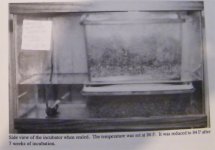
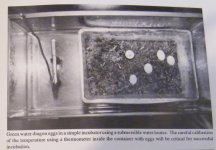
Candace, I remember reading somewhere about people using submersible aquarium heaters for an incubator. Essentially, you get a plastic tub or some sort of insulated container like a cooler, fill it a third of the way with water, place the submersible aquarium heater in there, and then rest your incubation containers on bricks above the water level. I would imagine that the coils on these heaters would physically melt before they could reach deadly temperatures, and the water would hold and retain heat a lot more effectively and moderately than air. Perhaps that could be an alternative?

In addition, I believe there are temperature probes with alarms. Has anybody used these with success?
 
I am sooooo sorry. Good luck with any leftover eggs you have. i personally like the Hova-Bator but im sure there are better ones out there. Good luck!!!
 
I really like our herpstat, but lots of people I have spoken with keep saying they like the rheostats. I wonder if I should use a different one as my secondary.

I like the rheostats as a secondary to a thermostat. It's a cheap back up but wouldn't be that great of a back up for an incubator because a rheostat would fluctuate as much as the ambient air in the room. Almost as if it retards the output by a percentage and not a set limit.

That's exactly what a rheostat does. They are a plug and play dimmer switch.
Thermostats, whether they are proportional or on/off regulate the power based on the temperature. They either shut the power off or reduce the power based on the current temperature reading, thereby maintaining a stable temperature within their own range of divergence.

Rheostats supply a reduced, but constant rate of power to the heater regardless of temperature. In a room with stable temperatures they work, but they still need regular monitoring and require a thermometer of some sort to be used in conjunction with them to verify the temperature.
They are not a good idea with incubators at all.

Back to the original post though, I have no experience at all with any commercially made incubator aside from a hovabator I used 15 years ago, so I can't even guess as to what might have been the cause of the malfunction.
However, with a reliable heater and a decent quality thermostat, DIY incubators made from old freezers and such are almost bullet proof when it comes to problems, and they can be built for a fraction of the cost.
 
In case anybody is interested, I finally found that reference for using an aquarium heater in a 10 gallon tank as an incubator. The following pictures are from The General Care and Maintenance of Green Water Dragons, Sailfin Lizards and Basilisks by Philippe de Vosjoli, published in 1992.
 

Attachments

  • book1.jpg
    book1.jpg
    208.7 KB · Views: 121
  • book2.jpg
    book2.jpg
    181.8 KB · Views: 129
Back
Top