• Responding to email notices you receive.
    **************************************************
    In short, DON'T! Email notices are to ONLY alert you of a reply to your private message or your ad on this site. Replying to the email just wastes your time as it goes NOWHERE, and probably pisses off the person you thought you replied to when they think you just ignored them. So instead of complaining to me about your messages not being replied to from this site via email, please READ that email notice that plainly states what you need to do in order to reply to who you are trying to converse with.

  • IMPORTANT! PLEASE READ!! About the Google Adsense ads being displayed

    =====================
    Posted 08/15/2025
    =====================


    Yeah, I know. They are a pain in the butt. But they pay the bills to keep my server running. Just a fact of life, I am afraid.

    Want to get rid of them? Simple. Just become a Contributor level member or above and they will be gone. -> Please click HERE."

    Is that too much for me to ask of you to keep this site running? Well, sorry about that. I too wish I could get everything for free. But alas.....

    =====================
    Addendum: 01/10/2026
    =====================


    Google Adsense ad revenue for December, 2025 was just $30 over the cost of the lease for the server running this site. So, in effect, the money providing the incentive for me to continue running this site is coming SOLELY from the paid memberships and sponsorships here. Which honestly ain't much....

Jamaican Boas Breeding

I knew another one was hiding!!! ;-) Glad to hear they are showing interest in food.

*** Thirty by Halloween or Bust! ;) ***
 
Alright, so after being left overnight with a day old chick thigh, cut above the hip and below the knee, 9 out of 28 babies ate. I take this as good news, as it is only just past the 2 week mark post birth, and that's considered a little early based on what I've read. It is also GREAT news that I can get them to eat something as readily available as day old chick thighs, as I already feed my other animals about 50 chicks per week, and I don't think any of them will miss a leg or two if I cut them off. Once they get a little larger, I'll start trying them on quail chicks and move up from there. I may or may not try to get some of them on pinkies, but since I feed the vast majority of my animals some form of bird or another (I'm allergic to rodents) I may not bother to switch them.

One interesting side note, all 4 of the escapee snakes ate, including the two that are still being held in gecko screen cages with basking lights. It's hard to say for sure, but the added exercise of exploration may be contributing to appetite.

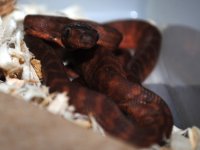
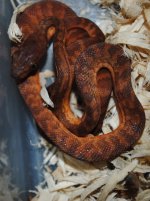
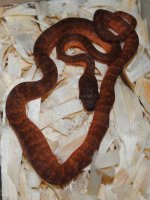
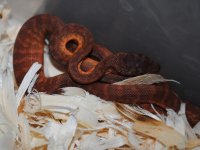
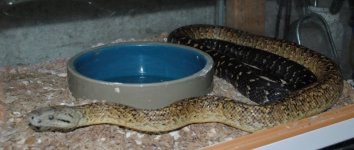
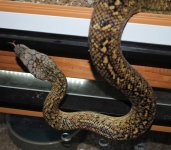
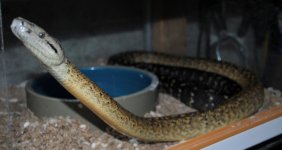
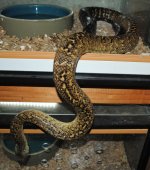
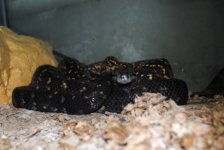
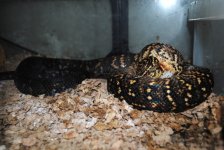
Sorry if I include a lot of esoteric information in this thread, but there is so little information available about breeding these guys that I want to make sure I put as much as possible on the internet for the next guy. The idea of feeding chick thighs is something that I found a single, vague reference to in an otherwise uninformative thread from almost a decade ago on another website after literally years of scouring the internet, and I'm sure glad I found it, so I want to make sure I leave as much information here as possible for the next guy. haha. Anyway, enjoy the pictures of my fat and happy little snakes:
 

Attachments

  • DSC_0009.jpg
    DSC_0009.jpg
    108 KB · Views: 272
  • DSC_0011.jpg
    DSC_0011.jpg
    269.2 KB · Views: 306
  • DSC_0012.jpg
    DSC_0012.jpg
    238 KB · Views: 281
  • DSC_0015.jpg
    DSC_0015.jpg
    139.9 KB · Views: 254
These are just gorgeous , thank for all the pics!

I am VERY interested in the chick thigh idea - I have Pacific Boas (Candioa bibroni) which look very similar to your Jamaican Boas, and the new borns are very similar in size (and are also escape artists - mine all went up when they got out and had to be rescued from the curtain rail).

I have fed them on baby geckos, but it's hard to find enough when there are 20+ babies, and I do raise chicks for the adults, so next time I will try this idea. Any other tips or observations you may make as you go along will be very welcome.

Good luck with all those feeds in your future! :thumbsup:
 
These are just gorgeous , thank for all the pics!

I am VERY interested in the chick thigh idea - I have Pacific Boas (Candioa bibroni) which look very similar to your Jamaican Boas, and the new borns are very similar in size (and are also escape artists - mine all went up when they got out and had to be rescued from the curtain rail).

I have fed them on baby geckos, but it's hard to find enough when there are 20+ babies, and I do raise chicks for the adults, so next time I will try this idea. Any other tips or observations you may make as you go along will be very welcome.

Good luck with all those feeds in your future! :thumbsup:

Glad to be of service. I was quite glad to find that reference myself. I've used chick heads in the past in place of hopper mice, but never realized the thighs could be used as well. I was definitely afraid I'd have to start feeding them geckos or anoles, but at $2-3 each, that was going to get tricky. Between the thighs and the heads, I'm pretty sure you could pretty much get them all the way to adulthood. I'll be feeding quail chicks for a few weeks in between, but I don't know if you have access to those. I imagine you could just double and triple up on the thighs until they get big enough for heads.

That's a good point about the babies all going up. So far, all the ones I've found have either been on the floor (presumably after falling) or climbing around mid-level. Maybe I should get a ladder and check the ceiling region. There's a whole mess of wires, pipes, ducts, etc. for them to climb on up there. I was so unprepared for the jailbreak. I really underestimated their ability to squeeze through tiny spaces.
 
Was cleaning out cages today, so I took the opportunity to take a few shots of Montego, the sire of these babies. (He's the friendly one, so I don't mind letting him nose around a little while I'm cleaning. Alexandria, the dam, can't be trusted if she has even the remotest shred of a clear line of sight to any part of you, haha)
 

Attachments

  • DSC_0001.jpg
    DSC_0001.jpg
    108.3 KB · Views: 253
  • DSC_0008.jpg
    DSC_0008.jpg
    188.4 KB · Views: 295
  • DSC_0004.jpg
    DSC_0004.jpg
    86.7 KB · Views: 249
  • DSC_0012.jpg
    DSC_0012.jpg
    261.5 KB · Views: 288
Yesterday was their second feeding, and I have good news to report. 19 of the 28 ate f/t chick thighs with no prompting (left overnight). It would have been 20, but I spooked one when I went to take a picture mid-swallow. I'm upset with myself for making such a rookie mistake, but I'll offer another one today and hopefully that one will also eat.

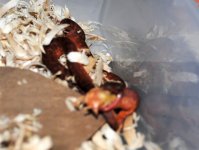
This leaves me with only 8 hatchlings that have yet to eat a single meal. None of these 8 were any of the escapees (and therefore, have had less exercise), and oddly enough, 7 of the 8 are all placed on the same level of my hatchling rack, so some temp checking may also be in order. However, due to the high increase of feeding from last week's 9 to this weeks 19 (or really 20, since the other one had opted to eat), I'm fairly confident that over time, they will all be easy feeders. I've snapped a couple random pics of the dam and the one (lousy) shot I got of the little one eating, right before it spit out the food. (still so mad at myself for that) Enjoy.
 

Attachments

  • DSCal_0001.jpg
    DSCal_0001.jpg
    123.2 KB · Views: 234
  • DSalC_0006.jpg
    DSalC_0006.jpg
    162.9 KB · Views: 297
  • DSC_0004.jpg
    DSC_0004.jpg
    141.9 KB · Views: 265
Awww cute! Sorry he (she?) turned out to be camera shy...but a promising start nonetheless!

Glad most seem to be eating for ya Chris!

Thanks. I'm definitely please with the numbers. 20/28 feeding easily at 3 weeks is a lot better than I expected, so I think chick thighs is definitely the way to go. I'll keep updating on progress.
 
Feeding update for week 3:

25 of 28 have eaten. The number of babies who eat is steadily growing. I have three left who have not yet eaten once, and am debating whether moving them to a larger, arboreal cage might help to push them over the edge.

So far, I have not tried feeding anything other than a frozen/thawed, day-old-chick thigh, placed in the tub and left overnight. The overnight part seems to be an important aspect of feeding, as even after an hour or two, I would say that only about 1/3 of the ones that eat do so right away (most within the first 10 minutes or so). An obvious majority wait until nightfall to eat. I have even checked on them all at dusk, 6-8 hours post feeding, and only one or two more will have eaten theirs. Then, first thing in the morning, I check again, and the other 2/3 of the eaters have consumed their meal. Feeding later in the day could possibly help reluctant feeders, as the food would be fresher and the snakes more active, but this does not appear to be necessary. Even by the next morning, chick thighs are still fairly fresh, whereas pinkies are clearly putrid by the 12 hour mark.

In addition, every baby who started eating has continued eating. I take this as a good sign with regard to the reliability of future feeding, general health, and my own husbandry techniques. The only exception to this is Escapee #1, who spit out its meal last week due to my interrupting the process (post #51). I tried to feed Escapee #1 the next day, but that meal was refused. However, upon feeding normally this week, Escapee #1 is back on feed. I should note, though, that Escapee #1 was one of the snakes that WAS eating in the first 20 minutes, but this week waited until nightfall. I take the lessons here as being:

1) Leave them alone when they're eating
2) If one is stressed out, the stress can have a lasting effect
3) They will, however, recover over time

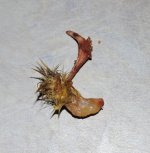
I would also like to describe one other anomaly that I have noticed. Escapee #4 has done something unusual two separate times now. Both Week 1 and Week 3, I have come downstairs to find a chick bone with skin attached on the floor of Escapee #4's cage. Thorough inspection shows that there is nothing but the bone and skin left, and inspection of Escapee #4 shows a clear bulge in the middle, where presumably, the meat alone lies. I'm not sure if this is something that is being done intentionally, or if there is something about Escapee #4's feeding process that is causing it as an accident, but it is definitely something too keep an eye out for when checking to see who has eaten the next morning, as my first thought is always that the food has been rejected. I have included a picture to show what I mean.

All in all, I have to say that this litter is progressing beyond my hopes. I was quite concerned at the onset that it was going to take months of scenting, lizard feeding, etc to get the majority to start eating, and was prepared to end up with several that had to be fed anoles until they were large enough for quail chicks, which looks like it will be around the 6 month mark. Instead, I have 25/28 so far that are easily feeding on a convenient, readily available, and quite cheap food source.

I am also confident that the 3 stragglers will come along. I'm going to take a day to think about whether moving them to an arboreal cage will help or hurt their development, and will post what I decide to do. On the one hand, I don't want to stress them out, and each week we've been seeing a significant increase in the number of eaters, with virtually no steps taken by me. On the other hand, all four of the snakes that originally escaped were among the first nine feeders. When only about 30% of the overall group was eating, 100% of escapees (who were then placed in screen cages due to space needs) were eating. This can't be a coincidence, so moving the non-feeders to screen cages could encourage them to begin eating. I'll mull it over for a day or two and post what I decide, but any input would be greatly appreciated.
 

Attachments

  • DSC_0003.jpg
    DSC_0003.jpg
    190.5 KB · Views: 280
I decided to move the three non-feeders to screen cages. All three are looking a little thin and lethargic compared to their siblings, so I don't think their refusal to eat is an issue of simply using up remaining yolk reserves. Hopefully, this exercise (and possibly the residual smell of nearby geckos) will help encourage them to start eating. I have also moved the escapees that were in screen cages to tubs (mostly for space reasons) and will monitor their progression as well.
 
Back
Top