Maybe he cheated at mathematics and reading, too.
From the video-
Seems to be a number with everything in my life.
Regarding the 3:36 to 3:41 segment shaking after adding solution 1-
Shaking for "30 seconds" (or 5 seconds for the math-advantaged). Counting sure is difficult. The good part about this is that this incorrect action was likely sufficient to satisfy what step 3
actually is.
Step 3 was to perform inversion several times. Not to shake for 30 seconds or "30 seconds" (5 seconds in reality). Reading sure is difficult. Again, no big deal for this bit because the 5 seconds of shaking
probably can substitute for inversion several times.
Here is where the substandard reading comprehension could begin to affect the test result validity.
Step 4 was to vigorously shake solution bottle 2 for
at least 30 seconds. At least means greater than or equal to. Not 1 second. Not 29 seconds. The instructions emphasize this part as being important for achieving an accurate result. The reason for this is because the individual ingredients that make up the solution may separate into heterogeneous gradient layers. That means concentrations of the solute or solutes may be higher or lower at different heights/depths of the total solvent present in the bottle. The point of the shaking is to disrupt these gradient layers and cause them to remix for the sake of achieving a sufficiently homogeneous solution. That is so the reagent concentration administered by the volume of drops prescribed in the instructions results in the correct amount of reagent being present in the sample solution. Too little or too much may make the test result inaccurate.
Regarding the 3:52 to 4:09 segment showing of the solution 2 bottle prior to dispensing drops-
No shaking was performed in accordance with step 4 described above. None. This is relevant to the accuracy of the result.
Then comes step 6.
Regarding the 4:19 to 4:20 and then 4:25 to 4:39 segments showing the shaking of the completed test solution with sample-
This was supposed to be a duration of 1 minute. For those with a congenital or acquired defect that prevents them from being able to count, the total time spent shaking was actually an approximate 15 seconds (with a sub-1-second pause that I will generously ignore). For those that are unaware of what units or subdivisions of time are, 1 minute is comprised of 60 seconds. The duration here was 25% of the prescribed time per the step assigned in the instructions.
Step 6 was to cap the test tube and shake vigorously for 1 minute (as mentioned above). As with step 4, the manufacturer emphasizes this part as being important for achieving an accurate result. The reason for this is again a matter of seeking to achieve sufficient homogeneity of the completely combined test solution with sample. Reactions can be viewed as microscopic collisions between reactants that then go on to actually chemically react. In order to have a timely reaction, making a homogeneous solution with the various reagents allows for standardization of one's test method. With that, you can trust its reliability and one test performed according to the
properly conducted test method can be compared to another test performed according to the same
properly conducted test method. When one does not perform the test according to the test method
properly, accuracy of the result may be compromised and invalid because the distance between the molecules of a partially dispersed reactant and the molecules of a fully dispersed reactant has been made more variable. This can lead to a failure to fully react in a timely manner, thereby throwing off the result.
Then comes step 7.
Regarding the 4:39 to 4:45 segment showing the shaking of the completed test solution with sample-
Step 7 was to wait 5 minutes for the color to develop (fully). I went through various school systems as a child, but I cannot speak to them all. What I can say is that across all of the ones I had the pleasure of attending, 6 seconds were not taught to be the equivalent of 300 seconds (5 minutes). Maybe there is a school somewhere that teaches something else. I do not know. The reason the manufacturer has instructed to wait 5 minutes is because the reactants should be given adequate time to meet each other and react (be consumed) to cause the color change to the extent that would yield an accurate result per the test method. 6 seconds constitute 2% of that prescribed time.
The test result was obtained via the woefully incorrect performance of the test method that the test manufacturer provides. Essentially a byproduct of overconfidence combined with what appears to be illiteracy as well as a misunderstanding of the very simplest math. It may as well have not been performed.
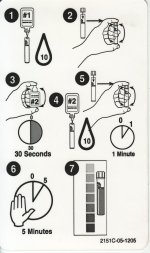
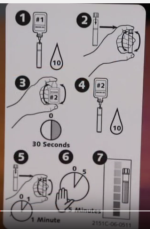
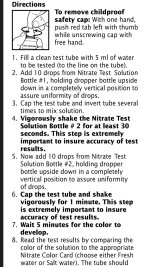
The step numbering differs between the written instructions and the card that has more of a flow diagram (which I suppose exists for small children to more easily perform tests on their goldfish tanks at home). Since the card was displayed in the video, I will align what was written above regarding the written instructions and the most critical steps involved with the card's simplified baby steps for people who find sentences scary.
Written instruction: step 4 = card: step 3
Written instruction: step 6 = card: step 5
Written instruction: step 7 = card: step 6
I have included the written instructions and two iterations of the card with this message.
I would have simply said to subtract 1 from each written instruction step when aligning with the card flow diagram steps, but we have already established that
someone has great difficulty working with numbers.
I do not care if the water quality is good or not, but watching that video was saddening from a technical perspective.
Others have added their thoughts on the person being addressed in the video and their opinions on whether or not that was considered appropriate.
This is simply another piece of the topic pertaining to the subject. In short, ineptitude.




 you off" really only publicly displayed how much of an insecure little boy you are. I believe you referenced you could have been an engineer or something to that degree if you really wanted to, but this is what you love to do (in the video). Ironically I am a 26 y/o white male as well, with my doctorate. I can assure you, if you are not intelligent enough to comprehend publicly bashing a minor on social media is wrong and disgusting, you would have a really hard time digesting more difficult information. With all the suicides caused by cyber bullying, and bullying in general you should be ashamed of yourself.