• Responding to email notices you receive.
    **************************************************
    In short, DON'T! Email notices are to ONLY alert you of a reply to your private message or your ad on this site. Replying to the email just wastes your time as it goes NOWHERE, and probably pisses off the person you thought you replied to when they think you just ignored them. So instead of complaining to me about your messages not being replied to from this site via email, please READ that email notice that plainly states what you need to do in order to reply to who you are trying to converse with.

  • IMPORTANT! PLEASE READ!! About the Google Adsense ads being displayed

    =====================
    Posted 08/15/2025
    =====================


    Yeah, I know. They are a pain in the butt. But they pay the bills to keep my server running. Just a fact of life, I am afraid.

    Want to get rid of them? Simple. Just become a Contributor level member or above and they will be gone. -> Please click HERE."

    Is that too much for me to ask of you to keep this site running? Well, sorry about that. I too wish I could get everything for free. But alas.....

    =====================
    Addendum: 01/10/2026
    =====================


    Google Adsense ad revenue for December, 2025 was just $30 over the cost of the lease for the server running this site. So, in effect, the money providing the incentive for me to continue running this site is coming SOLELY from the paid memberships and sponsorships here. Which honestly ain't much....

Blood gene question

wvaherp

New member
Joined
Dec 9, 2016
Messages
490
Reaction score
11
Points
0
Location
Reedsville WV
So my wife and I went to a reptile expo over the weekend and even though I was only intending to look at some caging offered by a vendor there, I ended up having one of the other vendors there offer me a deal on a pair of boas that were supposed to be het for plasma that I couldn't refuse. Unfortunately, I wasn't thinking of the correct combination in regards to "plasma", so I didn't realize that hypo was one that was needed for this, and neither animal appears hypomelanistic in any way. Of course I realized this after looking into combinations that include the blood gene once I got home. This, in and of itself, doesn't bother me too much, as the one that was sold to me as the male in this pair seems to me to be a somewhat dark visual blood. The pair definitely appears to have some sort of central American influence to me, with the attitudes and mouths to match, so that does seem to line up, but given that there's no way they could be het for what they were marked as and the fact that I've only seen bloods online, I'm curious about what else they may have been incorrect about. For the deal I got on them, I'm not extremely worried if I was totally taken for a ride, but I still wonder... Once they have settled in a bit more and hopefully de-stressed I will add photos to this thread so others can chime in with their opinions on what they see, but I'd prefer to leave these two to relax for a while before messing with them that much. Especially since I just treated them for mites yesterday (along with the rest of my collection) after finding they brought them into my home for the first time in 11 years of keeping snakes...

For now, I was wondering if anyone has seen or has a decent description of the phenotype of the blood gene? I've spent a decent amount of time searching on multiple sites, but have yet to find what seems to be a solid description of it (if one even exists), or if any surefire markers besides the coloration for this gene are known.

I tried to get the guy I bought them from to send me pictures of their parents, but he has yet to do that for me (which probably isn't helping my suspicions).


Thanks in advance for any help you can provide!
 
Check out Vin Russo website. He has a lot of good knowledge on there about boas. Good luck with them.

Chris
Bandspythons/facebook
 
I tried to get the guy I bought them from to send me pictures of their parents, but he has yet to do that for me (which probably isn't helping my suspicions).
Did the seller claim he produced the snakes? A lot of them buy babies to flip so he wouldn't have the parents.
 
Blood is a recessive color gene that intensifies red.
Pretty good description of it here: http://www.blumenboas.com/boamorphs.htm

I hope you'll share some photos of the babies, hypo can look dark in CAs. If they are not visual hypo maybe they only carry the blood and type 2 anery?
I'm sure it's frustrating not being sure what you got it what they were sold as
:(
 
I think plasma is anery hypo blood. I could be mistaken, but I think if both boas are normal in appearance (not hypo) than you wouldn't make plasmas. Could you post pics of both parents? Some CA hypos are pretty dark.
 
I did some digging and the plasma boas I found were all described as Type II anery, so I guess that makes a difference as well.

I'll wait for the pictures.
 
Check out Vin Russo website. He has a lot of good knowledge on there about boas. Good luck with them.

Chris
Bandspythons/facebook

Thanks for the tip, Chris. I did read the small piece on his website about them when looking through what I could find on them. I do find a bit of similarity to what he describes, but given that I'm not sure of the purity of these ones, I was hoping for maybe a few other clues.


Did the seller claim he produced the snakes? A lot of them buy babies to flip so he wouldn't have the parents.

That is a good question. His wording made it sound like he produced them, but he didn't directly say he did. He specifically stated he had a couple others that were holdbacks. I can't remember hearing someone refer to cherry picked individuals from a batch they bought as holdbacks.


Blood is a recessive color gene that intensifies red.
Pretty good description of it here: http://www.blumenboas.com/boamorphs.htm

I hope you'll share some photos of the babies, hypo can look dark in CAs. If they are not visual hypo maybe they only carry the blood and type 2 anery?
I'm sure it's frustrating not being sure what you got it what they were sold as
:(

Thanks April. I did know the basics of what a blood was before buying them along with the method of inheritance. I was mainly curious if anyone knew if there were any other unique indicators that this gene produces. I really don't think there is any hypo influence on either animal. They both have a lot of black in their patterns. As far as the type II anery goes, all I can do is cross my fingers. I know it's supposed to be part of the equation for the combo they were claimed to be het for, but they both show too much color compared to the pictures I've been able to find of a type II. But yes, it is very frustrating. Even more frustrating than not noticing the mites before I bought them...


I think plasma is anery hypo blood. I could be mistaken, but I think if both boas are normal in appearance (not hypo) than you wouldn't make plasmas. Could you post pics of both parents? Some CA hypos are pretty dark.

That's exactly what I have read in multiple places. Given that the hypo gene is co-dominant, you would also be correct that if neither show it, they can't be het for plasma. That's part of my problem though. I haven't been able to get a response out of the "breeder" to see if he's got any pictures of them.


I did some digging and the plasma boas I found were all described as Type II anery, so I guess that makes a difference as well.

I'll wait for the pictures.

Once again, the same findings I made when looking into it a bit deeper. I guess I could say that at least they could be het for anery type II since I won't know that until I breed them. If I'm not mistaken, without the hypo gene, but with blood and type II, they would be het for pewter.

I'll probably get them out this weekend if it is sunny and get some good pictures with the wife's "real" camera. Maybe that way they'll come out reasonably accurate. I'm still letting them de-stress and allowing the NIX treatment in their tubs work on those mites. Thanks for that write up you've posted a couple times on here, BTW. It helped give me a better idea of how to do that treatment.
 
Yes, that's what I've read as well.

At least we all seem to be in agreement about the combination of genes required to produce that morph.

Now if I only had the right combo in mind or at least got past the "new critter jitters" enough to just google it before I closed the deal! lol!


I gotta say, though. If I had more money to spend at the show, I may have paid a pretty steep price for a subadult female ghost another vendor had. She was a total sweetheart and definitely had something else going on. Her sides had a nearly piebald/calico look that was about a third of the height of her body. I'm sure I could have talked him down a little, but the $700 sticker was a bit of a shocker! Honestly, if it was a male I would have probably broke out the credit card. I would love to pair something like that up with my female hypo when she grows up.
 
Yes, whenever you can get pics, I can easily identify if they are CA hypos. Though they might not be pure CA, with all the crosses around. Anery 2 comes from Nicaragua and blood from El Salvador, hypo from various places such as Nicaragua, Colombia and Panama. If neither of the animals you purchased are hypos, I would question the rest of the genetics as well.
 
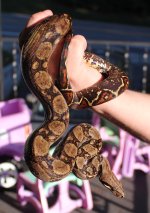
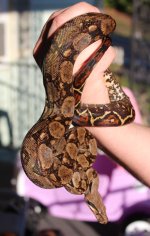
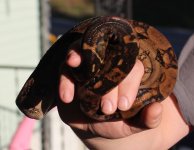
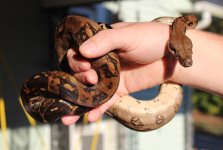
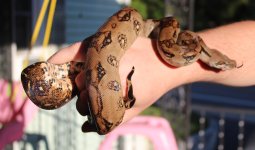
Here are a few "preview" shots I took with my phone of the "male." I use that term loosely because the pair was supposed to be from the same litter but this is the larger of the 2, with the much more prominent head, almost invisible spurs, and even though false negatives can happen with palpation or probing and "he" stays very tense, I feel no sign of hemipenes. I feel no hemipenes in the "female" either, but "she" has prominent spurs, less overall size, and a less prominent head compared to body size/length. I also know none of these things are necessarily absolute indicators of gender, but it does make me question the claimed genders at least as much as the genetics.

I'll be passing more photos of both from my wife's camera either tonight or tomorrow once we upload them to my pc.
b77632dd8642e812cf77887adb222b26.jpg
188803406a92af6bd595af4a2fdf08be.jpg
d0cb2f68af0f739b13d7667e2758af74.jpg
 
As promised, here are a few pictures of the "female" taken with a decent camera. The coloration is fairly accurate in these. Depending on the light, this one can appear a bit more grey in its background coloration. In afternoon sunlight it shows more of the brown tones you can see here.
 

Attachments

  • f1.jpg
    f1.jpg
    282.7 KB · Views: 92
  • f2.jpg
    f2.jpg
    233.8 KB · Views: 90
  • f3.jpg
    f3.jpg
    268.1 KB · Views: 93
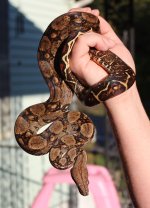
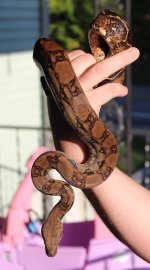
Here are some more pictures of the "male" taken with the same camera a few minutes later. Once again, the color is fairly accurate depending on the light you are looking at it in.
 

Attachments

  • m1.jpg
    m1.jpg
    192.1 KB · Views: 100
  • m2.jpg
    m2.jpg
    197.2 KB · Views: 96
  • m3.jpg
    m3.jpg
    180.7 KB · Views: 91
  • m4.jpg
    m4.jpg
    181.4 KB · Views: 94
Any comments as to what I've got here since I got the pictures posted? To me it does seem the "male" is definitely blood. Just browning out pretty well already. I have been continuing the mite treatment on them and have been avoiding handling them to help keep any stragglers from spreading to my other snakes, so I don't have any other pictures yet. I can take more if requested in a couple weeks when I start to handle them regularly, provided the mite treatment is successful. I plan on trying to handle them as much as they will tolerate a soon as I can since their temperament is terrible. I don't think I've ever kept or caught anything as vocal and testy as these two. Well... anything non-venomous that is. Last week after taking those pictures I had them in a couple totes out on my porch to feed them while I treated their tubs again and they were hissing and striking the sides of the smaller totes at me while I was about 15' away! It took them at least 30 minutes after being put back in their normal homes for them to calm down.
 
The animal in the picture is not a hypo, so it's not a het plasma (hypo het blood and anery type 2). If it is het pewter and the other animal is het plasma, they can still produce plasmas, but if both look like that, you won't get plasmas. Being dark like that does not mean the animal is 100% het blood, it just suggests that it is from a blood breeding, the blood boas having originated with dark El Salvadorean animals. It could just as easily be a 66% possible het from dark het parents, which means that it may not be a het at all. You won't know until you breed it it.
 
The animal in the picture is not a hypo, so it's not a het plasma (hypo het blood and anery type 2). If it is het pewter and the other animal is het plasma, they can still produce plasmas, but if both look like that, you won't get plasmas. Being dark like that does not mean the animal is 100% het blood, it just suggests that it is from a blood breeding, the blood boas having originated with dark El Salvadorean animals. It could just as easily be a 66% possible het from dark het parents, which means that it may not be a het at all. You won't know until you breed it it.
There are 2 animals pictured. Just in separate posts.

Do you not think that the one that I have posted as "male" appears to be a visual blood?
 
Ok, I see both posts now. I'm not sure if those are visual bloods, I thought all visual bloods had dark eyes. I can see that neither is hypo. So I don't think you can get plasmas, even if both parents are visual bloods. Final opinion: regardless of whether or not the animals are bloods or het blood, they aren't hypo so they can't produce plasmas. So they were misrepresented.
 
Ok, I see both posts now. I'm not sure if those are visual bloods, I thought all visual bloods had dark eyes. I can see that neither is hypo. So I don't think you can get plasmas, even if both parents are visual bloods. Final opinion: regardless of whether or not the animals are bloods or het blood, they aren't hypo so they can't produce plasmas. So they were misrepresented.
Thanks for confirming my suspicions on neither being hypo. There just too much black pigmentation.

On the matter of the eyes, I have read that as well. I can say that in the pictures "his" eyes appear a little lighter than in person, but "he" shed a few days after that. Honestly, I didn't even see "him" go through the blue phase, or I would have specified "he" was in shed. I just had them out today for another cleaning and mite treatment and noticed the eyes on that one are a pretty dark gray. It's quite striking in person after the shed. I wonder if it really is het for something else if that might be effecting them. I do still think "he" is probably blood, based on coloration.

The reason I repeatedly used quotes on the gender above is that I did confirm today that the lighter one is a male, even though it was sold to me as the female. I clearly felt the hemipenes roll under my finger during palpation 3 times in a row. I did not, however feel any sign of hemipenes with the darker one even though "he" was markedly more relaxed than the lighter one.

I was pleasantly surprised with their behavior today vs last time I had them out. The now confirmed male was still pretty flighty and did strike once, but no hissing at all from him. The darker one still showed that it was a bit nervous and tense, but barely showed any defensive body language and seemed to do very well with being handled a few minutes after I got it out. Still nowhere near as relaxed as my female hypo, but still a massive improvement. Hopefully this trend continues.
 
On the matter of the eyes, I have read that as well. I can say that in the pictures "his" eyes appear a little lighter than in person, but "he" shed a few days after that. Honestly, I didn't even see "him" go through the blue phase, or I would have specified "he" was in shed. I just had them out today for another cleaning and mite treatment and noticed the eyes on that one are a pretty dark gray. It's quite striking in person after the shed. I wonder if it really is het for something else if that might be effecting them. I do still think "he" is probably blood, based on coloration.

Looking at other pictures of blood boas, I can't find any where the eyes are as light as this one has, regardless of carrying other genes (whether co-dom, het for another recessive, or homozygous for another recessive). So who knows at this point. I know the closest thing I can find coloration wise is blood, which would make sense if the breeder wasn't completely full of it. I am excited to see how they turn out as they grow up and hopefully what they produce.
 
As someone who has bred blood boas, bloody hypos, plasmas, and pewters, I seriously question whether that male is a blood. He does have a sort of color wash on him and older bloods can wash out pretty badly and don't turn colorful. My biggest question is the eyes. Every blood boa that I have seen has almost unicolor dark eyes. I did an image search for blood boas just to get an idea of what you're talking about there and to see if my preconceived notion needed to be challenged and I saw a lot of animals that were not blood but did have a lot of color. Personally, if I were to make a statement, I would say that while he's interesting looking, he's not a blood.
 
Back
Top