• Responding to email notices you receive.
    **************************************************
    In short, DON'T! Email notices are to ONLY alert you of a reply to your private message or your ad on this site. Replying to the email just wastes your time as it goes NOWHERE, and probably pisses off the person you thought you replied to when they think you just ignored them. So instead of complaining to me about your messages not being replied to from this site via email, please READ that email notice that plainly states what you need to do in order to reply to who you are trying to converse with.

  • IMPORTANT! PLEASE READ!! About the Google Adsense ads being displayed

    =====================
    Posted 08/15/2025
    =====================


    Yeah, I know. They are a pain in the butt. But they pay the bills to keep my server running. Just a fact of life, I am afraid.

    Want to get rid of them? Simple. Just become a Contributor level member or above and they will be gone. -> Please click HERE."

    Is that too much for me to ask of you to keep this site running? Well, sorry about that. I too wish I could get everything for free. But alas.....

    =====================
    Addendum: 01/10/2026
    =====================


    Google Adsense ad revenue for December, 2025 was just $30 over the cost of the lease for the server running this site. So, in effect, the money providing the incentive for me to continue running this site is coming SOLELY from the paid memberships and sponsorships here. Which honestly ain't much....

Snake by way of dog

nickolasanastasiou

Moderator
Staff member
Staff
Endowment
Joined
Aug 7, 2006
Messages
3,762
Reaction score
564
Points
113
Location
Brooksville, FL
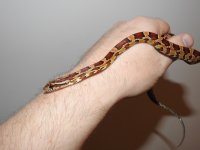
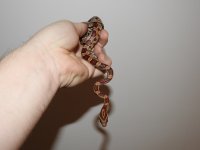
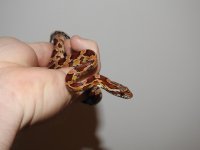
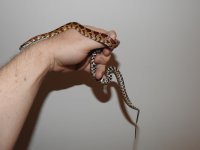
One of my dogs brought me this on Saturday night. Unharmed. My dogs are raised with all sorts of animals and they have proven themselves many times over as being especially gentle. My Vallhund brought his find to me in his mouth while I was inspecting the grounds. It was cold, so the corn (I assume a corn, as I do not work with Colubrids) was sluggish. I took a little time to introduce my other dogs to it so they would be at ease if finding another (we use "nice" and "baby" to signal them to be gentle with new animals). I held it and let it crawl on me for a couple of hours and then placed it in a heated hide for one of my tortoise project pens so it would have some warmth and could leave when it felt up to doing so (no tortoises were in there; they could easily harm the snake and a species I have in another pen has learned to catch and eat snakes).

Very pretty animal to me. This is fourth one I have seen here and I found the previous three on my own (on the front porch, climbing an elevated wire, and climbing a tortoise pen barrier). I am tempted to keep them, but I always let them go. They have lives to live and jobs to do.
 

Attachments

  • DSCN5204.jpg
    DSCN5204.jpg
    173.9 KB · Views: 609
  • DSCN5205.jpg
    DSCN5205.jpg
    208.6 KB · Views: 607
  • DSCN5207.jpg
    DSCN5207.jpg
    156.2 KB · Views: 607
  • DSCN5208.jpg
    DSCN5208.jpg
    149.7 KB · Views: 573
Haha, Robert, you twit!

That is a lovely corn snake, Nick! It does make me nervous that your dog would pick up a snake though especially given where you live, may be time to do some snake aversive training for him. If you need tips/tricks let me know, I live in south Georgia and trained my dog to avoid all snakes (which is a good thing, she found a large eastern diamondback rattlesnake last year).
 
The only dog/wild snake interaction I've had was firmly ordering a dog to stop shaking to death a large bullsnake he'd found. However, sighthounds are extremely game and kind of go crazy and don't listen to you when they've caught something. The snake did not survive. While saddened, I was a bit impressed that the bullsnake's size, loud threat display and copious biting did not faze the dog at all. I wasn't as knowledgeable about sighthounds at the time. I've now come to understanded that dogs who course and race at a competitive level need to be muzzled when walked because they are very tightly wound.
 
Interesting reading on snake training. Not sure it's worth the effort/possible psychological trauma to your dog. http://baddogsinc.com/rattlesnake-training/

"...there is no empirical data demonstrating that any current method of snake avoidance training is effective..."

"Other dogs may suffer severe emotional damage as a result of “snake-breaking”. The aversive (the shock) may become associated with something besides the intended the target (the snake). For instance, we’ve worked with dogs who became terrified of their leash, shrubs, the exact location where the shock was delivered, men with hats (the trainer was a man wearing a hat!). Since we don’t know what the dog is thinking about at the moment the shock happens, it can be a real crap-shoot about what the dog evaluates as the source of that threat.

In more than one dog, the fear response instilled was so intense as to drive the dog to panic. A panicked dog cannot make good decisions about his behavior. So a dog inclined to panic, upon encountering a snake, may run off, unable to respond to cues, and may also run headlong into another snake or nest of snakes."
 
It also really depends on the dog. The dog in my story was a game breed, not inclined to follow direction. I've worked with plenty of other dogs of breeds bred to be odediant (retriever, GSD) that would avoid any object, no matter how enticing, with a forceful "leave it" from the handler. Breeds meant to be directed by a handler will obey if trained properly, motivated by positive reinforcement from the handler; breeds meant to hunt independently (terrier, hound) are motivated by the game, not the handler.
 
My dogs have a significant role in the care, supervision, and protection of the outdoor reptiles I keep at home. I believe there are situations where aversion-oriented training would be useful, but I would be risking trade-offs that I consider to be elements of role and personality as things are. Some of my dogs bring me errant tortoise and turtle hatchlings as one example of the services they provide. They also rush off or alert me to perceived predators. The largest part is patrol and alert of troubles that involve tortoise behaviors themselves. If a dog can detect nesting, new burrowing activity (there is a flinging of dirt that the dogs get excited by), a flipping event, a territorial battle, or breeding, I am alerted often. The flip alerts have saved several tortoises and the digging alerts have prevented escapes. They also alert me to newcomers. Both intentional and unintentional. I use some spacious pens. They are not fancy or pretty by design (more like functionally industrial), but they tend to look lush during some portions of the year thanks to plant growth and the large areas the pens cover. I get many visiting creatures. Wild gopher tortoises live on the property and on adjacent sections of land (outside of the pens) and Florida box turtles visit every now and then. When one of these comes to the pens (for food, mates, battles, or perhaps wandering), the dogs let me know there is something new present. They also let me know when there is a new tortoise added even though I am the person who added it. After about three days, the dogs settle in with the idea that the new animals belong there.

My oldest female corgi will bring me hatchling tortoises that have either escaped their primary confines (the first barrier) or if she finds them hatching and emerging from a nest I have missed. My Vallhund will bring me snakes and lizards (anoles and skinks) when they are too sluggish to flee. My "cowboy corgi" and Vallhund will spearhead the alerts. Their son's role is as of yet undefined, but he has been providing a variety of alerts that apes some from each parent. The older corgi cannot be bothered with alerts these days.

I have partnered projects as well and at least one dog at one site offers some protective benefit (and both dogs at that site have had some habituation to both the project-related reptiles and some non-project-oriented wildlife).

I selected breeds and a mix (and in one case created a mix) that were directed towards interaction with our animals both great and small. Raising each from a tiny puppy, they have been repeatedly introduced and habituated to a wide variety of animals. While I certainly would not want them to become harmed by some forms of wildlife, I think I kind of have to accept the risks along with the benefits I have mentioned or risk losing some elements. Back when we had small parrot types while living in the Midwest, the birds used the corgi as a taxi from room to room and she would also try to nurse baby rabbits that she would find. I want them to be safe, but I am also very hesitant to dilute or remove anything that I perceive as conditionally positive from their behavioral identities. I have come to accept the bad with the good.
 
This is fascinating, you must have put a great deal into your dogs' training.

Here, trained dogs are being used to locate invasive iguana and endangered endemic seabird nests (burrows). It's such specialised work, but the dogs (generally labradors) seen to be very much able to do the tasks.
 
This is fascinating, you must have put a great deal into your dogs' training.

Here, trained dogs are being used to locate invasive iguana and endangered endemic seabird nests (burrows). It's such specialised work, but the dogs (generally labradors) seen to be very much able to do the tasks.

I really am not particularly skilled or knowledgeable about training like that. Part of it seems to be the breeds selected as a base. Herding types that are suited for a wide range (very small farm animals up to cows). I really only teach two commands or trigger words. Nice and baby. Anything to be treated gently is a baby. If I want them to step the physical enthusiasm down, I tell them to be nice. My wife uses the same words, but sometimes she refers to a new dog toy as a baby from her habits when she had dogs as a kid and we need to make sure that word is not used for something these dogs are permitted to chew on a roughhouse with. For the tortoises, we introduce something around the size of an adult redfoot when the puppies we bought were small. Eight weeks, give or take. For the litter that was born here, I started getting the litter used to my human baby and some mild-mannered tortoises before their eyes were open. Familiarity of scent. I do not know if that has an effect or not, but it does not seem detrimental and might be beneficial. Whenever I worked with the tortoises, I let the pups sniff them. Light licking is okay. Intense sniffing is okay. If they get excited with the licking, we back them off and tell them "Nice!" with an elevated volume. Easier to get them used to things with a medium-sized tortoise. I do not allow them any access to hatchlings and small juveniles to start. When I feel they are ready, then they get progressively less restricted contact. My dogs have thrown dog toys at the larger tortoises and then looked confused when the tortoises did not throw them back.

Dogs are fascinating. Detection of various chemicals gives them a lot of applications beyond hug-beasts (but they are hug-beasts first to me).

Dogs are my first love so... Could I get you to pm me pics of your bunch? ��

I will send you a message after I finish up with some stuff tonight.
 
It's very cool, and even though you make it sound simple, I don"t know many others with such an organised system. :thumbsup:

Dogs' capabilities are so much more than many people think.
 
Last edited:
I really am not particularly skilled or knowledgeable about training like that. Part of it seems to be the breeds selected as a base. Herding types that are suited for a wide range (very small farm animals up to cows). I really only teach two commands or trigger words. Nice and baby. Anything to be treated gently is a baby. If I want them to step the physical enthusiasm down, I tell them to be nice. My wife uses the same words, but sometimes she refers to a new dog toy as a baby from her habits when she had dogs as a kid and we need to make sure that word is not used for something these dogs are permitted to chew on a roughhouse with. For the tortoises, we introduce something around the size of an adult redfoot when the puppies we bought were small. Eight weeks, give or take. For the litter that was born here, I started getting the litter used to my human baby and some mild-mannered tortoises before their eyes were open. Familiarity of scent. I do not know if that has an effect or not, but it does not seem detrimental and might be beneficial. Whenever I worked with the tortoises, I let the pups sniff them. Light licking is okay. Intense sniffing is okay. If they get excited with the licking, we back them off and tell them "Nice!" with an elevated volume. Easier to get them used to things with a medium-sized tortoise. I do not allow them any access to hatchlings and small juveniles to start. When I feel they are ready, then they get progressively less restricted contact. My dogs have thrown dog toys at the larger tortoises and then looked confused when the tortoises did not throw them back.

Dogs are fascinating. Detection of various chemicals gives them a lot of applications beyond hug-beasts (but they are hug-beasts first to me).


I will send you a message after I finish up with some stuff tonight.

I have read a few interesting articles somewhere about how exposing newborn puppies to different textures and positions increases development of their nervous system and makes them more well adjusted as adults, less likely to react adversely to new stimuli, so I would say it definitely has an effect. Cannot remember what it was called right now, "something" protocol lol
 
Also, one of my dogs is really indifferent about my other pets and the other one runs from newborn mice, but at least neither of them are a threat!
 
Also, one of my dogs is really indifferent about my other pets and the other one runs from newborn mice, but at least neither of them are a threat!

:rofl: I'm a dog lover too- my current 2 aren't entirely trustworthy but are well-supervised, but a few years back I had an Italian Greyhound that didn't fit the mold for 'hound' behavior. She came trotting toward me one day with a huge toad in her mouth that appeared dead. She laid it on the ground as I scolded her, only to find that it was "pretending death" and was actually unharmed. It got up and left without further molestation. :face_palm_02:

I do allow my dogs to sniff my pet snakes occasionally (while I hold them) & tell them to just "kissy". They do seem to know not to hurt them. In the yard might be another story though, especially for anything that moves fast. Around here, I have the occasional garter snake, but there is much ground cover so happily they get away. These dogs don't seem to care much about toads, thankfully and they were mystified when a large box turtle wandered in. They were a little afraid of it & I was glad, but I relocated it for safety out of my yard anyway.
 
Back
Top