• Responding to email notices you receive.
    **************************************************
    In short, DON'T! Email notices are to ONLY alert you of a reply to your private message or your ad on this site. Replying to the email just wastes your time as it goes NOWHERE, and probably pisses off the person you thought you replied to when they think you just ignored them. So instead of complaining to me about your messages not being replied to from this site via email, please READ that email notice that plainly states what you need to do in order to reply to who you are trying to converse with.

  • IMPORTANT! PLEASE READ!! About the Google Adsense ads being displayed

    =====================
    Posted 08/15/2025
    =====================


    Yeah, I know. They are a pain in the butt. But they pay the bills to keep my server running. Just a fact of life, I am afraid.

    Want to get rid of them? Simple. Just become a Contributor level member or above and they will be gone. -> Please click HERE."

    Is that too much for me to ask of you to keep this site running? Well, sorry about that. I too wish I could get everything for free. But alas.....

    =====================
    Addendum: 01/10/2026
    =====================


    Google Adsense ad revenue for December, 2025 was just $30 over the cost of the lease for the server running this site. So, in effect, the money providing the incentive for me to continue running this site is coming SOLELY from the paid memberships and sponsorships here. Which honestly ain't much....

Adopting a Sav

TrpnBils

Jeff Hankey
Joined
Mar 10, 2005
Messages
85
Reaction score
0
Points
0
Age
42
Location
Berkeley Springs, WV
So here I am, new to the world of monitors, but not to reptiles, and I'd like some advice. I've searched this forum and read up as much as I could, so that's a start at least.

My aunt is having me take this monitor because I guess my cousin ended up in drug rehab for an indefinite amount of time. Apparently it's about 12" long and she says she thinks it's about a year and a half or two years old. Does that seem small? I obviously wouldn't know, but it just seems like it should be bigger than that at 2 years old. It hasn't been on any kind of regular feeding schedule though and he's been giving it one mouse (don't know which size) per week (or so). I guess it's not eating right now, but I'm not sure how long that's been going on. I'm hoping maybe the irregular schedule has something to do with that. It's a little aggressive too, but it's still young so I'm not real worried about that.

I won't be able to get it from her for probably 2 weeks because of how far away we live from each other, but I convinced my aunt to at least change the bedding when necessary and to try to feed it.

I'm aware of the size requirements and possible damage (to me and my belongings) by the claws and all that. A little background on my experience. I keep colubrids, so most of my personal experience is with snakes, although I have had smaller lizards in the past. I'm also a part-time keeper at the local zoo, dealing mostly with the reptiles. Everything from Tokays to gators to large boids, so I'm experienced with how to handle aggressive or dangerous reptiles somewhat. I figure if nothing else, I can just use my gator-handling skills with this guy... :hehe:

Any help is very much appreciated, and I'll keep you posted on how this goes.
 
I would not say it is too small, the Spiny Tail Monitor is one of the smallest and only reaches a max length of under 2 feet. A good website on them is:

http://www.pythonpete.com/info/ackieinf.htm

Let us know how it goes. Hopefully this websight will help. Until it is seen it sure is hard to figure out what you will be getting. You do have quite the skills and for a small monitor I am sure you will be able to keep it from eating you. :cool:
 
I'd say it's small for 1 1/2 to 2 years old. I've seen them that big at six months. Have you seen it yet? If it's well fed you'll see the thick tail like with gators. They are cool critters though. I remember the first one I picked up from this kid going off to college. The first time I fed it, it was mashing the prey into the ground, crunching bones and gulp. :eatsmiley I was like, "why didn't I get one of these before this?" They are good garbage disposals when one of your other reptiles doesn't eat due to shedding.
 
First I'd make sure it is a Savannah or check the age. Like David said it is easy to get them to that size very quickly. Maybe it's not a Savannah or maybe it has just been under fed. If you are sure it is a Savannah start feeding it, disposals they are! It's pretty neat to watch my big ones chase and catch the crickets, big lizard, little bug.We feed crickets or roaches every day, mice usually twice a week and let them gorge, eat all they want, usually once a week either on mice or peeps. Make sure he has good heat and plenty of hiding places. Enough substrate to borough in would be a big plus.
 
I agree

It sounds small, to me, for the supposed age. First thing you want to do is get your enclosure ready - figure out what you will be keeping him in, how you will heat it, substrate, etc. Personally, I feel that many people go too low with the temperatures on their monitors...and given the description (of size, feeding schedule, and current nonfeeding status), I'd guess that to be the case. For acclimation and rehabilitation, I would just set him up in an aquarium with a screen top (if you are planning to use something else, let me know - there may be ways to adapt things to work well). For temperatures, I would initially keep the range high...the "cool" side around 85 degrees. there should be a basking area with a temp of 110-115 degrees - as an example, I used to use 100w ceramic heat emitters on 20g aquariums, and 150w on 30g. Once he is eating and growing, you can mess with nighttime drops and/or slightly lower temps, but for now - hot is good.
Feedings should be on the smallish side, but frequent. Monitors are extremely opportunistic, and will eat when they can. Yes, they will gorge themselves... but it is better to go with smaller meals. Babies and very young should be fed almost every day, with slightly decreasing frequency as they get bigger. twice weekly as adults. Again, your goal is not to feed him to capacity each time - that will just get him fat. Without seeing this particular monitor, or at least a pic with a good size reference, I can't really guide you on prey items or amounts per feeding.
Keep handling to a minimum, initially. For monitors, not eating should be considered a bad sign - either the conditions are way off, or they have become ill...BOTH, is the most likely answer. luckily, they are pretty hearty critters, and can bounce back from alot. get the set up right, and minimize stress. Also, get back to us once you have it...esp if there is something that doesn't look right.
 
Junkyard said:
I would not say it is too small, the Spiny Tail Monitor is one of the smallest and only reaches a max length of under 2 feet. A good website on them is:

http://www.pythonpete.com/info/ackieinf.htm

Let us know how it goes. Hopefully this websight will help. Until it is seen it sure is hard to figure out what you will be getting. You do have quite the skills and for a small monitor I am sure you will be able to keep it from eating you. :cool:


First of all, sorry I didn't reply to anybody yet. I'm a regular over on Faunaclassified's Corn Snake forum and I thought that it was just the email notifications over there that didn't work. Apparently I was wrong though because I've yet to get one for this thread even though I subscribed to it.

Anyway, I'm confused. Unless Spiny tail monitors are the same thing as Savannahs (I'm not being sarcastic, they could very well be and I wouldn't know it...lol) then we're talking about two different animals. I've been told that Savs should be around 2-3 feet at two years old. Is that right?
 
TrpnBils said:
Anyway, I'm confused. Unless Spiny tail monitors are the same thing as Savannahs (I'm not being sarcastic, they could very well be and I wouldn't know it...lol) then we're talking about two different animals. I've been told that Savs should be around 2-3 feet at two years old. Is that right?
no, you're not confused. spiny tails and ackies are very different from Savannahs. different sizes, different appearance. Savannahs get bigger, and grow faster. And the size you mentioned 2 feet is very attainable by 2 yrs of age. when you get it, check some pics online to verify that it is, in fact, a savannah. the only monitors you might confuse it with would be whitethroats and blackthroats (which at one time were considered subspecies of V. exanthematicus). if you have a problem with identification, let me know...I can probably help you out.
 
hhmoore said:
It sounds small, to me, for the supposed age. First thing you want to do is get your enclosure ready - figure out what you will be keeping him in, how you will heat it, substrate, etc. Personally, I feel that many people go too low with the temperatures on their monitors...and given the description (of size, feeding schedule, and current nonfeeding status), I'd guess that to be the case. For acclimation and rehabilitation, I would just set him up in an aquarium with a screen top (if you are planning to use something else, let me know - there may be ways to adapt things to work well). For temperatures, I would initially keep the range high...the "cool" side around 85 degrees. there should be a basking area with a temp of 110-115 degrees - as an example, I used to use 100w ceramic heat emitters on 20g aquariums, and 150w on 30g. Once he is eating and growing, you can mess with nighttime drops and/or slightly lower temps, but for now - hot is good.
Feedings should be on the smallish side, but frequent. Monitors are extremely opportunistic, and will eat when they can. Yes, they will gorge themselves... but it is better to go with smaller meals. Babies and very young should be fed almost every day, with slightly decreasing frequency as they get bigger. twice weekly as adults. Again, your goal is not to feed him to capacity each time - that will just get him fat. Without seeing this particular monitor, or at least a pic with a good size reference, I can't really guide you on prey items or amounts per feeding.
Keep handling to a minimum, initially. For monitors, not eating should be considered a bad sign - either the conditions are way off, or they have become ill...BOTH, is the most likely answer. luckily, they are pretty hearty critters, and can bounce back from alot. get the set up right, and minimize stress. Also, get back to us once you have it...esp if there is something that doesn't look right.


Okay, where to start....

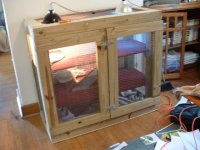
Housing - he's got it in a 20L right now, but I'm getting a 4x2x4 cage off of Ptdsnr on the cornsnake forum (see picture below - hope she doesn't mind me posting it). She kept an adult Sav in it and said it worked out real well. As far as what else I know I have at my disposal right now, there's some sort of heat lamp. I don't know if it's an infrared or white lamp, or if it's even strong enough to use in a bigger cage like this.

Food - I keep finding conflicting advice from people who have successfully kept and bred savs. Some say that it's possible to feed an adult sav inverts with the occasional mouse thrown in, others say to go with strictly rodents. I talked to my aunt last night and she said that my cousin was terrible at keeping on a schedule with this lizard (which could also account for the 5 uromastyx he's killed in recent years). She said it was being offered one mouse (don't know what size) per week, and that it hasn't been eating lately. I'm going to try to find out exactly what "lately" means next time I talk to her (hopefully tonight).

Health - I'm also going to ask her to get pictures of it so I can take a look at the tail/pelvic region. I'm expecting it to be very thin, expecting it to have parasites possibly, and expecting it to have other health problems when I get it. As a result, I'm looking for a herp vet up this way (Erie, PA) so I can at least get a fecal done soon. At the very least, I can always ask the zoo vet to do one for me. As far as age is concerned, I'm not real sure. It's at least a year old because my cousin moved back in with my aunt a year ago and he had it then. She said he had it for awhile before he moved back, but it's no older than 2 years.

Temps - I'm guessing he's kept them low based on the size of this lizard (if it's even a Sav - I never even considered misidentification until reading your replies here), and the deaths of his uromastyx. I doubt he even measured temps at all, because I know damn well he didn't do any research. I can remember him asking me for advice on his uros a couple of years ago. I've never kept them in my life and I was still more knowledgeable than he was about them. I'm going to get a probe thermometer before he arrives and get the whole cage set up (Sunday hopefully).

Lighting - I see that some people use UVB lighting and others don't. I've found "scientific" papers showing evidence for both schools of thought. Any input on this?

Hides/Water - I don't know what he's been using for either, but I'm expecting it to be dehydrated at least a little because the cage was apparently very rarely cleaned, so that's my first priority when the lizard gets here. I'm going to get a litter box for water on the bottom of the cage, and other various things for hides. If he (she?) is in fact dehydrated, would a moist hide be beneficial or just overkill with the water too?

I'll keep you all posted, and hopefully I'll start getting email notifications with this thread so I don't overlook it again. As soon as I can get pictures either by myself or through my aunt, I'll post them here so hopefully you all can tell me whether or not it's a Sav. I'm not experienced enough with the monitors to know the differences easily just through looking at pictures.

In the meantime, thanks for the help so far, and here's the cage picture I mentioned before. If uses AIM, my screen name is the same as my username on here.

- Jeff -
 

Attachments

  • 052905f.JPG
    052905f.JPG
    110.9 KB · Views: 120
A couple corrections/clarifications:

it's kept in a 20 Gallon-Long aquarium at their house right now, that 20L doesn't mean 20 liter!

If it has been eating mice so far, is it generally easy/okay to switch it back to inverts while it's still this small?
 
Jeff,

Everything that I have read and heard says additional UV is unnecessary for monitors. An adult Sav is going to be around four feet (or more) in total length, of which the tail will be about 60%. 4x2 feet of floor space may turn out to be too little. Time will tell. It's more than enough for a 12 inch animal and should be for awhile anyway.

A moist hide may be overkill. Give him/her a good soaking and plenty of water and dehydration will correct itself.

Heat, heat, heat and lots of it. They like it hot.

As for diet, I agree, they are opportunistic eaters and will eat anything they are offered. At this size I would think that insects would form the bulk of their diet. As they get larger they will need more vertebrate prey. I also give my monitors scrambled eggs and ground turkey. They may also accept high quality canned cat food.
 
until you get the little guy going strong, I would be inclined to keep him in the 20L tank. easy to heat to desired temps, and the crickets and superworms won't get out (*bonus*). At 12 inches, they will be the bulk of the diet (as has been stated), but I would try to get some animal protein in there, as well.
I never used UV lighting for savannahs, and I don't feel it is necessary.
As for water/dehydration. AVOID the use of a moist hide. High humidity and/or wet conditions cause problems for savannah monitors. let it soak for a while when you bring it home, then just include a bowl for drinking in the cage. periodic soaks are ok, and may be enjoyed, but keep in mind that savannahs are not like many other monitors - they aren't graceful in the water, and are not particulary good swimmers - keep the water shallow!!
 
hhmoore said:
no, you're not confused. spiny tails and ackies are very different from Savannahs. different sizes, different appearance. Savannahs get bigger, and grow faster. And the size you mentioned 2 feet is very attainable by 2 yrs of age. when you get it, check some pics online to verify that it is, in fact, a savannah. the only monitors you might confuse it with would be whitethroats and blackthroats (which at one time were considered subspecies of V. exanthematicus). if you have a problem with identification, let me know...I can probably help you out.

Stupid question: Are ackies, spiny-tailed, and ridge-tailed monitors the same thing? I keep finding those names being used interchangeably. I'm almost hoping it's not a Savannah at this point since it's that small at that age. I emailed my aunt about 6:00 and asked for some pictures, so I'm waiting to hear back from her.
 
TrpnBils said:
Stupid question: Are ackies, spiny-tailed, and ridge-tailed monitors the same thing? I keep finding those names being used interchangeably. I'm almost hoping it's not a Savannah at this point since it's that small at that age. I emailed my aunt about 6:00 and asked for some pictures, so I'm waiting to hear back from her.
Not stupid at all - V. acanthurus (ackies) are commonly called both spiny tailed and ridge tailed monitors. I apologize for any confusion caused by my previous post...it should have read
spiny tails (or ackies)
 
Alright, that makes more sense then. I wasn't finding much information on Spiny-tailed monitors last night, so this helps me out some. It seems to me that aside from the size of prey items offered, the basic husbandry of all of these monitors is pretty much the same, right? If it is an ackie, he's going to have ample room to move around, as I'm probably going to get this cage before I actually get the lizard...lol.

My aunt emailed me last night and she doesn't have a digital camera, but she said she'd try to borrow one to get me some pictures. I'm completely off today (from class AND work, which is a rare thing for me), so if I hear from her early enough, I'm going to make the 3 hour drive to get it myself tonight, rather than wait to meet her halfway like we were talking about the other night. Since my cousin is out of the picture now, I'm not even sure that this guy is even getting fresh water anymore, so the sooner I can get it, the better I'll feel. And I'll feel a lot better when I can find out what species it is for sure, because I'll have a lot of work ahead of me if it's a Sav and it's as small as she says (and the age is right).

I was talking to the other reptile guy from the zoo last night. He's kept all kinds of herps over the years, including Savs and a few other kinds of monitors. He said that it would be in my best interest to vary the diet (when it's an adult anyway) and not stick to just rodents. But he also told me that it would be okay if I could get him started on a carnivore diet (T-Rex was the brand name he mentioned). Anybody else have any thoughts on this approach? I'll admit, that sounds easier than 1000 crickets a week...
 
TrpnBils said:
Alright, that makes more sense then. I wasn't finding much information on Spiny-tailed monitors last night, so this helps me out some. It seems to me that aside from the size of prey items offered, the basic husbandry of all of these monitors is pretty much the same, right?
There are some small differences in husbandry between various monitor species - high end temps, diet, humidity, preferred substrates, cage furnishings, etc - but the description I initially gave is a good basic model to follow. Again, as soon as you can verify the species, we can make whatever changes are necessary to the housing and care plan.

TrpnBils said:
I was talking to the other reptile guy from the zoo last night. He's kept all kinds of herps over the years, including Savs and a few other kinds of monitors. He said that it would be in my best interest to vary the diet (when it's an adult anyway) and not stick to just rodents. But he also told me that it would be okay if I could get him started on a carnivore diet (T-Rex was the brand name he mentioned). Anybody else have any thoughts on this approach? I'll admit, that sounds easier than 1000 crickets a week...
I have not used any of the commercial diets, so I cannot comment on them. you can OCCASIONALLY supplement a rodent diet with fish, egg, ground or chopped meat, high quality canned dog/cat food (I recall that one of these was less desirable, but not which one - sorry). you can also add chicks and vary the rodents offered, as well as including invertebrate prey. An adult savannah will still eat bugs (and the act of catching them will get his lazy butt moving, lol), so crickets, superworms, roaches, etc are all acceptable additions.
 
hhmoore said:
you can OCCASIONALLY supplement a rodent diet with fish, egg, ground or chopped meat, high quality canned dog/cat food (I recall that one of these was less desirable, but not which one - sorry).

That'd be cat food - too high in fat from what I've read.
 
TrpnBils said:
That'd be cat food - too high in fat from what I've read.
Don't believe everything you've read. LOL. Cats, like most all monitors, are obligate carnivores. Cat food, if they will take it, is fine.

The cat food that I use for mine is "Pro-Plan Adult Indoor Cat Formula Turkey and Liver" which has:
Crude Protein (min) 12.0%, Crude Fat (min) 2.0%, Crude Fiber (max) 2.0%, Moisture (max) 78.0%

The wet dog food that I use as a supplement to my dogs' dry food is "Nutro Natural Choice" and has:
Crude Protein (min) 8.5%, Crude Fat (min) 7.0%, Crude Fiber (max) 1.0%, and Moisture (max) 78.0%
Canned cat foods are, I believe, in general, higher in protein and lower in fat than canned dog foods. I offer my monitors canned cat food occasionally. Some eat it avidly, some could care less. I suggest that whatever you buy, get it in small cans.
 
Water

There's been some discussion about this over on the corn forum lately, and nobody's come to any kind of a conclusion about it.

Water.

I live in the city, so I know there's chlorine, etc, in my water. Is it safe to used untreated water for a monitor? I've been thinking about this, and although I don't know for sure, I would imagine that we have city water at the zoo as well since we're pretty much right downtown and we go through a LOT of water each day. We don't treat it with anything and we routinely mist, water, and soak our reptiles/amphibians in it with no ill effects.

Thoughts?
 
I use untreated (tap)water for everything but my amphibians. The only time I don't is when there is a quality issue (local breaks, discoloration, etc), in which case I just grab a bottle of spring water for those in need of a drink.
 
awesome... I use bottled for my cornsnake, but we're talking about a substantial difference in the volume of water that a corn goes through in a week and what a sav goes through in a week...lol
 
Back
Top