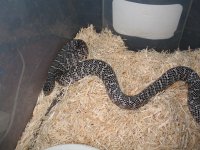
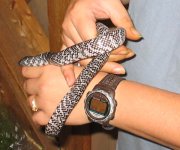
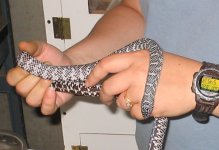
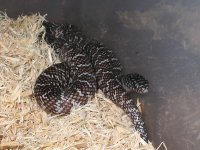
Kari,...... I know this is a fairly old post, but after reading it, it reminded me of some of the same genetic questions that I was pondering some time ago, not neccessarily just for the Florida King, but many other snakes as well,(mostly Hondurans). I have tried to understand as much as possible about snake genetics, and it can be very complicated at times. In any case, for what it's worth, here are some things you,and other readers might find useful........The cells that make up the colors that we see in reptiles are called "chromatophores", the pigment cells that are responsible for red and yellow pigment are known as "xanthophores", even though "xanthos" is a greek term meaning "yellow". The red and yellow pigments are called "pteridines". These may vary in color from pure yellow, to pure red, as well as intermediate shades thereof. Xanthophores that possess a predominately red coloration are referred to as "erythrophores" (thus, the term "an-erythristic for a reptile totally lacking red).Given this, I think the term "hypoerythristic" probably better defines what we have all been calling the "anerythristic" Honduran for years, and other snakes as well........."xanthophores" also appear to retain some yellow, to reddish coloration contained in the diet in the form of "carotenoids", like you see in some snakes, for example "snow corns", "ghost corns", ect....ect.....especially along the neck area. ......the animals genetic predisposition for the ability to store carotenoids, will of course vary in certain animals. ..........We wont even get into the blacks, blues, and greens, since you were mostly concerned with the red, and yellow............And YES!, like I said before, it can be quite complicated at times. I certainly don't consider myself a genetics expert, but just want to understand a little more about what I raise and breed........In short, after you read this,"axanthic" just might be a more defining term for your Fl. King.........I certainly am not trying to turn everything in the herping world upside down, just merely sharing some information that might help someone out.........Now that I have confused you as much as I sometimes get with genetics,.......I hope some of this helped out...............................D. Mong