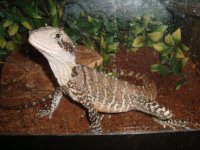
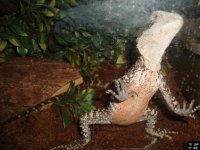
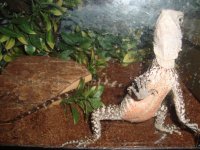
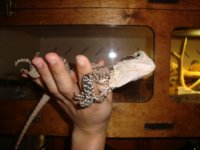
My Australian water dragon looked almost the same as yours. But he/she was a year older, and I started to notice the body was beginning to turn a turquoise color with each shed. It was the most unique Australian water dragon I had ever seen. I was so confused, because the vet had said my water dragon was a male, and a hemipenis was sort of visible. But my water dragon looked completely different from my two males. My males have a gray/black coloration and have the dark red stomachs. The "female" however, reached 3 years old and never laid eggs, and the vet said that she was not carrying any last year around breeding time and that all she felt were "fat pads" on the stomach. I was going crazy because I had never seen another Australian water dragon like it, male or female. But I just realized something... The Australian water dragon has 2 subspecies. Physignathus Leseurii and P.I. Howitti. My water dragon showed traits of BOTH subspecies! I now believe that I had a hybrid male. Nothing else explains it. I'm still kind of blown away as I literally researched and came up with this theory a few hours ago. I believe that Agama International aquired a Gippsland Water Dragon at some point that had bred with the Physignathus Leseurii, as I have started to see more "mystery" Australian water dragons like mine and yours that are traced back to Agama International. I have not been able to find any that have lived to be older than mine yet. Mine was 3 years old and was determined to be a female, but never had an infertile clutch. When placed the "female" with my Physignathus Leseurii male last year, they fought and the "hybrid" became stressed and hid from the male, so I seperated them and didn't attempt to breed them again. A year passed. My water dragon started to become weak and listless over the past few months, but there was no medical explanation. The vet treated for parasites and said that it just seemed to be a "lazy" water dragon. But it only got worse until finally Wayne died this Sunday. I've been driving myself crazy trying to figure out what it was that killed my water dragon. And nothing make sense. My other 2 males (That look like normal Physignathus Leseurii males) are happy and healthy, and were kept in the same conditions as the "female". Now I'm wondering if the fact that it may have been a hybrid has anything to do with it. It would certainly explain why it had all male characteristics (such as enlarged crest, larger jowls, apparent hemipenis, and the overall body structure of a male) but had a completely different coloration. I feel like I'll never know the answer for sure, but I'm wondering if you also have a "hybrid". Your water dragon is the only one that even remotely looks like mine did with that same orange stomach and the lighter coloration, so I wonder if they were siblings from the Physignathus Leseurii and Gippsland Water Dragon.