• Responding to email notices you receive.
    **************************************************
    In short, DON'T! Email notices are to ONLY alert you of a reply to your private message or your ad on this site. Replying to the email just wastes your time as it goes NOWHERE, and probably pisses off the person you thought you replied to when they think you just ignored them. So instead of complaining to me about your messages not being replied to from this site via email, please READ that email notice that plainly states what you need to do in order to reply to who you are trying to converse with.

  • IMPORTANT! PLEASE READ!! About the Google Adsense ads being displayed

    =====================
    Posted 08/15/2025
    =====================


    Yeah, I know. They are a pain in the butt. But they pay the bills to keep my server running. Just a fact of life, I am afraid.

    Want to get rid of them? Simple. Just become a Contributor level member or above and they will be gone. -> Please click HERE."

    Is that too much for me to ask of you to keep this site running? Well, sorry about that. I too wish I could get everything for free. But alas.....

    =====================
    Addendum: 01/10/2026
    =====================


    Google Adsense ad revenue for December, 2025 was just $30 over the cost of the lease for the server running this site. So, in effect, the money providing the incentive for me to continue running this site is coming SOLELY from the paid memberships and sponsorships here. Which honestly ain't much....

Central American Boa - Need Suggestions

Zack319

New member
Joined
Jan 9, 2009
Messages
144
Reaction score
8
Points
0
Location
Amherst, New York
Hi Fauna, I'm very new here, and I've come here looking for some advice.

I recently obtained a 7 1/2 ft male Central American. I've been told he his around 3-4 years old, and was a rescue, and had been not fed properly, and was housed in a rabbit cage. I was also told when the people I got him from rescued him, he was skin and bones, and is still very thin, and malnourished.

I took him to the local Pet Store, and they said he looks very good, though malnourished, on parasites from what they saw, or I have scene.

He is very curious and docile, has not yet tried to strike at me or anything like that. He is feeding on Jumbo Rats, and the pet store told me to give him as many as he'll eat until he gets to the size / weight he should be.

I got him last night from the show in PA, drove him home to Buffalo, NY. Got him in his setup, which isn't much yet, other then a basking lamp, with 150 watt bulb, a large hide spot, and a heating pad from Rite Ade. He's in a 75 until I get him a custom built one.

The next day or today, I woke up, thawed out a Jumbo, and he took it with no problem. I then went to work, got another Jumbo and he took that with no problem.

I don't want to over feed him, the pet store told me to give him as many as possible, and even recommended two or three at a time, but I want to make sure that's alright to do.

I will provide some pictures shortly, and I'm just looking for some comments and suggestions on what I can do to better his life.

Thank you.

Zack.

I do not want to
 
I took him to the local Pet Store, and they said he looks very good, though malnourished, NO parasites from what they saw, or I have scene.

Figured I would fix that ahead of time.

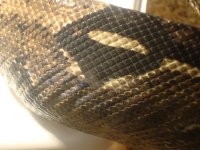
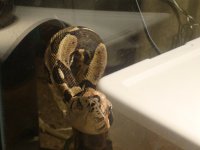
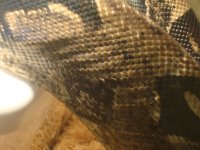
These pictures don't do him really any justice. Tomorrow I will upload some others, he just finished eating, and its dark. I'll try and get some better ones tomorrow during the day time.
 

Attachments

  • DSC00150.jpg
    DSC00150.jpg
    139.7 KB · Views: 170
  • DSC00146.jpg
    DSC00146.jpg
    170.2 KB · Views: 171
  • DSC00154.jpg
    DSC00154.jpg
    112.3 KB · Views: 168
I took him to the local Pet Store, and they said he looks very good, though malnourished, no parasites from what they saw, or I have scene.

Parasites can be both external and internal. A good eyeballing can rule out external parasites like ticks and mites but diagnosing internal parasites requires a fecal exam.

I'd suggest getting one done as soon as possible, a malnourished animal is an immuno-compromised animal and even if internal parasites weren't the cause of his weight issues, some may have ended up becoming problematic in response to a lowered immune response.

He is very curious and docile, has not yet tried to strike at me or anything like that. He is feeding on Jumbo Rats, and the pet store told me to give him as many as he'll eat until he gets to the size / weight he should be.

That's poor advice.

When snakes eat, they don't really chew- the prey is swallowed whole and digested from the outside in, largely as a result of enzyme action. When a snake hasn't eaten for awhile, the enzyme production can be negatively impacted and they aren't physically capable of digesting as much as they normally could. Feeding them too much or too large a prey item when they are coming off a period where they haven't eaten can cause rotting food to pass, undigested, through their system or they will often simply regurgitate the meal within a couple days of taking it (generally that first night), which puts them even further behind on having a healthy digestive system.

Ease into it a little bit until you are positive that he's going to keep food down. More frequent feedings of fewer rats at a time will be better digested and turned into useful calories, while being less stressful on an already weakened system.

I got him last night from the show in PA, drove him home to Buffalo, NY. Got him in his setup, which isn't much yet, other then a basking lamp, with 150 watt bulb, a large hide spot, and a heating pad from Rite Ade. He's in a 75 until I get him a custom built one.

The physical specs are good to know but... what's the temperature at the warm end and the cool end? How are you measuring it? What are you using for substrate? What's the humidity? What are you using for hides?

I don't want to over feed him, the pet store told me to give him as many as possible, and even recommended two or three at a time, but I want to make sure that's alright to do.

If you knew more about his feeding habits and knew that he was healthy and well fed, it wouldn't be a problem. Coming from a position where his feeding records are unknown and there's a weight issue, I'd feed one at a time, spaced a couple days apart and see how he handles them to start. After he starts putting some weight on, you can think about adjusting that to a more convenient schedule.

If he's seven and a half feet, I'd start to question the gender too. Males can get that big but it's less usual than it is to see females that size.
 
I do plan on getting a fecal exam shortly. Thank you for telling me about how I should be feeding him, I will not start feeding him one rat every few days, and go from there.

The temperature has been 85 - the low 90's on the hot side, and 75 - 80 on the cool side.

I have two thermometers, one on each side of the enclosure *hot and cool*.

As for the humidity goes, I have not yet purchased a gauge to measure the humidity yet, but will tomorrow. I do mist the cage every morning.

As for the hide spot, I'm using a plastic container that he seems to like. I cut a whole into it, that's big enough for him to fit into, and burned all of the sharp angles / corners and everything around the whole. I put Aspen shavings in there with some moss in there, and mist that every morning as well.

As for the substrate on the rest of the enclosure, I am using Aspen shavings.

As for the snakes gender, the people I got him from told me he was a male, and 3 other people I know also have said he was a male.

The people I purchased him from said he was actually a Colombian, but after looking at some pictures, and listening to what others have said, I have come to believe its actually a Central American.

Once again, thank you for your advice. I want to make sure I can do as much for him as possible.

Is there anything else I should know ?
 
Got a full body shot? From what I can see, there is nothing wrong with that snakes weight. CA Boa tend to be a tad slimmer built then Colombians get. They also tend to stay a tad shorter. So if your guy is 7½ ft long, he's likely a mature adult and likely more then 4 yrs old. If he was malnourished, and he's still 7½ ft long, well, you get the idea. You don't grow normally under malnourished conditions,

I agree with Seamus too. Bad advice was given to you about feeding. Feeding them as much as they want will cause you more grief then you want to deal with. Even a malnourished Boa will put their weight back on with a normal feeding every couple weeks.

And a fecal exam is a must when taking in Boa of questionable upbringing. Like pointed out, when they get that far along, other things start happening internally. They can harbor certain micro organisms that their body keeps in check. But when they are malnourished, sick or otherwise unhealthy, then these naturally occurring organisms can get out of control and cause harm.
 
Some great advice has been offered in this thread already but I'll throw in my .02.

As far as feeding, I agree that you should bring him along slowly. If you overstuff him, he could start regurging, as Seamus pointed out, and that is absolutely no fun at all for either him or you. It will cause him further stress and it will take you a month or more to get him back on track to where he is holding down meals on a consistent basis.

Seems to me like 7.5 feet is kind of big for a CA, especially if it is a male as stated. So you could have either a cross or a Colombian, can't really guess based on the pics submitted so far. Male Colombians usually top out at around 8 feet. I would expect a CA male to be more in the 4 to 6ft range.
 
I would have to agree.... 7.5 is really big for a male CA boa..... 4-5 is more likely..... I would bank on him being Columbian.... CA boas are a hot item lately, unfortunately pple are trying to pass Columbians off as the. Not that there is anything wrong with having a Columbian....

I noticed his ribs showing on his sides..... Large boas tend to have quite a bit of muscle mass , so the ribs shouldnt show like that... I would get the fecal done..... just to make sure.... after you get him eating on a schedule he should put on weight no prob
 
I would have to agree.... 7.5 is really big for a male CA boa..... 4-5 is more likely..... I would bank on him being Columbian.... CA boas are a hot item lately, unfortunately pple are trying to pass Columbians off as the. Not that there is anything wrong with having a Columbian....

I noticed his ribs showing on his sides..... Large boas tend to have quite a bit of muscle mass , so the ribs shouldnt show like that... I would get the fecal done..... just to make sure.... after you get him eating on a schedule he should put on weight no prob

You may be right, but it gave me the impression of skin rolls rather then ribs. Maybe I need an eye check up though. LOL
 
They aren't really the shots that I'd want to judge the weight on but I was seeing a pretty sharply defined spine and a few spots where there was a sunken quality to the skin.

It could all be funny angles and folds. He mentioned a weight problem though so I was just going with "Alright, there's a weight problem."

Some more shots would be appreciated. Full body, ideally fairly straight to best judge the proportions.
 
Thanks, its fantastic to get this great advice.

He is thin, you can see his ribs, as well as his muscle definition.

The people I got him from said that he was a Colombian, but the people at the pet store *Markheims* in Amherst NY, said they were nearly positive it was a CA.

I also got some good advice from the Pet store, telling me I should have the snake checked by a vet they recommended by the name of Dr. Wade, and I will surely have her do Fecal test for parasites.

As soon as someone gets home here, I'll be able to get some pic's of his full body, I wasn't able to last time, he had just eaten, and I didn't want to bother him.

I also noticed that he has his head up every once in a while, the people at the Pet Store said he could be "Star Gazing", and having difficulty breathing at times, they said I should put another lamp over the basking spot to get it warmer, and help his breathing.
 
Looks like a Colombian to me. Granted, could be crossed with another ssp, but he has a lot of characteristics found in Colombian Boa, that you don't normally see in a CA Boa. The head spear for one. Most CA Boa have a bit of a cross on their head spear (marking), some have them very distinct. Colombians and Boa from SA tend to have just a strait line looking sorta like a sword more then a cross. The circles on the back, most CA, but not all, tend to have these really tight circles between their saddles which are round. With Colombians, those circles tend to more oblong, then round. And the length also speaks Colombian. He's fairly long for a male. Most CA Boa also tend to have thinner saddles, where Colombians tend to have a bit thicker saddles like yours has.

Either way, after seeing those pictures, I change my stance a little. If that's a CA, he is underweight. If he's Colombian, he's grossly underweight.

As for which he is, I'd guess Colombian, but that's only a guess based on the pictures. When you cross ssp, it is possible for the offspring to take on the phenotype of either parent, or a mix of both parents. So looks are no longer a guarantee these days.

Lights. Not a good heat source, because they will work against your humidity efforts, and humidity levels are important for good lung health. Lights dry the air, and he can get an RI from that alone. Although I agree, a little extra warmth may be good for him right now, a light is not what you want to use. Get a UTH or flex watt or something along those lines.

Hope that helps you out. :thumbsup:
 
I agree with Rick, looks like a Colombian to me, and he does look underweight, but no need to panic as far as feeding goes. So long as he is eating every week or every two weeks(there is no need to feed him every few days)I would not be concerned about his weight. I am not saying that he should stay at that weight, you just need to be patient and realize that he did not get so underweight overnight so he is not going to gain the weight back overnight either. Make sure he has lots of clean water available at all times to drink, get him checked out by that vet, treat him for parasites if need be, and eventually,he should be fine.

I am also not a big fan of using lights for heating, I think belly heat is more effective. You can go to most any big chain pet store or your local reptile shop and pick up an undertank heating pad and a rheostadt. I would get both so you can control the heat output of the pad. I have also found heat rope used with a rheostadt to be effective. I have used foil tape(available at any home improvement store) to secure the heat rope to the bottom of the enclosure.

Good Luck with him..
 
You mentioned that he had shed. Unless he was in blue in these pics, or its just the pic (or my eyes,) it appears that he has retained eye caps in this pic:
http://i73.photobucket.com/albums/i2...0/DSC00168.jpg

If he does have retained eye caps you should soak him and put eye drops in his eyes daily. Watch the water temp.
After they are loose you can use a wet q-tip to rub them off. Be gentle though, and do not force them off! If they don't come off just continue soaking and putting eye drops in.

If he is showing signs of a raspatory condition take it easy on the misting and maybe take the moss out of his hide. Too much humidity can be worse than not enough. Definitely pick up a UTH, and use good quarantine and husbandry practices.
I would feed him 1 medium rat every 5 days, or 1 large rat every 7 days until he gets to a good weight and condition. If he is underweight and is fighting a resp infection/cold he will need the nutrition. If his resp problem gets worse he may start refusing food, so I would take advantage of his healthy appetite(without overdoing it.)

If he does regurge those Jumbo rats wait at least 2 weeks before feeding him again.

The people that are helping you here now (Richard, and Seamus) are more experienced than I am, so if they disagree with me, listen to them.
Good Luck!
 
Sorry Marc and Alex, You both are probably more experienced with keeping Boa's than I am also. I just couldn't remember everyone that had posted.

Everyone has offered great advice here so far. I do have one question that may help Zach though.
Richard, You said that he should put his weight back on with a normal feeding every few weeks.
Seamus said smaller meals spaced a few days apart.
I was also thinking an appropriate sized meal every 5-7 days.

I would wait about 10-14 days before feeding again because of the 2-3 Jumbo rats he has already eaten, and then feed a single medium rat every 5 days, or a large rat every 7 days.
Would that be correct, or too heavy of a feeding schedule?

Feel free to correct any of my other suggestions(I know you would anyway,) I know y'all are more experienced than myself.
 
Sorry Marc and Alex, You both are probably more experienced with keeping Boa's than I am also. I just couldn't remember everyone that had posted.

Everyone has offered great advice here so far. I do have one question that may help Zach though.
Richard, You said that he should put his weight back on with a normal feeding every few weeks.
Seamus said smaller meals spaced a few days apart.
I was also thinking an appropriate sized meal every 5-7 days.

I would wait about 10-14 days before feeding again because of the 2-3 Jumbo rats he has already eaten, and then feed a single medium rat every 5 days, or a large rat every 7 days.
Would that be correct, or too heavy of a feeding schedule?

Feel free to correct any of my other suggestions(I know you would anyway,) I know y'all are more experienced than myself.

No, I actually said "Even a malnourished Boa will put their weight back on with a normal feeding every couple weeks." Meaning like 2, not a few.

To elaborate, I feed every 2 weeks, or 3 or 4, with all my Boa that are healthy, (right now that's all of them ;) ) and they only get one item, and none are under weight. Boa Constrictor IMO, being the sort of predators they are, naturally do a lot of laying around, and they are rather efficient at nutritional absorption.

Reason 2 would be already mentioned above. Snakes have evolved past the stage where they use UV radiation to help synthesize needed chemicals for proper digestion. They use an enzymatic/micro-organism action to digest, and if this guy is under weight, and not in good health, then he is likely deficient in his GI tract. So he would need more time between meals, to build up sufficient enzymes and micro organisms in the GI tract, to get the best out of the next meal. An increase in heat could help boost this action though. So can this stuff. Nutribac df

Reason 3 would be that Boids when feeding undergo physiological changes. Chemicals and hormones flood the system, heart rate increases, blood pressure goes up. Although these things are natural, so is testosterone. What happens when a man has too much of that? Hair falls out, they rage and lose control, etc. IMO the scenario applies to critters too. Although natural, too much, or too often, can have adverse effects. (wish I still had the link to the study I am referring to, cuz it was neat. But I lost it when the HDD went.)

Anyway, 5 days I will disagree with emphatically, even if God himself told me so. But people do, what people do. :shrug01: Every week, well, if the heats turned up, maybe that ain't so bad given the circumstances, but not for long term. 10-14 days would be best IMO, for the snakes long term health.

Don't get me wrong, I fed every week, fairly good sized meals, for over 15 yrs, maybe closer to 20. Also never had a Boa live past 10-12 yrs of age in that time. You have big breeders that fed the crap out of their snakes to get them up to breeding "size" in a year or 2, and I'd wager money, none of those animals are alive today, and I personally know of some that passed away at 6 and 7 yrs old. I believe wholeheartedly, it is because of our propensity to feed them.


Hope that helps explain my take on things. Doesn't mean I am right, it's just my belief, based on science, and hard evidence.
 
Sorry Marc and Alex, You both are probably more experienced with keeping Boa's than I am also. I just couldn't remember everyone that had posted.

Everyone has offered great advice here so far. I do have one question that may help Zach though.
Richard, You said that he should put his weight back on with a normal feeding every few weeks.
Seamus said smaller meals spaced a few days apart.
I was also thinking an appropriate sized meal every 5-7 days.

I would wait about 10-14 days before feeding again because of the 2-3 Jumbo rats he has already eaten, and then feed a single medium rat every 5 days, or a large rat every 7 days.
Would that be correct, or too heavy of a feeding schedule?

Feel free to correct any of my other suggestions(I know you would anyway,) I know y'all are more experienced than myself.

Long term, I agree completely with Richard. Adult boa constrictors only need to eat an appropriately sized prey item about once every two weeks.

Short term, for an animal that's underweight, it's a judgment call. How underweight matters. If the animal is underweight enough so that it's likely to start developing health problems as a result, that needs to be corrected, carefully. If it's thin but not unhealthy-thin, then a normal feeding schedule will bring them back up just fine.

Increasing the caloric intake for snakes has a few variables that can be manipulated. The surface area relative to the mass of the items fed changes the rate of digestion. The actual composition of the tissues involved; percentages of hair, bone, fat, skin, muscle and so on... a baby rabbit might have the same total mass as an adult rat but they're very different nutritionally, the same can be said for rat pups versus adult mice. And then the frequency of feeding can be manipulated, using smaller meals that are more completely digested more often- the same total mass of prey is put in the front of the snake over the course of say, a month, but since it's more completely digested, there's a greater net benefit from the items that have been fed.

And of course knowing enough to know when the animal has stopped being dangerously unhealthy thin to "just a little skinny" is important.

I definitely agree that a lot of captive animals are overfed and powerfed. Snakes spend most of their wild life unsuccessfully hunting for or waiting to ambush prey. There's some differences between species, but most of them are built to take full advantage of food when it's available, because it's unlikely to be regular.
 
Good point about the different prey items Seamus. Maybe Zach can get a hold of some hairless rats to make digestion easier on the snake. (If that is what you meant.)

Richard, I did not mean to mis-quote you or anything. I thought you said "few," not couple, and didn't want Zach getting confused.

I also agree with you that feeding every 5-7 days would be too heavy for a long term schedule. I just thought that an appropriate sized meal every 5-7 days, with higher temps would help turn this snake around.
Once he is not unhealthily skinny, maybe moving to a 7-10 day feeding schedule, and then up to every 10-14 days once the snake was back in shape.

Anyway, I think y'all have given Zach some good advice and that is what this is all about.

Good luck with the Boa Zach.
 
Back
Top