• Responding to email notices you receive.
    **************************************************
    In short, DON'T! Email notices are to ONLY alert you of a reply to your private message or your ad on this site. Replying to the email just wastes your time as it goes NOWHERE, and probably pisses off the person you thought you replied to when they think you just ignored them. So instead of complaining to me about your messages not being replied to from this site via email, please READ that email notice that plainly states what you need to do in order to reply to who you are trying to converse with.

  • IMPORTANT! PLEASE READ!! About the Google Adsense ads being displayed

    =====================
    Posted 08/15/2025
    =====================


    Yeah, I know. They are a pain in the butt. But they pay the bills to keep my server running. Just a fact of life, I am afraid.

    Want to get rid of them? Simple. Just become a Contributor level member or above and they will be gone. -> Please click HERE."

    Is that too much for me to ask of you to keep this site running? Well, sorry about that. I too wish I could get everything for free. But alas.....

    =====================
    Addendum: 01/10/2026
    =====================


    Google Adsense ad revenue for December, 2025 was just $30 over the cost of the lease for the server running this site. So, in effect, the money providing the incentive for me to continue running this site is coming SOLELY from the paid memberships and sponsorships here. Which honestly ain't much....

Coccidia

thesnakeman

thesnakeman
Joined
Aug 5, 2004
Messages
505
Reaction score
0
Points
0
Location
Missouri, U.S.A.
Jeff,
This post is mainly intended for your input, but hopefully others will have some useful information to add. We have discussed this briefly on the phone, but maybe this forum will provide others with a learning opportunity as well.

A couple months ago, I acquired a neonate couperi from someone who shall, for the time being, remain nameless. This person informed me of the possibility of coccidia in his collection. I believe this to be entirely possible, given his poor cage cleaning habits, and apparent laziness. I have since purchased and read a book called "Understanding Reptile Parasites", by R.J. Klingenberg D.V.M. According to what the book says, there is a possibility of this protozoan being present in this new snake. He has very runny feces, but eats like a champ. He appears healthy, and is growing like a weed. But his fecal deposits just ain't right. I'm concerned. Should I be? I am in the process of acquiring my own microscope, and this book gives some good pictures of all the bad bugs. So I'm going to check for the presence of this particular bug myself. What advice could you offer on my microscopic search? And if I do find it, what advice would you offer on treatment? The book says Sulfadimethoxine [Albon-Roche], 50mg/kg x 3 days, and then same dose every 48 hrs as required. But I've heard that Indigos can be sensitive to some treatments. Would this be safe for this little guy? Coccidia, if left untreated can kill him, and possibly be transmitted to the rest of my collection. I simply will not allow either of those two things to happen.

I know, I know, I'm not a vet. But, my vet is 150 miles away, and I'm not convinced he knows any more about this than you or I. Sooner or later, I think I should learn to do this myself. If I do have coccidia in this snake, I want to know about it, and I want to get rid of it. Period.

Thanks for your advice, and hopefully we will all learn something helpfull.
T.
 
Coccidian spp.

Hey Tony,

There are a variety of Coccidian spp. out there, but the two most frequently found in reptiles are C. isospora and C. eimeria, both of which can be effectively treated using Sulfadimethoxine (Albon).
While sulfadimethoxine is known to be slightly nephrotoxic to Drymarchon spp. it is generally safe if used correctly.
Since “Flea” is feeding readily and is not lethargic, I would simply apply a small dose of Albon onto a food item twice weekly for three weeks.
Also, you will want to be certain to keep the enclosure exceptionally clean during the treatment period, as Coccidian oocysts will develop into sporulated oocysts within the feces and substrate, which will in turn re-infect the snake. You will also want to make certain “Flea” remains well hydrated during the treatment, so regular soaking will be of benefit.
As for the identification of Coccidian spp., via microscopic examination of fecal samples, you will need to learn how to capture the specimen and prepare a slide. I will be happy to show you a variety of techniques when I see you, but it would be very difficult, and take a great deal of space, for me to do so here on the forum.
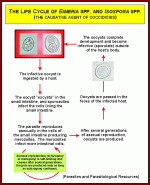
Attached is a very nice representation of the life-cycle of Coccidian spp.

Best regards,

Jeff
 

Attachments

  • coccidia_lifecycle.gif
    coccidia_lifecycle.gif
    34.9 KB · Views: 249
Now that's what I call a reply!! Thanks a bunch Jeff. I can't wait!

Very good information. I hope this information helps others as well. Thanks again,
T.
 
I got all excited about doing my own fecal samples a few years back, but couldn't find a decent microscope without paying a fortune. Of course I didn't know about e-bay back then. I'll bet there's some good ones on there.
Hmmm, I think i'll take a look. :)

Eric
 
Eric, ol buddy,
Check with the Lab at your local hospital. Explain what it's for, and that you work with an endangered species. That's what I did, and today, after a few days of paperwork, the lady at the "materials management office" says I can come and pick up my microscope for free. Yup,...FREE! Of course it's twenty years old, and it probably helps that my wife works at the hospital, but hey,...a free microscope that works. You can't beat that! Also check with schools, and universities. You never know. What happens is,...everyone wants to have the latest model, so they write the old ones off, and get new, whenever the budget will allow. If you happen to be standing there with your hand out at that time,...well,...you never know. Don't give up! Good luck!
T.
 
Here it is

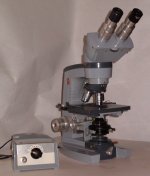
This is the free microscope, I got from the lab at our hospital. I can't believe it. This is a really nice unit! Kick ass, is more like it! I know it's a little old, but this thing is really nice, and it works, as near as I can tell. Now I'm gonna have to have someone show me how to use it! Any volunteers? I can't believe I got this lucky! I never get this lucky. Well, maybe now I should go out and buy a lotto ticket!
T.
 

Attachments

  • HPIM0933.JPG
    HPIM0933.JPG
    88.3 KB · Views: 157
Man that's awesome!

Thanks for the idea, I may have to go to the local hospital & see if I can sweet talk them out of one myself. The name of the hospital is Blessing. Let's see if they live up to that moniker.

Eric
 
Coccidia and parsitology-Enquiring Minds Want to Know

Hi Tony, now that you have some of us all worked up about the hazards of parasites/infections, update us on what you learned. Have you been able to make a Positive I.D.? Is Flea responding to treatment? If so, I will contact you and find out all about slide prep etc. Thankyou for sharing this information, unfortunately it is hard to come by and my "country" VET does not dabble in "exotics" despite his expertise with Dogs, Cats, Cows and horses.
Have you checked samples from your other animals? What are you finding? I sometimes wonder about our efforts to wage war on "parasites", wondering which are "natural" and what population levels are acceptable. I have a couple of wild caught snakes (NOT Drys!) that I have never treated for parasites, and they are robust, handsome and fertile. Anyway, let us know what you are learning, gazing at the microworld with your new 'scope.
 
Bin bizzy

Sorry if I left anyone hanging. With loved ones who live in Biloxi, the re-thinking about moving there, and eight new hatchlings to care for, I've had a lot on my mind!

Flea seems to be doing just fine without any treatment. He eats voraciously every other day. And he is growing at a phenomenal rate! His stools seem to have become much more normal also. So I don't really have a sense of urgency about it at this time.

The other stumbling block was getting to town, with gas at $3 a friggin gallon, and buying Epsom salt so to make saline solution with. Which is needed to do fecal floats, for slide prep, and exam. According to the info. I got from the net, I need 5 lbs of Epsom salt, per one gallon of water, in order to obtain the desired saline solution. Unfortunately, Wally World only carries a 4 lb bag. So this project is still a work in progress. I guess one cannot obtain the status of "Mad Scientist, bent on world domination", over night.

I wasn't aware that I had anyone's attention. But I will post results as soon as I have some. Thanks for being here guys! Stick around, and bring friends!
T.
 
Good luck with the total score of a microscope.

I've got a decent monocular scope, but I feel a bit clueless on determining what the heck it is that I'm looking at. I've seen plenty of little swimming parasites that could be deadly or healthy... Don't know. Frankly, I quit worrying.

Doug T
 
Hey Tony...

First time post here. hello all.

undoubtedly too late for this, but... you don't have to use epsom salt and you don't have to make so much. you can use almost anything that will dissolve in water. all that you need to do is make a very dense (high specific gravity) solution. i have used table sugar (sucrose), table salt, zinc sulfate, etc.

make a saturated solution by adding the solute (salt, sugar, etc) to a glass of room temp water (more will dissolve in warmer water) and stir until you can't dissolve anymore. this solution will be far more dense than the parasites or their eggs -- and thus will float to the top.

hope this helps,

matt
 
Well, I finaly got busy, and made some saline, and started checking fecal samples. So far, Iv'e found nothing. What a relief! I think they are all just fine and dandy, but I like to keep a close eye on things around here, and will continue to do so. Thanks for the advice to all who offered! I'll post again if I find anything unusual.
T.
 
There are several ways of preforming a "fecal", I will not list all of them here but the two most common way are a "Direct" and a "Float". A "Direct" is taking a small amount of poop and mixing it in a small amount of saline on a slide. (A VERY SMALL AMOUNT) The problem with this method here is coccidia is harder to find..
The BEST method for detecting coccidia is the "Float" method

The "Float" you need more poop. 1 to 2 grams for best results, of course if it is a smaller snake or reptile this is kind of hard to get. The poop is mixed up throughly in a "sugar" solution. Pour the contents into a test tube...then place a slip cover on top of the test tube..make sure the "poop soup" is touching the slip cover
It then should sit for at least 10 minutes..try not to let it sit longer because the solution will start to crystalize..but it must sit! That way, what happens is, the specific gravity of the solution makes the eggs float to the top and they will stick on the slip cover..

then plop the slip cover on the slide..you want to look for it on a "Low" to "High" power.. not the "Oil Lens" and basically you want to look for a "Fried Egg"..they are pretty easy to find...

you can buy fecal soultion at most of the onlline vet supply places..if you need one let me know.. the stuff is cheap and this is worth having..you can also use it to find other parasites as well..

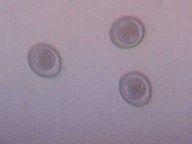
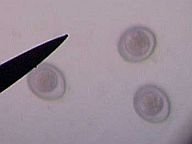
Here are some pretty good pictures of what they look like..
 

Attachments

  • coccidia192_03.jpg
    coccidia192_03.jpg
    2.5 KB · Views: 96
  • coccidia192_05.jpg
    coccidia192_05.jpg
    3 KB · Views: 90
thesnakeman said:
I am in the process of acquiring my own microscope, and this book gives some good pictures of all the bad bugs.
The pictures in that book are actually pretty bad quality. I do hope you've got other books at your disposal if you're going to be doing fecal tests on your own. I suggest buying a vet manual or two, or even better, some prepared slides that already have different parasites on them. Protozoans are very easy to miss if you've never seen what they look like under the microscope. Depending on what magnification you use (sometimes 400x is too small in my opinion), that little speck you pass by might be the parasite you're looking for.

Coccidiosis isn't just restricted to reptiles. Any cat or dog vet should be able to do a fecal test for you to confirm coccidia. It's the treatment I wouldn't really trust them to do for reptiles. :hehe:
 
Thanks,

I got all the above info. already, but thanks to all who are offering help! Keep it coming! I am always eager to learn! What are some better books?
T.
 
There's a book called <u>Veterinary Clinical Parasitology</u> by Sloss. I like this one because it's not too technical to understand. It also has a section about parasites in birds and rodents (in case you ever use those for feeders). Other than that, grab whatever books you can find that has pictures of parasites under a microscope. Just like how you have to look at lots of lots of pictures of reptile morphs to differentiate between them, you have to look at lots of lots of pictures of parasites.

Having a microscope that has at least 1000x magnification (with immersion oil) is tremenously useful, especially for really small protozoans like giardia and amoebae.

Good luck.
 
Update.

I stopped in a local veteranarian's office the other day, and asked a few questions about what I'm trying to do here. He said I probably won't need to use the oil lens, but if I do, plain old mineral oil, which is readily available at Walmart, will work just fine.
Now all my saline went bad. After having sat for too long, stuff started growing in it. So I reccomend mixing up small quantities at a time,...instead of mixing up a full gallon like I did. Just remember to use distilled water, in a sterile container. Then add epsom salt until the water has absorbed all the salt it can hold. And you have saline.
On the original note,...Flea is eating and processing everything I give him. And he appears in perfect condition. He is also growing at a phenomenal rate! Not quite 2 years old now, and nearly 5' long! So I'm not as concerned as I was origionally. Although I still plan to do fecal floats at least a couple times per year on all my critters.
I will post here if I ever find anything. I can't believe that more than 1000 people have read this. Amazing!
T.
 
Back
Top