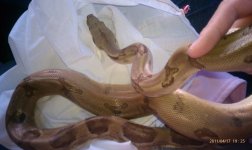
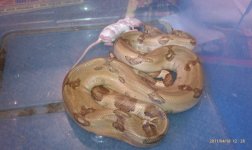
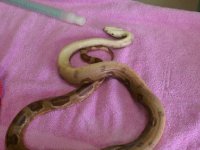
I have read most all of this thread and I want to say that at times I feel there was a mob mentality going on (the talking (yelling) and not thinking or trying to see things from all prospectives). The thread has turned around to a useful discussion, and I would like to add a few things.
Just goes to show that he has the same mentality as Nick does. It's all about the money.
First off I am a woman not a man. Second, making assumptions like this are not professional at all. I have done extensive work with reptiles and IBD. When this came up years ago I talked to Dr Roger Klingenberg DVM (a very good friend)about the impact on the show and I followed his protocol. I have also talked to Brian Potter about what he would do. So please don't assume you know what I should do, or tell me what I should do. You are not here and did not see what Nick brought to the show. Nick has some of the most amassing minerals I have ever seen. He brought no animals, not that it was your concern.
Since the report from Colorado State University (dated 5-9-11) is only a preliminary report and indicates the necrospsy & histopathologic reports are both pending, IBD is NOT yet conclusive, only suspected.
IMHO, kudos go only to Wendy Finkle (and Brad) for recognizing that poor snake needed medical attention and then going the distance to determine the cause of it's abnormal behavior and decline. I only hope IBD is not the culprit.
.

for everyone an necrospsy is always the best way to learn more.
IMO, if Raintree Animal Clinic had positively identified IBD as the cause of death, they would not have forwarded the snake carcass/specimen samples to the University of Colorado for further testing. The case would have been closed there at Raintree with a postive finding for IBD and the report from Raintree would indicate IBD. Obviously, it has not.
They would not be able to do that. These would have to go to CSU,
So, the snake was in Nick's possession for a month even before Wendy took it home. I have no idea how quickly IBD spreads. I'm still not convinced there IS IBD, from that vet report. I don't doubt the report is real, but to my (admittedly untrained) eye, it "looks" inconclusive without a necropsy, which is still pending.
But *if* there is IBD, what does that month-long time frame say about where it may have come from? Does anyone that understands the disease a bit better have any insight there?
I'm not going to look for the post but here are some answers to some of the questions I found in the many posts.
I would not consider this a new disease. It has been recognized as a disease syndrome for over thirty years, but isolations of the etiologic agents was accomplished only in the last decade. This retro-virus does not survive well outside the body and transmission appears to be from direct contact with the carriers or their body fluids. Yes, mites are generally responsible for the spread of this disease through entire collections. However the exchange of body fluids from fecal contamination, nasal and salivary secretions along with sex are also contributing factors of the spread of this disease. But because IBD replicates itself so fast, it does not survive outside of a host body for very long. It must nearly be direct contact. Because IBD can lie dormant in boas for months or even years. Is evidence that boas are the natural host of this virus and precautions and quarantine are important.
Roger Klingenberg DVM, did developed a blood test for IBD, however the drug companies did not find it economical to produce it and we are left with doing tissue samples. You can do tissue samples on a live boa, taking a small liver sample. However CSU will perform tests on the liver, pancreas, and brain tissue. The pancreas and brain tissues seem to be preferred to the liver, but the pancreas is to delicate to get from a live animal.
I have heard of a boa at one of the collages that has IBD, and has shown no signs of the disease for over 15 years. I believe that stress brings predisposed boas to active cases of this disease. For instance the cooling for breeding or the shipping for an animal. These stressing factors weaken the immune system and bring on aliments like respiratory disease, regurgitation, and neurological problems.
For all these above reasons I rarely buy boas and they are quarantined for a year, yes a year. I prefer babies as they will show symptoms early on with little stresses in their new lives.
This post from me come from the indirect and direct correspondences I have had with:
Dr Roger Klingenberg DVM
Dr. Elliott Jacobson, Florida State Universities Veterinary School
Dr. Dale Denardo, Berkeley
And of course my own life experiences and work.
For those of you more familiar with IBD, apparently Nick is going to vend at a show. If he does have IBD in his collection, could it be spread on inanimate objects?
Since he apparently sold the snake to a visitor while it was still in quarantine, I'm not sure I would rely on his strict quarantine ethics.
I do not have the same love and wonder that I did then. I am much more cautious and jaded. I made huge mistakes, may my mistakes help others.
Openly sharing is the best thing. It helps teach others.