• Responding to email notices you receive.
    **************************************************
    In short, DON'T! Email notices are to ONLY alert you of a reply to your private message or your ad on this site. Replying to the email just wastes your time as it goes NOWHERE, and probably pisses off the person you thought you replied to when they think you just ignored them. So instead of complaining to me about your messages not being replied to from this site via email, please READ that email notice that plainly states what you need to do in order to reply to who you are trying to converse with.

  • IMPORTANT! PLEASE READ!! About the Google Adsense ads being displayed

    =====================
    Posted 08/15/2025
    =====================


    Yeah, I know. They are a pain in the butt. But they pay the bills to keep my server running. Just a fact of life, I am afraid.

    Want to get rid of them? Simple. Just become a Contributor level member or above and they will be gone. -> Please click HERE."

    Is that too much for me to ask of you to keep this site running? Well, sorry about that. I too wish I could get everything for free. But alas.....

    =====================
    Addendum: 01/10/2026
    =====================


    Google Adsense ad revenue for December, 2025 was just $30 over the cost of the lease for the server running this site. So, in effect, the money providing the incentive for me to continue running this site is coming SOLELY from the paid memberships and sponsorships here. Which honestly ain't much....

Info Everegreen Pet Supply in Spokane Valley...sick rodents!

If there's anything I else I can do to make it right let me know. I'm at a loss. :shrug01:

Yes, make a very determined effort to switch your snakes to frozen/thawed rodents, as others have suggested.

It is way better for all concerned parties, the scaley, the furry, the cash strapped, and the musophobic:)
 
Actually, the exact opposite is true. Humans are very susceptible to Lepto, and if not treated, the disease can end up being fatal.

Yes there are species of Lepto that humans can contract. As per my vet the varieties that can be carried by rats are not contagious to humans. Although they can be contracted by other mammals. I'm no authority on the matter but I do consider my vet's information and trust it. He's only human and could be wrong. :shrug01:
 
I, too, am in veterinary medicine, and have never heard that some lepto can be transmitted to humans. I am also not right everytime, but as far as I have ever heard, trad and dealt with lepto is lepto, and it's zoonotic
 
Yes there are species of Lepto that humans can contract. As per my vet the varieties that can be carried by rats are not contagious to humans. Although they can be contracted by other mammals. I'm no authority on the matter but I do consider my vet's information and trust it. He's only human and could be wrong. :shrug01:

I, too, am in veterinary medicine, and have never heard that some lepto can be transmitted to humans. I am also not right everytime, but as far as I have ever heard, trad and dealt with lepto is lepto, and it's zoonotic

Not to take this to far off topic, you both peaked my curiosity. While I'm not in veterinary medicine or have any knowledge on the subject it seems that there is plenty of information online. While I know that one should be cautious about taking what you read as gospel but there seems to be plenty to suggest that you both are wrong with your statements in bold.


Leptospirosis
Content reviewed by Dr. V. Ramasubramanian
MD, MRCP (UK), DTM & H (London), DGUM (London)
Why is Leptospirosis called 'Rat Fever?'
Worldwide, rats are the most common source of human infection by the bacteria that causes leptospirosis. That is why this disease is also called 'Rat Fever.'
Humans are usually a dead-end-host. That is, the disease does not spread from person-to-person.
How does the bacteria enter the body?
Leptospirosis bacteria can enter the body through broken skin and mucous membranes, or when a person swallows contaminated food or water, including water swallowed during water sports. Once in the bloodstream, the bacteria can reach all parts of the body and cause signs and symptoms of illness.
CDC Centers for Disease Control
Leptospirosis is a bacterial disease that affects humans and animals… If the disease is not treated, the patient could develop kidney damage, meningitis (inflammation of the membrane around the brain and spinal cord), liver failure, and respiratory distress. In rare cases death occurs…

Outbreaks… are usually caused by exposure to water contaminated with the urine of infected animals… cattle, pigs, horses, dogs, rodents, and wild animals. Humans become infected through contact with water, food, or soil containing urine from these infected animals… by swallowing contaminated food or water or through skin contact, especially with mucosal surfaces, such as the eyes or nose, or with broken skin.

It is an occupational hazard for people who work outdoors or with animals… It is a recreational hazard for those who participate in outdoor sports in contaminated areas… swimming, wading, and whitewater rafting in contaminated lakes and rivers. The incidence is also increasing among urban children.
The Leptospirosis Information Center
http://www.leptospirosis.org/topic.php?t=47
Leptospirosis is famously a 'disease of rats' but in reality rodents are remarkably immune. Rodents can become carriers of a selected number of strains, but are impossible to infect with any other. They do not become noticeably ill from the infection, and so leptospirosis is not a 'rat disease'. The reason it becomes important is that the strains rodents can carry are the same strains that cause severe illness in other animals, and in humans. It's simply a coincidence, but it's what makes leptospirosis such a serious issue.

http://www.allabthealth.com/health-articles/leptospirosis-2-3655
A Leptospirosis is an infectious disease caused by certain pathogens of the genus Leptospira (from the order of the spirochete occurs).

It is a reported that zoonotic diseases are main cause of this disease. The main animals which possibly cause infections are rats and mice. But it is also found in the case of pig disease in pigs and cattle keepers are also suffer from this infection. The transfer to humans through contact with urine, blood or tissue of infected animals or contaminated water.

As per my vet the varieties that can be carried by rats are not contagious to humans.

, and have never heard that some lepto can be transmitted to humans.
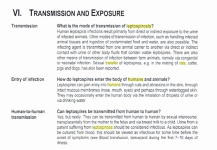
I keep looking and every single resource I've read states the opposite. CDC and others state, if a rat or other animal urinates in something you drink or enters by way of cut or abrasion into the blood stream, it can easily be transferred that way.
 

Attachments

  • Capture.PNG
    Capture.PNG
    77.8 KB · Views: 125
Cont..

The reason it becomes important is that the strains rodents can carry are the same strains that cause severe illness in other animals, and in humans. It's simply a coincidence, but it's what makes leptospirosis such a serious issue.
http://jmm.sgmjournals.org/cgi/content/abstract/58/9/1227
J Med Microbiol 58 (2009), 1227-1230; DOI: 10.1099/jmm.0.011528-0
© 2009 Society for General Microbiology
ISSN 0022-2615
Human leptospirosis cases and the prevalence of rats harbouring Leptospira interrogans in urban areas of Tokyo, Japan
Nobuo Koizumi1, Maki Muto1, Tsutomu Tanikawa2, Hiroshi Mizutani3,{dagger}, Yoshiko Sohmura3, Eiji Hayashi4,{ddagger}, Nobuaki Akao4, Mayu Hoshino1,§, Hiroki Kawabata1 and Haruo Watanabe5

1 Department of Bacteriology, National Institute of Infectious Diseases, 1-23-1 Toyama, Shinjuku-ku, Tokyo 162-8640, Japan

2 Ikari Corporation, 579 Chibadera, Chuo-ku, Chiba 260-0844, Japan

3 Tokyo Metropolitan Animal Care and Consultation Center, 3-2-1 Jonanjima, Ohta-ku, Tokyo 143-0002, Japan

4 Section of Environmental Parasitology, Tokyo Medical and Dental University, 1-5-45 Yushima, Bunkyo-ku, Tokyo 113-8510, Japan

5 National Institute of Infectious Diseases, 1-23-1 Toyama, Shinjuku-ku, Tokyo 162-8640, Japan

Correspondence
Nobuo Koizumi
nkoizumi{at}nih.go.jp

Received April 1, 2009
Accepted May 28, 2009

Thirteen patients with leptospirosis were identified, as confirmed by laboratory analysis during the last 5 years in our laboratory, who came from urban areas of Tokyo, Japan. All of the patients came into contact with rats before the onset of illness. Seventeen per cent of Norway rats captured in the inner cities of Tokyo carried leptospires in their kidneys. Most of these rat isolates were Leptospira interrogans serovar Copenhageni/Icterohaemorrhagiae. Antibodies against these serovars and their DNA were detected in the patients. This suggests that rats are important reservoirs of leptospirosis, and that rat-borne leptospires occur in urban areas of Tokyo.

{dagger}Present address: Tokyo Metropolitan Shibaura Meat Sanitary Inspection Station, 2-7-19 Konan, Minato-ku, Tokyo 108-0075, Japan.

{ddagger}Present address: Togane Hospital, 1229 Daikata, Togane, Chiba 283-8588, Japan.

§Present address: Horticultural Institute, Ibaraki Agricultural Center, 3165-1 Ago, Kasama, Ibaraki 3165-1, Japan.

The GenBank/EMBL/DDBJ accession numbers for the flaB sequences of rat isolates and patient samples are AB454100–AB454125.

A table of detection test data and a figure of PFGE results are available as supplementary data with the online version of this paper.


http://www.ncbi.nlm.nih.gov/pubmed/7461920
Human leptospirosis in Detroit and the role of rats as chronic carriers.

Thiermann AB, Frank RR.
Abstract

Human leptospirosis was diagnosed in three patients from Detroit General Hospital. Epidemiological studies of these cases revealed heavy rat infestations in the residences of two of the patients. Leptospires serotype icterohaemorrhagiae were isolated from the rats and one of the patients. Cultural isolation was attempted from numerous blood and urine samples from each patient. Media containing different selective contaminant inhibitor substances was also utilized. Only two samples were culturally positive. It appears that very few viable cells are shed by human patients intermittently. Clinical reports and leptospirosis diagnosis are reported for each of the cases. The agglutinin-absortion test proved to be helpful in elucidating the true etiologic agent in the absence of cultural isolation. A serological survey for leptospirosis was conducted among swine slaughterhouse workers in Detroit. Significant titres to Leptospira pomona were observed.

PMID: 7461920 [PubMed - indexed for MEDLINE]

Publication Types, MeSH Terms

[Human leptospirosis in French Polynesia. Epidemiological, clinical and bacteriological features].
http://www.ncbi.nlm.nih.gov/pubmed/17691431
[Article in French]

Coudert C, Beau F, Berlioz-Arthaud A, Melix G, Devaud F, Boyeau E, Jaomeau C, Lablee P, Jarno P.

Laboratoire de biologie médicale, Institut Louis Malardé, Papeete, Polynésie française. [email protected]
Abstract

Leptospirosis is a severe zoonotic disease that constitutes a major public health problem for the island populations of French Polynesia. Due to protean clinical manifestations and the risk of misdiagnosis with dengue fever, endemic viral disease, laboratory studies are necessary to confirm diagnosis of leptospirosis. At the request of the Pacific Public Health Surveillance Network, a prospective study was conducted in the population of Raieatea in the Windward Islands and the Marquis Islands to determine the epidemiological features of the disease and to define appropriate control measures. A total of 113 patients were enrolled in study between March 2004 and March 2005. Thirty-three cases were confirmed based on demonstration of serum DNA or seroconversion. The estimated annual incidence of leptospirosis was 1.7 per 1000 inhabitants. Cases involved mainly (75%) young men (mean age, 30.5 years) and occurred predominantly during the rainy season. Swimming in fresh water was the only factor showing significant correlation (p < 0.02) with positive diagnosis of leptospirosis. The most frequently identified serotype was Leptospira icterohemorrahgiae (43% of strains), thus suggesting that the rat was the most common human transmission vector. However other serotypes were found, underlining the presence of diverse reservoirs and casting doubt on the efficacy of immunization using a monovalent vaccine. These findings also indicate that enhancement of prevention and control measures for leptospirosis is needed.

Control and prevention of rat fever (Leptospirosis) outbreak in six villages of Raichur district, Karnataka.
http://www.ncbi.nlm.nih.gov/pubmed/18405089
Masali KA, Pulare MV, Kachare VK, Patil MB, Reddi S.

Department of Community Medicine, Navodaya Medical College, Raichur.
Abstract

The study describes an attempt to record leptospirosis in Raichur taluk/district, in Karnataka, by serological test such as microscopic test and IgM by ELISA. A house to house survey was done in six villages of Krishna river basin. Cases were interviewed regarding chief complaints like, fever, headache and oliguria, age, sex and treatment given with diclofenac, doxycycline, tetracycline and vitamin B complex. A total of 1516 cases were treated. The age of the patients ranged between 10 and 71 years. Most of them were agricultural workers. Out of 15 blood samples 12 samples sent to DHO Office, 3 were negative for leptospirosis, the density of rats were increased in all villages, the mode of transmission was food and water contamination, duration of incubation period was 5 to 10 days. Health education, for the community was undertaken to take measures against rats. Causative agent may be Leptospirosis interrogans, 3 cases were referred to Civil Hospital, Raichur and Navodaya Medical College, Raichur. Community participation was excellent. This study showed the presence of leptospirosis among the community of 6 villages, the disease is posing health hazards for agricultural workers in Raichur taluka villages.

PMID: 18405089 [PubMed - indexed for MEDLINE]
 
what i meant to say is that i have never heard that there some the humans can get. meaning, i have never heard of species specific lepto (that humans get some strains and not others)
 
Back
Top