• Responding to email notices you receive.
    **************************************************
    In short, DON'T! Email notices are to ONLY alert you of a reply to your private message or your ad on this site. Replying to the email just wastes your time as it goes NOWHERE, and probably pisses off the person you thought you replied to when they think you just ignored them. So instead of complaining to me about your messages not being replied to from this site via email, please READ that email notice that plainly states what you need to do in order to reply to who you are trying to converse with.

  • IMPORTANT! PLEASE READ!! About the Google Adsense ads being displayed

    =====================
    Posted 08/15/2025
    =====================


    Yeah, I know. They are a pain in the butt. But they pay the bills to keep my server running. Just a fact of life, I am afraid.

    Want to get rid of them? Simple. Just become a Contributor level member or above and they will be gone. -> Please click HERE."

    Is that too much for me to ask of you to keep this site running? Well, sorry about that. I too wish I could get everything for free. But alas.....

    =====================
    Addendum: 01/10/2026
    =====================


    Google Adsense ad revenue for December, 2025 was just $30 over the cost of the lease for the server running this site. So, in effect, the money providing the incentive for me to continue running this site is coming SOLELY from the paid memberships and sponsorships here. Which honestly ain't much....

Everglades Pythons this bad?

Ugh. Love bugs. I hated driving through there in a truck because of those.

For whatever odd reason, the feral cats issue is always off limits. Trap, neuter and release still leave cats out there to kill wildlife. Burms aren't getting that courtesy.

Had a total snake hater mention this to me the other day. He said the news had made it sound like you'd be tripping over all the snakes down there. How much proof does anyone need that they're down there, just not in anywhere near the numbers they were claiming. But went ahead and shoved knee-jerk legislation through anyways based on those inflated numbers and threat.
 
The problem with ANY efforts to eradicate "non-native" species is where, exactly, to draw that arbitrary line in the sand.

And it sure does help if YOU are the species drawing that line.
 
all because I refused the kool-aid,your judgmental is well passed its service interval

Who then is the fool that plays another mans game ?

I rest my case.

Besides, you shouldn't be replying to me anyway... you're allowing yourself to be a sheep to this site's ALLEGED representation of a person from the Chicago area commenting on the effects of extremist paranoia. You certainly haven't proven to yourself, as your sig commands, that I am actually a person who formulated thoughts in first place, so as to warrant your response.

Rather glaring lack of judgment, wouldn't you say?? You might want to make sure you're not succumbing to the lull of mainstream internet technology and assuming forums are made up of people! WAKE UP!
 
I rest my case.

Besides, you shouldn't be replying to me anyway... you're allowing yourself to be a sheep to this site's ALLEGED representation of a person from the Chicago area commenting on the effects of extremist paranoia. You certainly haven't proven to yourself, as your sig commands, that I am actually a person who formulated thoughts in first place, so as to warrant your response.

Rather glaring lack of judgment, wouldn't you say?? You might want to make sure you're not succumbing to the lull of mainstream internet technology and assuming forums are made up of people! WAKE UP!

:rofl:
 
The problem with ANY efforts to eradicate "non-native" species is where, exactly, to draw that arbitrary line in the sand.

And it sure does help if YOU are the species drawing that line.

I remember what the Glads looked like in 1970 and what it was like in 1990. Man made destruction. Also my dad was one of the truckers when they started building Disney. I went with him one day. He drove the dump trucks with the 10 ft tires. Hauling muck and debris away. The devastation was sickeningly phenomenal. How about when they burned sugar cane. I used to watch 100's of animals flee. Many 1000's didnt make it out. To impact breeders the way they did when man and domestic animals have destroyed multiple times over.
 
Honestly this only proves the news is truly far behind on its coverage, feral cats have been a problem destroying native wildlife (not only in florida) ever since they became domesticated (which goes waaaaayyyyyy back lol), its there instinct to catch and kill prey, get with the times this is old news CBC!
 
Old news to anyone who has ever owned a pet cat who has brought "presents" home from time to time, but with the rampant and ignorant use of Trap-Neuter-Release being employed in municipalities across the world, spearheaded by Alley Cat Alleys (which thinks it has the authority to debunk scientific literature just because the results disagree with their image of fluffy harmless kitties), it's good that the negative impacts of cats on wildlife and even human health are finally hitting the mainstream media. TNR is widely advertised by ACA and HSUS as being the only "humane" method of "controlling" cat populations, when in fact it is neither humane nor effective at even stabilizing feral cat populations. It's a symptom of the larger anti-euthanasia movement (as seen by increasing numbers of no-kill shelters), which while laudable in its utopian ideals is completely unrealistic.
 
Yeah, I don't know how many times I have seen cats patrolling our porch late at night looking to snag birds roosting overnight there. They look well fed, so I'm assuming they belong to our neighbors. 12 gauge "bird bombs" work as a temporary solution, but a permanent solution is likely illegal.

Years ago someone dropped off three young cats and they wanted to hang around here. Connie almost caved and wanted to let them stay till one of them made the mistake of snagged up a green anole right before her eyes. That was it. Cats had to go. You DON'T mess with the lizards here. They are ALL Connie's unofficial pets.
 
Honestly this only proves the news is truly far behind on its coverage,

I don't think article was posted as new but as updated info.

Connie almost caved and wanted to let them stay till one of them made the mistake of snagged up a green anole right before her eyes.

Anoles used to hang out in our kitchen window. My mom would sit there and talk to them. She loved those things!
 
Old news to anyone who has ever owned a pet cat who has brought "presents" home from time to time, but with the rampant and ignorant use of Trap-Neuter-Release being employed in municipalities across the world, spearheaded by Alley Cat Alleys (which thinks it has the authority to debunk scientific literature just because the results disagree with their image of fluffy harmless kitties), it's good that the negative impacts of cats on wildlife and even human health are finally hitting the mainstream media. TNR is widely advertised by ACA and HSUS as being the only "humane" method of "controlling" cat populations, when in fact it is neither humane nor effective at even stabilizing feral cat populations. It's a symptom of the larger anti-euthanasia movement (as seen by increasing numbers of no-kill shelters), which while laudable in its utopian ideals is completely unrealistic.

OMG :iagree:
 
this was the most relevant thread I could find regarding this issue. So there were stories released about how the pythons were to blame for all these declining populations of mammals in Florida which of course most of us know it's propaganda bs, other animals (specifically cats) and human enroachement on territory is the real problem.

Story that was released today supports this -
"Cats Are Obliterating Florida's Endangered Wood Rats"
http://news.yahoo.com/cats-obliterating-florida-39-endangered-wood-rat-174948677.html

I love cats and keep mine indoors only, house cats let out and feral cats absolutely can devastate native populations. Some measures can be taken for house cats, bells and such but even then, it's better (IMO) to keep them indoors to avoid the unwanted negative impact on the natural fauna of an area. A few strays here at work we have neutered and we feed them plenty, they still catch/kill birds and mice anyways, it's sad.
 
Heck, does anyone even keep data on the number of roadkills by vehicles? The number has to be enormous. And that isn't even touching on the subject of habitat destruction done via real estate development. Vast tracts of Florida have been rendered unsuitable for all classes of wildlife simply because the land has been bulldozed to the bare earth, paved over, and housing developments put in.

And I was reading an article in the local news rag where they want to put more species of large constrictors on the prohibited list with the reasoning that it would stop the spread of these tropical snakes all across the USA. Yeah, like boa constrictors and anacondas could become established in Kansas. :rolleyes: I swear, the government officials in Washington D.C. must have access to the best recreational drugs EVER.
 
When I was a kid our neighbors cat used to come into our yard every night to hunt and to do his other nasty business. That is until he got too curious about the strange animal being kept in the kiddie pool in the back yard. I won't say that curiosity killed the cat but the 9 inch snapping turtle certainly put a crimp in its olfactory sense for a while. We had a good idea where all the blood had come from but seeing Felix (I have no idea if that was the cats name it was the only common cat name I could think of) running around with a big bandage on his nose confirmed it.

Regarding the article, I bring this up every time someone brings up the python thing but they just gloss over it. I don't mind the idea of the python hunt. If it brings license money into the state and eliminates a few invasive pythons I have no problem with it. I can't help but wonder however how many native snakes may be killed by "mistake" and are simply left to rot.

I wonder how much more money could they make if they instituted feral cat hunting season. Some people would pay to kill anything.
 
I would bet money that any eastern diamondback or cottonmouth spotted by many of those hunters didn't live through the encounter.

Seriously, how many of the banned, or proposed to be banned, species could survive freezing temperatures?
 
I'm not sure about the proposed banned snakes, Rich, but there was an interesting article published earlier this week that discussed the history of snake invasions in different parts of the world. It is a fascinating read.

http://snakesarelong.blogspot.com/2014/01/the-first-invasive-snake.html

Interesting, but not really relevant since the temperature zones of the "infected" areas are pretty much equivalent to the species native range. And they are species that came from a mainland area and became established on isolated islands. Likely the only reason the snakes weren't already established on those islands is because of the water barrier that prevented them from getting there naturally.

The question I have is how similar is the native range of the supposedly invasive pythons involved in a FEDERAL ban to the supposed suitable areas of the USA where they could potentially become established. Can a burmese python or an anaconda survive the winters of, say, Georgia, much less Nebraska? I don't think that it is any accident that generally large constrictors are limited to ranges that are generally tropical in nature. Otherwise, they would likely already have become "naturally" established all across the world's temperate climate zones.

And I have to confess, it does bring a chuckle to me to read about a highly invasive species like humanity kicking up a fuss about other invasive species. Even being the cause of such invasions. Had burmese pythons been able to build boats to come to the USA, then that would have been OK?
 
The question I have is how similar is the native range of the supposedly invasive pythons involved in a FEDERAL ban to the supposed suitable areas of the USA where they could potentially become established. Can a burmese python or an anaconda survive the winters of, say, Georgia, much less Nebraska? I don't think that it is any accident that generally large constrictors are limited to ranges that are generally tropical in nature. Otherwise, they would likely already have become "naturally" established all across the world's temperate climate zones.

exactly! I mentioned that in my response on the lacey act to senator Stark as follows:
"Due to the limited environmental conditions these species can tolerate as well as thrive in, they are not pervasive in the majority of the United States, restricted to a small portion of Southern Florida. These species are overwhelmingly tropical animals found mainly in neotropical regions, tropical deciduous forests and jungles from sea level to moderate elevations. They require a permanent water source as excessive dehydration invariably spells death. "

source material:
Response from Michael Cota, herpetologist working in SE Asia
“The Giant Snakes” by Clifford Pope, pages 12, 25, 26, 108
Debunking the USGS map showing how invasive the species would be: NatGeo report: http://blogs.nationalgeographic.com/blogs/news/chiefeditor/2009/12/547.html
Critique of the Analysis Used to Predict the Climate Space of the Burmese Python in
the United States by Rodda et al. (2008, 2009) and Reed and Rodda (2009):
http://www.usark.org/uploads/Barkers_DataSetCritique-002.pdf
Testimony of Mr. Shawn Heflick, Herpetologist before the House Subcommittee on Insular Affairs, Oceans and Wildlife and the House Subcommittee on National Parks, Forests and Public Lands:
http://www.usark.org/uploads/Heflick Testimony.pdf
 
A sneaky snake: Teams hunt for rock pythons in Everglades

http://news.yahoo.com/sneaky-snake-teams-hunt-rock-pythons-everglades-202428381.html

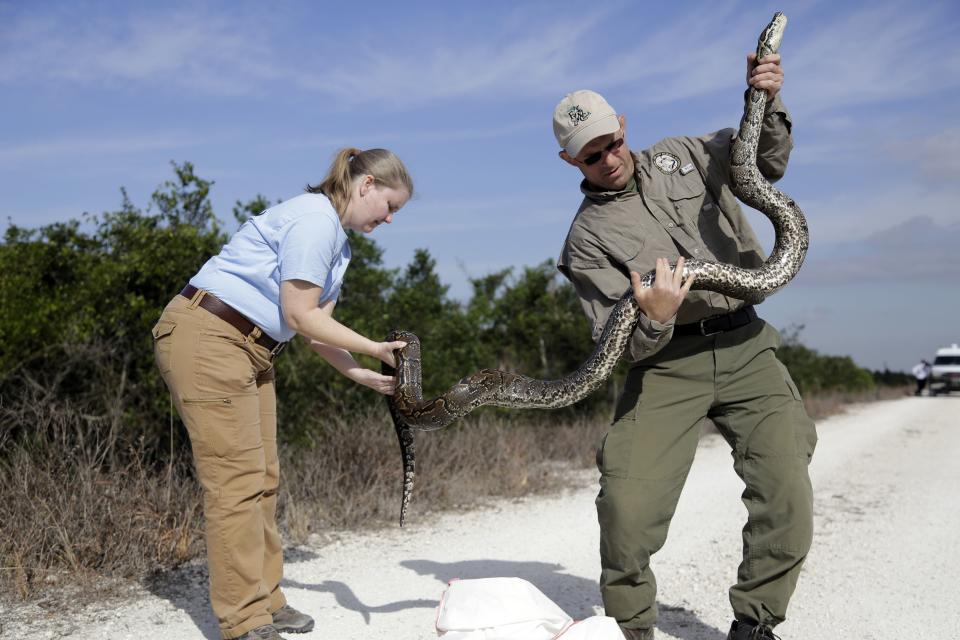
92265d63aef4a3046c0f6a70670005c6.jpg


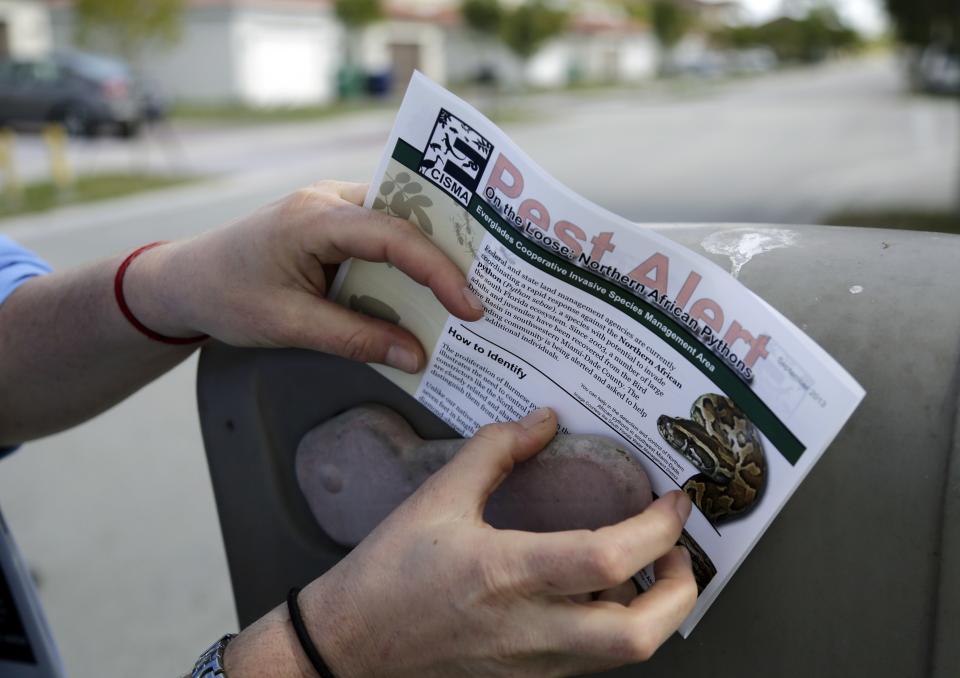
93b45fbcaef3a3046c0f6a706700b6bb.jpg


MIAMI (AP) — For all the danger posed to Florida's Everglades by invasive Burmese pythons, there's one thing researchers don't want to know: how they would interact with another python species that threatens to move into the same territory.

The Florida Fish and Wildlife Conservation Commission is racing to keep northern African pythons, also known as rock pythons, from slithering into the Everglades. So far, just a few dozen rock pythons have been found in suburban Miami, not in the wild wetlands where their Burmese cousins thrive in large numbers.

That's still enough to scare wildlife officials into hiring a specialist over the last year to patrol weekly for rock pythons in the hopes of eradicating them before they join the other invasive species threatening restoration efforts in the Everglades.

TWO SNAKE SPECIES:

Both snakes are non-venomous and can grow to 20 feet long in their native habitats. Wildlife officials say rock pythons captured here have averaged 10 feet in length; the longest Burmese python caught in Florida was over 18 feet long. Each has a splotchy, black-and-tan pattern, though the Burmese pythons' markings are more defined and resemble the spots of a giraffe. There's no good population estimate for either species, wildlife officials say, but it's generally believed that tens of thousands of Burmese pythons live in the Everglades. Both snake populations likely originated from pets that either escaped or were illegally dumped by their owners.

Last year, 141 Burmese pythons were removed from 1.5 million-acre Everglades National Park. Since 2001, about 30 rock pythons have been removed from a 6-square-mile suburban area west of Miami. Last year, officials found just one rock python, which was run over by a state Department of Transportation lawn mower in August. "Just like Burmese pythons, we know they're very hard to find. We know it's going to take a lot of surveys of finding none before we're able to say that we were successful," said Jenny Ketterlin Eckles, a wildlife commission biologist.

UNNATURAL HABITAT:

So far, the rock pythons' range is limited to the suburbs where marshlands are divided by a highway, canals, strip malls and housing developments crowded with new homes. They've been captured in canals and in open areas next to homes; some end up as road kill. One fatal dog attack by a rock python was confirmed in 2013.

On Thursday, wildlife officials timed a monthly survey to coincide with cooler temperatures that drive cold-blooded snakes seeking warmth to bask in open, sunny areas like roads and levees. The wildlife commission also left fliers about the snakes on mailboxes in one neighborhood. Anyone who encounters either python species is encouraged to contact Miami-Dade Fire Rescue.

WHAT'S AT STAKE:

Biologists spent Thursday morning slowly scanning grasses winding through spindly skeletons of melaleuca trees that have been poisoned and burned to keep the invasive plants from spreading in the Everglades. Edward Mercer, the rock python specialist for the wildlife commission, said his frequent patrols regularly turn up the Cuban tree frogs and green or brown anoles, invasive species he ignores because biologists have given up trying to eradicate them. He'd pick up any Burmese python he saw, because those snakes eat endangered species, but biologists think they long ago lost the fight to rid the Everglades of them.

The state and federal governments have pledged billions of dollars over decades toward restoring a more natural flow of water through the Everglades, unique wetlands largely drained for development, farms and flood control structures. Allowing rock pythons into the Everglades would mean one more invasive species competing with native wildlife for natural resources. By the time the water flow is fixed, researchers worry the Everglades might be filled with plants and animals that aren't supposed to be there.

Fewer and fewer rock pythons have been found each year since aggressive eradication efforts began five years ago, and no nests have been found since 2011, Eckles said.

"We are hopeful we're having an impact in removing the species from the wild," she said.

 
Back
Top