• In case most of you have not noticed, I made changes to the donation amounts as well as the durations for all of the paid membership levels. Things are winding down here, and this seems to be the most prudent way to deal with the "end of life" period of this site.

    Contributor level members - $10 per 30 days
    Sponsors - Eliminated
    Benefactor level members - $25 per 30 days
    Endowment level members - $50 per 30 days

    Account Upgrades Page
  • Responding to email notices you receive.
    **************************************************
    In short, DON'T! Email notices are to ONLY alert you of a reply to your private message or your ad on this site. Replying to the email just wastes your time as it goes NOWHERE, and probably pisses off the person you thought you replied to when they think you just ignored them. So instead of complaining to me about your messages not being replied to from this site via email, please READ that email notice that plainly states what you need to do in order to reply to who you are trying to converse with.

Flex Watt Mfg says NO to foil/aluminum tape

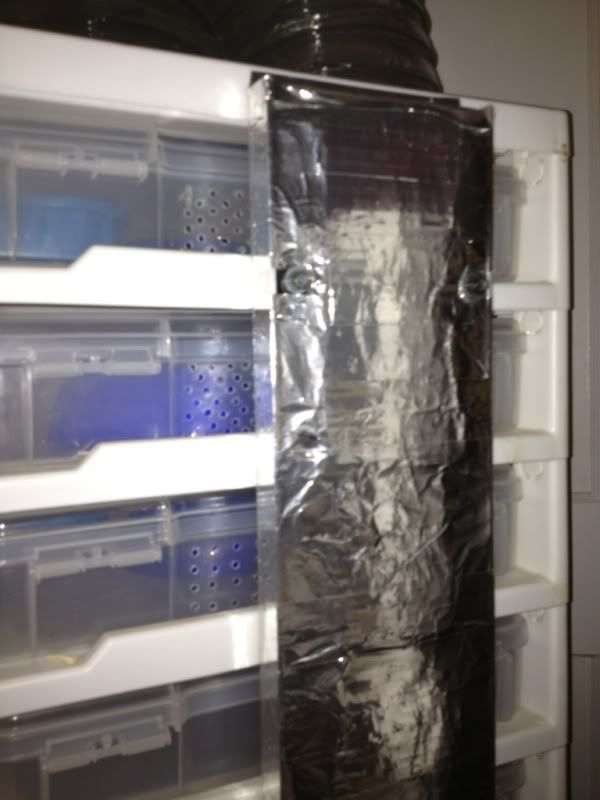
So Nick, you're flexwatt is sandwiched between aluminum and insulation board?

A little late on this, but this is what it looks like:
9cbe971d.jpg


ff676a81.jpg
 
Nick, what kind of insulation board/material is between the heat tape and foil tape on the back? This set-up is similar to what the mfg. suggested to me. Blue board on the underside of the heat tape to keep the heat from being absorbed on the side away from the tubs.
 
It is the only tape allowed by universal building code, to be used to seal duct work from leaks. It is reinforced with fibers like grey duct tape. Like alluminum tape it does have a slight insulating factor, as well as being an electrical conductor. Alluminum tape is simply the cheap version of the tape I'm referring to. Being a certified HVAC/R contractor, I'm well aware of how heat transfers, and the materials we are discussing. That being said, I used metallic tape over just the clear edges of flexwatt, I have since replaced it with the kevlar because of profile, ease of sliding, and durability. Given that I only cover a 1/4" of the clear plastic on the ends, I am not in anyway concerned about Kevlar being an insulator. I also cover all cut ends with electrical tape to avoid any issues.

Ah, I see! Nifty.

Yeah, I don't see a problem with kevlar tape if you're only covering the edges.

As to why you need metal tape for ductwork, there are numerous reasons. First is that you loose significant amount of airflow and velocity and efficeincy when you don't seal joints. Second universal building code requires the use of it. Third, metal tape does not dry out and deteriorate at anywhere near the rate of grey or alluminum duct tape. I do not know the exact metals used to make said tape, only that it is significantly stronger then either of the other options. Blending in is of no concern when making or sealing ductwork, keeping hot/cool air in the ductwork until it reaches the desired location is the one and only reason for using tape or mastic to seal joints. It is used to seal all types of duct, from sheet metal, to duct board, to spiral. Hope this answers any questions you have, and again i reccommend that you don't cover your complete heating surface as you are only asking for trouble in doing so with no real advantage.

First reason: That's why one tapes the ducts, not a reason for using a specific type of tape.

But yep, that does answer some of the questions I have! Thanks!

I still disagree on covering the heat tape with Al tape, but...well...we may never agree on that. :) Given the tape's high conductance, there is no physical reason I can think of as to why covering Flexwatt with it would create hot spots or similar heating problems. (Do you have a reason as to why you think it's a problem?)

Plus, there are definitely real advantages: it protects the heat tape from damage. Flexwatt is protected by the plastic covering, but I don't know how long it lasts when sliding tubs over it constantly. (And until someone does a rub test, that will remain unknown.) With that in mind, I prefer to add extra protection. Perhaps it is unnecessary, but I would rather the Flexwatt have extra protection than not enough.
 
In my incubator I sandwich a 12" section of 11" heat tape between two large ceramic tiles. My thinking is that they are such good heat conductors that they even the heat out and prevent hot spots and of course do a great job of holding the tape in place. Also, there is some heat sink characteristic keeping my incubator a little warmer after a quick check on the eggs. I just can't think of any such material for the back of my rack though.
 
Nick, what kind of insulation board/material is between the heat tape and foil tape on the back? This set-up is similar to what the mfg. suggested to me. Blue board on the underside of the heat tape to keep the heat from being absorbed on the side away from the tubs.

I'm not sure what type, but it's the kind you can cut and build boxes out of. It's yellow on one side, about an inch thick, and silver/aluminum tape-looking on the other side. It comes in a 4'x8' sheet I believe. It was left over from running some duct work in my house. I think we got it at home depot.

(And until someone does a rub test, that will remain unknown.)

I have helped local members change out their heat tape on expired racks. Depending on the setup, it will rub and wear, short and burn. The two and only instances that I have seen it rub, is on certain manufactured racks that have 3" heat tape zig-zaging left to right (then right to left) through all the shelves. The pre-made slots for the heat tape were about a 1/4" short and caused the center of the tape to bow upwards. I really wish I took pics, but yes, if it's not laid flat, it will rub through.
 
In my incubator I sandwich a 12" section of 11" heat tape between two large ceramic tiles. My thinking is that they are such good heat conductors that they even the heat out and prevent hot spots and of course do a great job of holding the tape in place. Also, there is some heat sink characteristic keeping my incubator a little warmer after a quick check on the eggs. I just can't think of any such material for the back of my rack though.

Randy, can I see a couple pic's of your incubator setup? I just got a mini fridge and am gonna start gutting it today. Ron
 
Krystal, thermal and electrical conductance are 2 very differant things. The AL tape has high electrical conductance, but not so much on thermal conductance. It will eventually heat to the temp of the material it is attached to, but not at the same rate as the material. This coupled with the fact that you most likely overlap it to some degree, can cause hot spots as some areas heat faster and hotter then other areas. If you run the tape so it is completely flat (or better yet recessed) then rubbing can be kept to a minimum. I would never cover the whole sheet, but if it's been working for you then good luck with it. As to why Uniform Building Code requires a specific type of tape, well it performs and lasts better then the other available options.
Nick the board you are reffering to is actually called duct board. It comes in varying thicknesses and has a high R-value. You place the foil side against the back of the heat tape?
Randy, other then simple mass to keep temps up (I prefer water bottles) I can't think of any benefit to using ceramic tiles. To me it's simply a larger load for your heating element. The only material I could think of that would be similiar would be Hardeebacker. It's a 1/" to 1/2" tile backing board, but I think that Nick's idea of duct board would be better.
 
Nick the board you are reffering to is actually called duct board. It comes in varying thicknesses and has a high R-value. You place the foil side against the back of the heat tape?

No, I put the raw material against the heat tape and the foil towards the rear. I did this because when we made the ducting box, we folded it so the foil was on the outside so I just kept that idea.
 
I have two of those older racks where the heat tape bows upwards and rubs against the tubs. And from the constant rubbing its not a matter of "if the tape will fail, but when".

So what are my alternatives? Aluminum tape, plastic tape or duct tape over the flexwatt? Laying a thin sheet of vinyl on the top of the shelf over the flexwatt? Other? Thousands of these racks were sold and are in use out there.
 
Krystal, thermal and electrical conductance are 2 very differant things. The AL tape has high electrical conductance, but not so much on thermal conductance. This coupled with the fact that you most likely overlap it to some degree, can cause hot spots as some areas heat faster and hotter then other areas.

I have been mostly referring to thermal conductance, not electrical conductance, since we're talking about heat, and Al tape is thermally conductive:
http://solutions.3m.com/wps/portal/3M/en_US/3M-SpecialtyTapes/SpcltyTape/ProdInfo/Spec6/AlumFoil425/

Plus, the tape is extremely thin, so any overlap will be insignificant in terms of causing hot spots.
 
I have been mostly referring to thermal conductance, not electrical conductance, since we're talking about heat, and Al tape is thermally conductive:
http://solutions.3m.com/wps/portal/3M/en_US/3M-SpecialtyTapes/SpcltyTape/ProdInfo/Spec6/AlumFoil425/

Plus, the tape is extremely thin, so any overlap will be insignificant in terms of causing hot spots.

Couldn't have given better proof of this point. Good post Krystal!!! Everyone should read the info given in the link. All of the things listed by 3M are things we are looking to achieve by using heat tape in combo with aluminum tape. As stated in my earlier posts, just don't touch the electrical conductors with the aluminum tape, and you will be fine.
 
I'm looking at a concrete board meant to go under tile to sandwich 11" heat tape between. It seems dense enough to be a good thermal conductor but I'm worried it might be impregnated with a lot of fiberglass for strength and be a better insulator than I think. Can't imagine it would conduct electricity though.
 
Here's what I think is a partial solution. Got myself some plastic hardware cloth 1/2" grid. This can go on top of the heat tape and the tubs can slide over this. This doesn't solve the issue with the old style racks where the tape bows up. The tub height space btw tub top and the shelf above it are too small to allow the addition of this plastic hardware cloth under the tubs, at least on my rack.
 
I'm an idiot. I like it simple. Can we use the aluminum tape under the heat tape and cover the entire heat tape on top except for the end where we connect the wires and the other end where we cover with electrical tape? Simple question, simple answer, yes or no, please. Thanks Ron
 
I'm an idiot. I like it simple. Can we use the aluminum tape under the heat tape and cover the entire heat tape on top except for the end where we connect the wires and the other end where we cover with electrical tape? Simple question, simple answer, yes or no, please. Thanks Ron

Realistically, don't put it under your heat tape. It will cause a heat sink at the bottom. Putting it over the top you can also do, just watch for rub on the heat tape. Then yes make absolutely sure that the aluminum tape isn't touching the conductive leads, as well as insulating the ends with the plastic connector covers and electrical tape.
 
Thanks Brendan, I had aluminum tape under and over, but not touching the ends. Because of all this, I put painter's tape under and on the edges of the top to hold it down. I'm gonna change the top back to a.t. without touching the ends. I didn't think anything was wrong with the way I had it, but reading everybody elses comments, I changed it.
 
I hate just having the tubs slide over the flex watt on my old style racks where the flexwatt rubs against the sliding tubs. I can't help but think covering the flexwatt for protection with anything will trap heat. So is the general opinions here that aluminum tape on the top of the flex watt is OK, but below is not?
 
I hate just having the tubs slide over the flex watt on my old style racks where the flexwatt rubs against the sliding tubs. I can't help but think covering the flexwatt for protection with anything will trap heat. So is the general opinions here that aluminum tape on the top of the flex watt is OK, but below is not?

Because of the high thermal conductivity of the aluminum tape, you would be drawing some of the heat out down to the bottom if you had the aluminum tape on the bottom. whereas if you just have it on top of the tape, you are creating a protective barrier from friction from the tubs, as well as creating a heat sink on top of the tape, which is where you want the heat to be right? Touching the tubs. Exactly. This is why it would be ok. Wood/melamine has a low thermal conductivity and would not create a heat sink on the bottom of the heat tape, whereas the aluminum tape is very thermally conductive and would most definitely create a heat sink.. To express the idea of what is more thermally conductive, stick these three objects into a cup of either boiling water or ice water

-a pencil (wood)
-a straw (plastic)
-a nail (metal)

make sure the tops of each are sticking completely out of the water so you can touch them with your fingers. let the objects sit in the water for a few minutes. you will find that object made of metal is going to be very close to the temperature of the temperature of the water itself. The wood and the plastic really wont be anywhere near the temperature of the water. you may feel some temperature change in them, but it wont be much, and this is because they are non thermally conductive materials. Metal is very much so thermally conductive (i.e. aluminum tape.)
 
I always use foil tape and have never had a problem. just make sure were you attach the wires you wrap it in electrical tape. I put down the flex watt and completely cover it with foil tape, and it works great and saves your flex watt from wear. Just stop the foil tape short of the connections.
 
Back
Top