Fossil reveals how the turtle got its shell
11:22 08 October 2008
NewScientist.com news service
Ewen Callaway
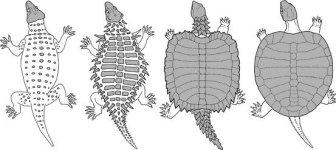
The gradual origin of the turtle shell with two hypothetical ancestors, from an animal with isolated lumps of armour, to one with a complete shell (Image: Royal Society)A newly identified fossil could explain one of evolution's biggest mysteries – the origin of the turtle's shell.
Bone fragments from a 210-million year-old, land-dwelling reptile from New Mexico suggest that the earliest turtles didn't have much of a shell at all.
Over millions of years, rows of protective armour plates gradually fused together and to the reptile's vertebrae, eventually creating a complete shell.
"Turtles ultimately originated from something that looked like an armadillo," says lead author Walter Joyce, a palaeontologist at the Peabody Museum of Natural History in New Haven, Connecticut.
His colleague Spencer Lucas, of the New Mexico Museum of Natural History and Science in Albuquerque, discovered a neck-bone fragment of the new reptile more than a decade ago, but its provenance remained debatable because the skeleton was so small, Joyce says.
However, recent erosion revealed enough pieces of Chinlechelys tenertesta – Latin for thin-shelled turtle – to remove any doubt.
Unlike turtle fossils dating from the later Jurassic era – "they're so common people stopped collecting them," Joyce says – Triassic turtles are few and far between. That's probably because they lived on land, where fossilisation is far less likely to happen, he says.
The new animal is about 30 centimetres long, with a shell only a millimetre wide. "This one's by far the thinnest ever found," Joyce says.
More importantly, the reptile's dorsal ribs aren't fully fused to its shell – or carapace – as is the case in later fossils and in modern turtles.
"This is a crucial new discovery," says Guillermo Rougier, at the University of Louisville in Kentucky, who uncovered the first Triassic turtles in northwest Argentina. These and other early turtles had already gained their carapaces and offered few clues as to its origin.
C. tenertesta, on the other hand, points to the body form that must have given rise to the shell. "This new guy is an animal that belong to the lineage of turtles, it's a proto-turtle in a way," he says.
Exactly why turtles evolved their shell remains a mystery, Joyce says. A full shell might offer added protection and stability. And the proof could be in the pudding – their body plan is the world's oldest, changing little over 200 million years. "For some reason just being a turtle is an idea that came along and just really works," he says.