California Breeders Union
Active member
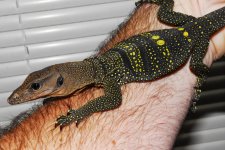
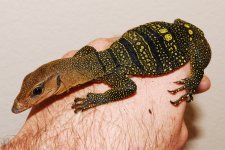
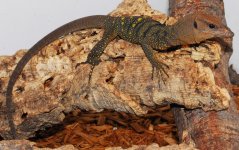
I have a few Perfect, well established Baby Varanus spinulosus (Also called "Spiny Necked Monitor" or "Isabel Monitor").
This species is endemic to Isabel Island/San Jorge, in the Solomon Islands.
This species although widespread throughout the lowland parts of the island of Isabel, is most densely populated in the thick mangrove swamps of the interior of the island. This is also where the old growth hardwood is mostly found, which is being logged heavily by foreign timber industries.
Never commonly available in the US pet trade (and with an EU trade suspension on imports) this species is far from established in captivity. With no reports of true US captive breeding until just this year, there has been a few specimens having hatched from gravid imports there is much work to be done to take this species to a point where they are not at risk of disappearing altogether from captivity.
Over the past year we have seen the largest flux of availability of Varanus spinulosus that I can recall. This has been an up and down series of events, which I would hypothesize is not going to last long term. There are too many variables at the moment which could lead to discontinuing availability. Now is the time to acquire seed stock if you'd like to have a hand in establishing this truly unique lizard.
Natural life? Their habitat is rife with primary growth forest, fresh water feeding into the swamps is clear and funneled down from nearby mountains. The riparian habitat is primarily avoided. The floor of their habitat is littered with red crawed land crabs, frogs, toads, small lizards and large moths. The trees are littered with fruit doves, lorikeets, cockatoos and hornbills. Ground foraging and nest raiding are logical food sources, although I did not see any wild feeding when I visited.
This species, to me and others is most similar to the frugivorous Varanids of the Phillipines and likely shares a common ancestor. They are hesitant (resistant) to bite, have keeled scales along their necks, and a near avian facial structure. They also have a rich crossbarring of canary yellow with large yellow ocelli.
They prefer warm and humid temperature, with 82*F being the lowest ambient temperature they should be exposed to, and happily basking after a meal in the range of 130-140*F on a localized basking spot. Humidity should never drop below 60% with daily spikes of 100% being appreciated. The cage should not be wet.
Frequently hesitant to take rodents as food, some will with time. Rather they are fond of invertebrates and avian food sources. Crickets, giant mealworms, hornworms, dubia, egg, chopped f/t quail are generally taken readily.
Hatchlings are available at $750.00 each + shipping or two for $1,500.00 shipped
Jordan Russell
714.612.4210
Canyon Lake, Ca
www.CaliforniaBreedersUnion.com
-Visa-Master Card-American Express-Discover-Paypal-
Shipping is done Monday - Wednesday.
Shipping Rates:
Small Box $50.00
Medium Box $75.00
Large Box $100.00
Delta $100.00
Purveyor of Fine Ectotherms
*It is the customer's responsibility to adhere to all state and local laws - know them! We will never knowingly facilitate any illegal activity. Please respect our hobby and do the same*
*no live arrival guarantee below 40* or above 80* F*
*Any claims, or issues must be emailed within 4 hours of receiving the shipment*
*no cash refunds-credit only*
*All deposits are non-refundable, and any failure to follow through on payment terms will render deposits forfeited.
This species is endemic to Isabel Island/San Jorge, in the Solomon Islands.
This species although widespread throughout the lowland parts of the island of Isabel, is most densely populated in the thick mangrove swamps of the interior of the island. This is also where the old growth hardwood is mostly found, which is being logged heavily by foreign timber industries.
Never commonly available in the US pet trade (and with an EU trade suspension on imports) this species is far from established in captivity. With no reports of true US captive breeding until just this year, there has been a few specimens having hatched from gravid imports there is much work to be done to take this species to a point where they are not at risk of disappearing altogether from captivity.
Over the past year we have seen the largest flux of availability of Varanus spinulosus that I can recall. This has been an up and down series of events, which I would hypothesize is not going to last long term. There are too many variables at the moment which could lead to discontinuing availability. Now is the time to acquire seed stock if you'd like to have a hand in establishing this truly unique lizard.
Natural life? Their habitat is rife with primary growth forest, fresh water feeding into the swamps is clear and funneled down from nearby mountains. The riparian habitat is primarily avoided. The floor of their habitat is littered with red crawed land crabs, frogs, toads, small lizards and large moths. The trees are littered with fruit doves, lorikeets, cockatoos and hornbills. Ground foraging and nest raiding are logical food sources, although I did not see any wild feeding when I visited.
This species, to me and others is most similar to the frugivorous Varanids of the Phillipines and likely shares a common ancestor. They are hesitant (resistant) to bite, have keeled scales along their necks, and a near avian facial structure. They also have a rich crossbarring of canary yellow with large yellow ocelli.
They prefer warm and humid temperature, with 82*F being the lowest ambient temperature they should be exposed to, and happily basking after a meal in the range of 130-140*F on a localized basking spot. Humidity should never drop below 60% with daily spikes of 100% being appreciated. The cage should not be wet.
Frequently hesitant to take rodents as food, some will with time. Rather they are fond of invertebrates and avian food sources. Crickets, giant mealworms, hornworms, dubia, egg, chopped f/t quail are generally taken readily.
Hatchlings are available at $750.00 each + shipping or two for $1,500.00 shipped
Jordan Russell
714.612.4210
Canyon Lake, Ca
www.CaliforniaBreedersUnion.com
-Visa-Master Card-American Express-Discover-Paypal-
Shipping is done Monday - Wednesday.
Shipping Rates:
Small Box $50.00
Medium Box $75.00
Large Box $100.00
Delta $100.00
Purveyor of Fine Ectotherms
*It is the customer's responsibility to adhere to all state and local laws - know them! We will never knowingly facilitate any illegal activity. Please respect our hobby and do the same*
*no live arrival guarantee below 40* or above 80* F*
*Any claims, or issues must be emailed within 4 hours of receiving the shipment*
*no cash refunds-credit only*
*All deposits are non-refundable, and any failure to follow through on payment terms will render deposits forfeited.