

-
Responding to email notices you receive.
**************************************************
In short, DON'T! Email notices are to ONLY alert you of a reply to your private message or your ad on this site. Replying to the email just wastes your time as it goes NOWHERE, and probably pisses off the person you thought you replied to when they think you just ignored them. So instead of complaining to me about your messages not being replied to from this site via email, please READ that email notice that plainly states what you need to do in order to reply to who you are trying to converse with.
-
IMPORTANT! PLEASE READ!! About the Google Adsense ads being displayed
=====================
Posted 08/15/2025
=====================
Yeah, I know. They are a pain in the butt. But they pay the bills to keep my server running. Just a fact of life, I am afraid.
Want to get rid of them? Simple. Just become a Contributor level member or above and they will be gone. -> Please click HERE."
Is that too much for me to ask of you to keep this site running? Well, sorry about that. I too wish I could get everything for free. But alas.....
=====================
Addendum: 01/10/2026
=====================
Google Adsense ad revenue for December, 2025 was just $30 over the cost of the lease for the server running this site. So, in effect, the money providing the incentive for me to continue running this site is coming SOLELY from the paid memberships and sponsorships here. Which honestly ain't much....
- Home
- Forums
- Reptile & Amphibian - General Discussion Forums
- Veterinarian Practice & General Health Issues
You are using an out of date browser. It may not display this or other websites correctly.
You should upgrade or use an alternative browser.
You should upgrade or use an alternative browser.
Help with sick Ball python- skin thing
- Thread starter Elfmaze
- Start date
Scott Ashton
Gnitubirtnoc Rebmem
Elfmaze said:the vets in the area are being a PITA they will not sell me the clorahexaderm. without seeing the snake and they don't have anyhting open for at least a week
The presence of fungal organisms could be a contributing factor, but ulcerative dermatitis (the fancy term for sclae rot) is almost always associated with bacterial infections. The keys to correcting this situation are providing a dry warm environment. I don't think you'll have an issue in continuing the neosporin treatment - just don't glob it on, spread it thinly.
It is important to realize that this is not an infection that is localized to what you see on the skin. These are systemic infections and can quickly lead to septicemia and death.
My advice is to be aggressive - make sure your temps are in line - my concern here would be less about humidity and more about temperature (as in at this point dryer is better than moister). Are the vets that you have called experienced with treating reptiles? I'd schedule an appoinmet now - if you see improvement than you can always cancel. If you don't notice improvement in the next couple of days its time to go to the vet and get systemic antibiotics.
Chlorhexidine diacetate (Nolvasan) could be used as an adjunct in cleaning the skin - it is available from some pet supply stores or stores that stock livestock care products.
See here for more info: http://www.merckvetmanual.com/mvm/index.jsp?cfile=htm/bc/171407.htm
***Disclaimer - I am not a vet.
Elfmaze
New member
I though i had heard of this before its a chlorohexadine salt! I have that stuff for my teeth, its called PerioGard. Its not quite the same though i have Clorhexadine Glucconate. its close but the chemical structure is C22H30Cl2N10*2C6H2O7 instead of C22H30Cl2N10*(C2H4O2)2. I can also get the Glucconate in a spray for at the vets for dogs with skin problems. Will that work?
Scott Ashton
Gnitubirtnoc Rebmem
Elfmaze said:I though i had heard of this before its a chlorohexadine salt! I have that stuff for my teeth, its called PerioGard. Its not quite the same though i have Clorhexadine Glucconate. its close but the chemical structure is C22H30Cl2N10*2C6H2O7 instead of C22H30Cl2N10*(C2H4O2)2. I can also get the Glucconate in a spray for at the vets for dogs with skin problems. Will that work?
Chlorhexidine gluconate should work also.
See here for info: http://www.emea.eu.int/pdfs/vet/mrls/010796en.pdf

kellysballs
New member
Chlorhexiderm is an antimicrobial liquid that you put onto the wounds of pets to keep them from getting infected. It's sort of like neosporin for pets, except you basically flood the area with the liquid. It can kill off many forms of bacteria, fungus, viruses, and yeast
This is what I used it was given to me by my vet
This is what I used it was given to me by my vet
Elfmaze
New member
yeah but my vets aren't participating, the chlorohexadine is the same thing, in this application its to kill gum line bacteria. You're chlorohexaderm what concintration is it? i have .12% should i further dilute that? and just wipe down his whole belly with it?
kellysballs
New member
I just read my bottle and it does not have a percentage on it but if you go to this web site this looks like pre mixed bottles
http://petmarket.stores.yahoo.net/chfldvm.html
If you are not having any luck you could try this. I dont think it could hurt while you are waiting to see the vet.
http://petmarket.stores.yahoo.net/chfldvm.html
If you are not having any luck you could try this. I dont think it could hurt while you are waiting to see the vet.
Double "D" Reptiles
New member
Definite scale rot. Treat as directed with newspaper or butcher paper as the substrate and change daily. Raise temps on warm end to 88 to 92 degrees with plenty of fresh water available on the cooler end (not cooler than 82 degrees) and change substrate more than once a day if it becomes wet due to sloshed water from soaking or anything (may want to give/take water a couple times a day to avoid this depending upon how active BP is and how receptive to hands rummaging around the enclosure.
Use neosporin (triple antibiotic ointment) or the Chlorhexidine. Another possible might be an antifungal foot powder, ointment or spray (aggressive action as mentioned but many are just different concentrations and ingredients the same just concentrated different between foot care and feminine care.)
Change should be noticeable after the shed and will give you a good indication of severity of infection in relation to the new underlying scales. Had one case that took long-term care and 3 or 4 sheds to get cleared up completely even though progress was noticeable with each progressive shed. Watch to make certain that sores do not develop and/or open into oozing or bleeding wounds as it would be a sign that it is getting worse instead of better.
Basically just follow all the advice previously given.
Now, as for the cage. Clean it out, load it up and take it to a gas station or tire shop that you're friendly with and use their air chuck for blowing things out. Get the sawdust and sanding dust out as much as possible this way. Then take it home and begin sealing it up. First, fill in any air gaps that may have developed after you've allowed it to dry for a couple of days in the lowest humidity possible. Then apply coats of polyurethane clear sealer in thin coats. Allow each coat to dry completely and use a 180 grit or finer sandpaper to clear any burrs that may develop before applying the next coat. Apply a minimum of 3 coats this way. If you have access to a Low pressure spray gun you can use this effectively as well. Let the cage air out afterwards for at least a week and 2 or 3 weeks will only help to remove any lasting fumes. Also, during this curing time it isn't a bad idea to apply a heat source to simulate the conditions under which your cage will be used. If keeping animals at 86 degrees, apply heat up to 96 degrees just for good measure.
Be sure that air circulation will be possible even after the cage is put into use, not only for the animals but for any residual fumes that may still be lurking. U may have been in a new home with brand new cabinetry and noticed that even a month after being installed, with nobody living in the home, that the cabinets sometimes still have a lingering odor about them from the finishes commonly used. Same thing applies here and regular/steady ventilation will assist in the total dissipation of these fumes.
If I can be of any assistance, especially with the cage issue since UR using wood, don't hesitate to drop me an e-mail or a PM on here. BTW, for everyone's future reference, when choosing woods for caging, avoid Cedar like the plague, pine like a cold or the flu, avoid particle board and unlaminated melamine...lean more heavily towards maple, birch and other hard woods. Think of the woodland areas where you might herp hunt and the trees associated with these areas. Also, think of the amount of glues and other chemicals involved in the processes used to produce some composite wood products as these linger undetectable to us but can cause severe (and sometimes fatal) reactions to our animals.
Use neosporin (triple antibiotic ointment) or the Chlorhexidine. Another possible might be an antifungal foot powder, ointment or spray (aggressive action as mentioned but many are just different concentrations and ingredients the same just concentrated different between foot care and feminine care.)
Change should be noticeable after the shed and will give you a good indication of severity of infection in relation to the new underlying scales. Had one case that took long-term care and 3 or 4 sheds to get cleared up completely even though progress was noticeable with each progressive shed. Watch to make certain that sores do not develop and/or open into oozing or bleeding wounds as it would be a sign that it is getting worse instead of better.
Basically just follow all the advice previously given.
Now, as for the cage. Clean it out, load it up and take it to a gas station or tire shop that you're friendly with and use their air chuck for blowing things out. Get the sawdust and sanding dust out as much as possible this way. Then take it home and begin sealing it up. First, fill in any air gaps that may have developed after you've allowed it to dry for a couple of days in the lowest humidity possible. Then apply coats of polyurethane clear sealer in thin coats. Allow each coat to dry completely and use a 180 grit or finer sandpaper to clear any burrs that may develop before applying the next coat. Apply a minimum of 3 coats this way. If you have access to a Low pressure spray gun you can use this effectively as well. Let the cage air out afterwards for at least a week and 2 or 3 weeks will only help to remove any lasting fumes. Also, during this curing time it isn't a bad idea to apply a heat source to simulate the conditions under which your cage will be used. If keeping animals at 86 degrees, apply heat up to 96 degrees just for good measure.
Be sure that air circulation will be possible even after the cage is put into use, not only for the animals but for any residual fumes that may still be lurking. U may have been in a new home with brand new cabinetry and noticed that even a month after being installed, with nobody living in the home, that the cabinets sometimes still have a lingering odor about them from the finishes commonly used. Same thing applies here and regular/steady ventilation will assist in the total dissipation of these fumes.
If I can be of any assistance, especially with the cage issue since UR using wood, don't hesitate to drop me an e-mail or a PM on here. BTW, for everyone's future reference, when choosing woods for caging, avoid Cedar like the plague, pine like a cold or the flu, avoid particle board and unlaminated melamine...lean more heavily towards maple, birch and other hard woods. Think of the woodland areas where you might herp hunt and the trees associated with these areas. Also, think of the amount of glues and other chemicals involved in the processes used to produce some composite wood products as these linger undetectable to us but can cause severe (and sometimes fatal) reactions to our animals.
Elfmaze
New member
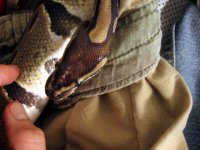
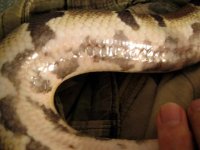
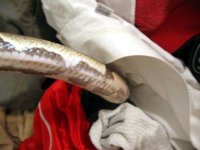
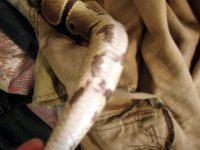
OK Sheds done
He finally shed for me last night. looks 90% better, still a few little spots though. He also made one heck of a mess of his enclosure. i had a felling this was going to be the night so i put his rock water dish in there gave him some water and went to work.
Pretty much a perfect shed, though the skin got wet and ripped alon gthe way there was only one small patch he didn't get off. hes quite spunky this morning when i was checking him out, hence why the pics are a little blurry.
Looks like there are still a few spots, his vent cleared up nively though still may be a little swolen. And there are just a few "dimples" in regular intervals down his center portion. Some light discoloration still exists in a few spots and he nicked a wound on his head.
Do you think this is something he'll recover from or does he need to see a vet?
He finally shed for me last night. looks 90% better, still a few little spots though. He also made one heck of a mess of his enclosure. i had a felling this was going to be the night so i put his rock water dish in there gave him some water and went to work.
Pretty much a perfect shed, though the skin got wet and ripped alon gthe way there was only one small patch he didn't get off. hes quite spunky this morning when i was checking him out, hence why the pics are a little blurry.
Looks like there are still a few spots, his vent cleared up nively though still may be a little swolen. And there are just a few "dimples" in regular intervals down his center portion. Some light discoloration still exists in a few spots and he nicked a wound on his head.
Do you think this is something he'll recover from or does he need to see a vet?
Attachments
kellysballs
New member
If by the time the vet has an opening your snake still has these sores I would take him in and create a rapport with the vet. That way he/she can confirm the diagnosis and in the future if you need medicine for the snake you may be able to get them with out paying for the office visit.
Just a thought. Thats what I did and I worked out well for me.
Just a thought. Thats what I did and I worked out well for me.
mrwenninger
Member
Just a quick note--veterinarians are not being a pita when they do not give meds without seeing the pet first. By law we need active client/patient/veterinarian relationship and can lose our licenses by prescribing medications without first seeing the pet.
Michael Wenninger DVM
Michael Wenninger DVM
Elfmaze
New member
he hasn't gotten any worse. Still another 5 days before i can get him to see a vet. still trying to decide if i should just cancel. the sores aren't getting any worse as is. I would have been cool taking him to see the vet but none had any openings. It would have been nice if they could have at least given advice what to do untill i can make it in. Even my doctor can tell me get plenty of sleep and eat well if i have a cold. These guys straigh up said "I'm sorry we can't say a word till we've seen the pet"

hhmoore
tired & cranky shadow
well, you got advice here on what to do in the meantime...but I don't think there are many that would straight up tell you NOT to keep your appt for similar reasons. We can't see the animal.
(just for the record, I think refusal to advise you on supportive husbandry is a bunch of crap. Granted it comes from the need to reduce liability, because the phone answers/appt makers are not usually the vets; and the wrong information is worse than no information because they can be blamed...but it is crap none-the-less)
(just for the record, I think refusal to advise you on supportive husbandry is a bunch of crap. Granted it comes from the need to reduce liability, because the phone answers/appt makers are not usually the vets; and the wrong information is worse than no information because they can be blamed...but it is crap none-the-less)
mrwenninger
Member
Most people know to keep warm and clean while waiting for an appt. If more advice is given it can be a liability. Our office has an exotics vet on staff all days except Sundays and many emergency hospitals have exotics vets that can be called in. I don't know where you live but if you check the ARAV website you can likely find a vet in your area that has hours that are more suitable.

Cool, a real DVM on fauna. Welcome, Micheal.
Folks, don't be too too pissed that he doesn't have some instant home cure.
I have worked in medicine long enough to know, that prescribing drugs, based on a phone call, is professional suicide.
So, either she takes her animal to the clinic, or tries to deal with it herself.
Fairly straightforward situation.
Folks, don't be too too pissed that he doesn't have some instant home cure.
I have worked in medicine long enough to know, that prescribing drugs, based on a phone call, is professional suicide.
So, either she takes her animal to the clinic, or tries to deal with it herself.
Fairly straightforward situation.
Elfmaze
New member
Well its back. Hes been on fresh reptibark in a different cage, freash water and at least 80-85*. His scale problems are back again..... And he still hasn't eaten since october. How do you get these guys off of a winter fast if this is what this is?

Cat_72
Back from exile :)
If the temps are only 80-85 degrees, he's not going to want to eat anyway.....did you keep the original vet appointment, and if so, what did you find out?
Elfmaze
New member
Yeah he went to the vet right after a shed and vet said it was clearing up and no further treatment was needed. What temp should a ball python be at? i though 85 was a good ambient for them. My white lips i keep a bit warmer at 90
Cat_72
Back from exile :)
What is the "hot spot" temp?