

• Responding to email notices you receive.
    **************************************************
    In short, DON'T! Email notices are to ONLY alert you of a reply to your private message or your ad on this site. Replying to the email just wastes your time as it goes NOWHERE, and probably pisses off the person you thought you replied to when they think you just ignored them. So instead of complaining to me about your messages not being replied to from this site via email, please READ that email notice that plainly states what you need to do in order to reply to who you are trying to converse with.

  • IMPORTANT! PLEASE READ!! About the Google Adsense ads being displayed

    =====================
    Posted 08/15/2025
    =====================


    Yeah, I know. They are a pain in the butt. But they pay the bills to keep my server running. Just a fact of life, I am afraid.

    Want to get rid of them? Simple. Just become a Contributor level member or above and they will be gone. -> Please click HERE."

    Is that too much for me to ask of you to keep this site running? Well, sorry about that. I too wish I could get everything for free. But alas.....

    =====================
    Addendum: 01/10/2026
    =====================


    Google Adsense ad revenue for December, 2025 was just $30 over the cost of the lease for the server running this site. So, in effect, the money providing the incentive for me to continue running this site is coming SOLELY from the paid memberships and sponsorships here. Which honestly ain't much....

Hog questions, and eye candy

phoenix-cry

New member
Joined
Jan 21, 2011
Messages
1,797
Reaction score
45
Points
0
Location
Dover, NH, USA
Okay, questions first. What is the minimum size that hognose female *can* lay eggs and what size *should* they be before breeding. I ask because I'm hearing weights from 100 to 250 for breeding size and that's a really big margin.

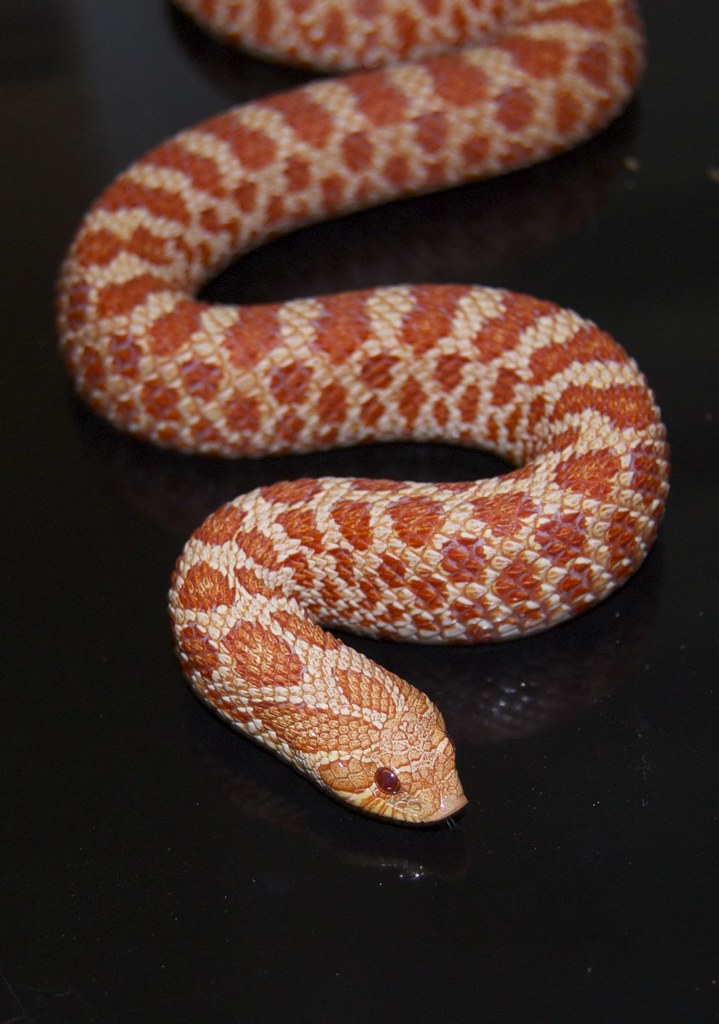
Second. I bought an Extreme Red Albino female a while back and I thought at the time (cause I was a noob) that she was just a really nice albino and that 'extreme' was just a description. But now I see snakes labeled 'het extreme red'. So do you think she has both 'extreme red' and 'albino' or is there something I'm missing?

Here she is (she's the eye candy). Currently 88 grams, eats anything. She would eat five fuzzies a day if I let her (I don't).
7816075378_e820ba74ac_b.jpg
 
Okay, questions first. What is the minimum size that hognose female *can* lay eggs and what size *should* they be before breeding. I ask because I'm hearing weights from 100 to 250 for breeding size and that's a really big margin.

I too have heard first hand that some breeders will go ahead and breed their females at 100 grams. While I have no idea what size they will breed in the wild at, I personally will not subject my own females to breeding under 200 grams. Every female that I've bred at 250+ grams has never had any problems, but I've had 3 females weighing in the 200 gram range that became eggbound, 2 died and 1 survived only because I performed a paracentesis on her so that she could drop the eggbound eggs. That particular female actually double clutched 2 months later from retained sperm and successfully laid 11 fertile eggs. I have had a couple of other females weighing around 200 grams that have successfully laid, so it can be done. From my own experience, there seems to be a risk involved when the females are of a smaller size. :shrug01:

Second. I bought an Extreme Red Albino female a while back and I thought at the time (cause I was a noob) that she was just a really nice albino and that 'extreme' was just a description. But now I see snakes labeled 'het extreme red'. So do you think she has both 'extreme red' and 'albino' or is there something I'm missing?

This is probably the largest problem coming from the Extreme camp, that the extreme red coloration is a type of Mendelian heritable trait, it is not! Red coloration is a polygenic trait which can be passed from parents to offspring, but it's not a recessive trait that can exist in het form. That being said, when someone claims that they have a "het extreme red albino", it's an ignorant misrepresentation of the genetics, whether intentional or not. An animal from such a background should instead be labeled as "het albino from extreme red albino parents". If the het albino has heavy red coloration patterns, it's possible this could be passed along to it's offspring depending of course on the other parents genes involved as well. However, if you have a "het red extreme albino" hognose and it's not exhibiting much red coloration if any at all, then the chances of it's offspring being red are close to nil. But again, red coloration is a polygenic trait, so if you breed the offspring back to the parent animal, there is a chance that you might be able to genetically reconstruct that red coloration if the right genes are present in both animals. The bottom line is, most extreme red hognose are the culmination of selective and extensive line breeding, nothing more.

Having said that, you have a beautiful hognose there. All the best with her!
 
Thanks for the informative info! I asked about the minimum because someone sold me a hognose as 'proven' and I didn't think to ask her weight. When I got her she is only 130 grams and I was wondering how such a small hognose could be proven.

Thanks for the heads up on the egg binding. I'll make sure my gals are at least 250 to keep that from happening. My friend lost a 450 gram female to egg binding despite all efforts to save her.


So Extreme red is more of a line breeding type deal. That makes sense. So 'het red' is just silliness.

I think I've got a good pair because I have a bright red anaconda to go with my albino, I hope to then get a nice red anaconda het albino male to breed back to her.

Thanks again for the helpful info!!
 
Well, I've been told by a couple of hog breeders that they themselves have successfully bred females at 100 grams, other than that, no more data was ever given ie. clutch size, clutch viability, overall long term health of the female, etc... I'm not saying that it hasn't been done nor done unsuccessfully with little nor ill effects on the female, I just wouldn't recommend it based on my own experiences but I know a few people who would.

Glad to be of service! :thumbsup:
 
In this case I was told that there were six eggs, but they all died due to mold. The female seems healthy (I've had her for a month). My really hope is that she hasn't been bred. I'd rather she be unproven than have too early a clutch hurt her health!
 
Brent Bumgardner himself told me that females can go 190g and up for breeding and males can start at just 30g if they're willing. I trust his word as his reputation is very good.
 
Back
Top