• Responding to email notices you receive.
    **************************************************
    In short, DON'T! Email notices are to ONLY alert you of a reply to your private message or your ad on this site. Replying to the email just wastes your time as it goes NOWHERE, and probably pisses off the person you thought you replied to when they think you just ignored them. So instead of complaining to me about your messages not being replied to from this site via email, please READ that email notice that plainly states what you need to do in order to reply to who you are trying to converse with.

  • IMPORTANT! PLEASE READ!! About the Google Adsense ads being displayed

    =====================
    Posted 08/15/2025
    =====================


    Yeah, I know. They are a pain in the butt. But they pay the bills to keep my server running. Just a fact of life, I am afraid.

    Want to get rid of them? Simple. Just become a Contributor level member or above and they will be gone. -> Please click HERE."

    Is that too much for me to ask of you to keep this site running? Well, sorry about that. I too wish I could get everything for free. But alas.....

    =====================
    Addendum: 01/10/2026
    =====================


    Google Adsense ad revenue for December, 2025 was just $30 over the cost of the lease for the server running this site. So, in effect, the money providing the incentive for me to continue running this site is coming SOLELY from the paid memberships and sponsorships here. Which honestly ain't much....

How to prevent MBD in Hatchlings?

gemdreamer

New member
Joined
Sep 29, 2004
Messages
64
Reaction score
0
Points
0
Location
california
I am curious at how to prevent MBD in hatchlings. I mean I have babies right now and they get 12 + hours of UV a day, feeding fruit flys, 1 week old crickets.

I have noticed that three babies have started to get MBD and I dont know how to stop it or prevent it, since these guys are so small.

Any help or suggestions would be wonderful.
 
gemdreamer said:
...I have noticed that three babies have started to get MBD...
Howdy,

What symptoms are you seeing?

Reptisun 5.0 at 6"-12" distance from their normal basking area.

This site, listed below, has a reasonable schedule for supplementation for babies etc.:

Example of a baby (only) schedule on that site:
"Calcium every day (beginning at about 2 weeks). Alternate between one with D3 and one without."
http://vipervenom9.tripod.com/id2.html

It is very easy to over or under supplement these little ones. You'll have to be very careful. I'd suggest using either Rep-Cal Ca/D3 and also Rep-Cal Ca/No-D3. Miner-All (I) and Miner-All (O) are also great products.

How about posting photos of your setup and some of the critters in question?

Good Luck,

Dave Weldon
 
Thanks for replying, I am at work right now so I wont be able to post any pics until later.

But, I have been keeping them in 10 gallon glass tanks, seperated into four different groups about 10 per group, they are provided with many climbing items, also a live plant is included in the setup, they are being provided with I think its Reptisun 5.0 or higher and a basking lamp with a 75 watt blue light.

I have them in my reptile room, so I think right off the top of my head the temps are at least 85 and up, but Im not sure without looking at the thermometer.

they are fed two to three times a day and sprayed at least four times a day, I also take them out and inspect them every couple of days.

I guess my main question is how do I supplement them? I mean the crickets are too small to dust. Can I use liquid calcium mixed with water, that way when I spray them they will be getting the much needed calcium.

I do put food in with the crickets, like carrots, potatos and chick start, which is what people feed baby chickens. I was told by the cricket supplier not to put greens in with the crickets, cause it can cause diarrea in the baby crickets and make their enclousure messy.
 
I forgot to tell you what symptoms I have been seeing.

I have seen the rubbery legs and the deformation in their legs.
 
gemdreamer said:
...I have them in my reptile room, so I think right off the top of my head the temps are at least 85 and up, but Im not sure without looking at the thermometer.

...sprayed at least four times a day...

...how do I supplement them? I mean the crickets are too small to dust...

I do put food in with the crickets, like carrots, potatos and chick start, which is what people feed baby chickens. I was told by the cricket supplier not to put greens in with the crickets, cause it can cause diarrea in the baby crickets and make their enclousure messy.
Howdy Shari,

If the overall room air temperature is 85F then I'd be worried that the babies are not able to find thermal gradients from 90F down to 70F inside their glass tanks. At this point, if the room is really that warm, then the addition of a basking lamp might be pushing things over the limit for the high end. If you meant that the basking spot was in the high 80's then that isn't as big a problem. 10 gal tanks may not be offering the thermal gradient control necessary.

Even though you are misting 3-4 times a day they may not actually hydrate to the extent that they need. Spray duration can be just as important as spray interval. These little critters might require you to spray their leaves, watch their drinking pattern, spray again and again over a period of 5++ minutes. If they are running away from the spray, try a finer mist and use luke warm water. Dehydration and MBD (if it really is MBD) are linked to some extent.

If your crickets are super-small pinheads then you are ready for a larger pinhead but still smaller than a typical small cricket. If you have a supplier with that size, use them instead. Otherwise, buy what you buy and then grow them for a week or so until they are bigger. A little more research on the best cricket growing foods might yeild better ingredients. These larger pinheads will be easier to dust with a fine, high quality product like I mentioned in my previous posting.

Open issues are temps, hydration, supplementation, cricket size.

How many babies do you have?

Also, start thinking about acquiring some screened enclosures for them...

Good luck!

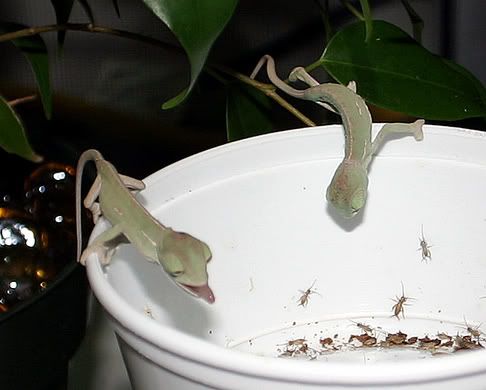
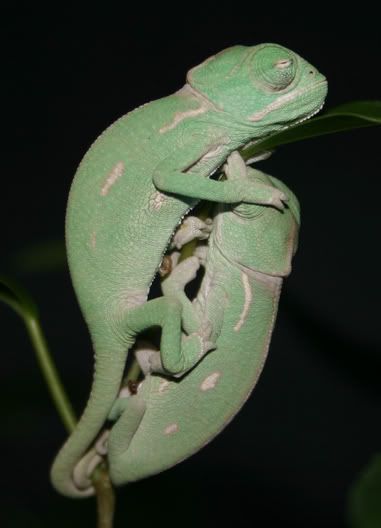
P.S. A few photos of some that I hatched (57 total) for a friend!

3.jpg

7.jpg

9.jpg

10.jpg
 
Uh, I'm not a "cham person", but I DO know you have to be very careful to get NON-MEDICATED chick starter if that's what you feed your crickets....the majority of the chick starter/grower feeds are medicated.

Just my quick $.02 ....
 
gemdreamer said:
Thanks for replying, I am at work right now so I wont be able to post any pics until later.

But, I have been keeping them in 10 gallon glass tanks, seperated into four different groups about 10 per group, they are provided with many climbing items, also a live plant is included in the setup, they are being provided with I think its Reptisun 5.0 or higher and a basking lamp with a 75 watt blue light.

I have them in my reptile room, so I think right off the top of my head the temps are at least 85 and up, but Im not sure without looking at the thermometer.

they are fed two to three times a day and sprayed at least four times a day, I also take them out and inspect them every couple of days.

I guess my main question is how do I supplement them? I mean the crickets are too small to dust. Can I use liquid calcium mixed with water, that way when I spray them they will be getting the much needed calcium.

I do put food in with the crickets, like carrots, potatos and chick start, which is what people feed baby chickens. I was told by the cricket supplier not to put greens in with the crickets, cause it can cause diarrea in the baby crickets and make their enclousure messy.

I'll add a few things to Dave's posts.

First, the liquid calcium in the water is a nice supplemental source of calcium but in most cases the actual intake of calcium will be pretty low. You can indeed dust pinheads if you use a finely ground supplement like Rep-Cal in the pink jar. The added D3 in the Rep-Cal will also help with calcium absorbtion and utilization.

Carrots, potato, and chick starter is what cricket suppliers use when mass rearing crickets. It is not a gutload on any level. Try using a quality gutload product like the ones found at www.wildeyereptiles.com or www.cricketfood.com or the DIY mix at www.adcham.com. Dark leafy greens such as romaine, collard and mustard greens are a great source of extra calcium, vitamins and minerals and should absolutely be a part of any gutloading regime.
 
Shari,
A good topic. Good advice so far, although there's room for more info. First off, and unfortunately, your offspring may be genetically predisposed to MBD. They can recover from this with the proper diet, but may suffer through a couple months of visual symptoms, and perhaps always bear some of the bow-legging scars, etc. As for "crickets being too small to dust", there is no such thing, although you may need a finer powder. Try Citrical powder. So far, results with calcium citrate are better than with some of the commercial calcium dusts. You can also buy calcium citrate on-line. Its pricier than calcium carbonate products, but also finer ground. I think Ronnie at Cricketfood can hook you up with all. Also, using chicken mash, especially that designed for "chicks" is a giant no-no. Medicated is to put it mildly, as many contain growth hormones (not on label) that go right through your crickets and into your chameleons. And they work, except that the downside of having some chameleons reach adult size in four months (no joke), they will have enormous bone problems. I did this to about 200 chameleons once, and I know. Switch to the gutloads recommended. Also, you can feed larger crickets than what is pictured, fully up to a length equal to the distance across the top of the head of the chameleons, or roughly twice the size of the crickets pictured. Insect feeders that you cannot gutload are of little value, especially fruit flies. If ever you get into raising mealworms, they and crickets are plenty. Good luck!
 
Dave W. said:
Even though you are misting 3-4 times a day they may not actually hydrate to the extent that they need. Spray duration can be just as important as spray interval. These little critters might require you to spray their leaves, watch their drinking pattern, spray again and again over a period of 5++ minutes. If they are running away from the spray, try a finer mist and use luke warm water. Dehydration and MBD (if it really is MBD) are linked to some extent.

Open issues are temps, hydration, supplementation, cricket size.

How many babies do you have?

Also, start thinking about acquiring some screened enclosures for them...


Dave W. said:
Dave,

I agree with you about the hydration, as I stated I work during the day, I have given instructions to my mom who helps me with the reptiles to spray them more often and lengthier times.

Since I have added another Reptisun bulb to my outlet I have noticed the MBD start to correct itself.

as far as crickets I will be ordering larger sizes, as before they would have been to big for the babies to eat, but they are growing everyday and I think they are ready for bigger ones.

I have Screen cages already, I just didnt feel that keeping babies in then would have been adaqute for them, since it would have been almost impossible to keep food inside for them.

 
Cat_72 said:
Uh, I'm not a "cham person", but I DO know you have to be very careful to get NON-MEDICATED chick starter if that's what you feed your crickets....the majority of the chick starter/grower feeds are medicated.

Just my quick $.02 ....


I really do appreciate your comment and I will never use it again ! I was not aware that they medicate this product.
 
JasonDescamps said:
I'll add a few things to Dave's posts.

First, the liquid calcium in the water is a nice supplemental source of calcium but in most cases the actual intake of calcium will be pretty low. You can indeed dust pinheads if you use a finely ground supplement like Rep-Cal in the pink jar. The added D3 in the Rep-Cal will also help with calcium absorbtion and utilization.

Carrots, potato, and chick starter is what cricket suppliers use when mass rearing crickets. It is not a gutload on any level. Try using a quality gutload product like the ones found at www.wildeyereptiles.com or www.cricketfood.com or the DIY mix at www.adcham.com. Dark leafy greens such as romaine, collard and mustard greens are a great source of extra calcium, vitamins and minerals and should absolutely be a part of any gutloading regime.


Jason, thanks for replying

So using the liquid calicium would be a waste of time to use? If I am hearing you correctly.

Also I will look into geting a finer calcium supplement, although I do have Miner-all, would that be sufficient? I use that on my older chams.

Also, I wanted to say that, when I asked my cricket supplier about gutloading with dark leafy greens I was told that it was best not to use them because it gave the crickets diarrea. But since I know you are experienced with Chams alot more then I am I will start using that as a supplement for gutloading.
 
Chamco said:
Shari,
Try Citrical powder. So far, results with calcium citrate are better than with some of the commercial calcium dusts. You can also buy calcium citrate on-line. Its pricier than calcium carbonate products, but also finer ground. I think Ronnie at Cricketfood can hook you up with all. Also, using chicken mash, especially that designed for "chicks" is a giant no-no. Medicated is to put it mildly, as many contain growth hormones (not on label) that go right through your crickets and into your chameleons. And they work, except that the downside of having some chameleons reach adult size in four months (no joke), they will have enormous bone problems. I did this to about 200 chameleons once, and I know. Switch to the gutloads recommended. Also, you can feed larger crickets than what is pictured, fully up to a length equal to the distance across the top of the head of the chameleons, or roughly twice the size of the crickets pictured. Insect feeders that you cannot gutload are of little value, especially fruit flies. If ever you get into raising mealworms, they and crickets are plenty. Good luck!

Thanks for the info about Calcium carbonate products, I will check into that as well.

As for the chick mesh, like I said I will never use that again ! Also, I already do breed mealworms and I have been feeding the babies small mealworms.
 
I just wanted to appologize to everyone for not responding sooner, I usually get an email with your response, but I didnt for some reason.

I really do appreciate all of the input that I received from you guys. This is my first time having baby chams. I had 54 babies total and 100% hatch rate, although it took a month for all of them to hatch. I did loose some, about 10, due to lack of food and my stupidity. I forgot to order the week of thanksgiving and it took longer then usual to get their much needed food.

I have noticed that the MBD i noticed have subsided and is only visable to a very minimal.

I will be trying my hand at breeding again this season, my male has already been very eager to get with my female, as the first time I put them together it took him less then 2 minutes to mate with her. I left him in there with her for like two days and she gave him a nice nip on his tail and foot overnight, so I have put him back in his own cage again.

I have one question, once the female lays eggs, is it recommended to put the male with the female again to breed that way the next batch of eggs are fertile? Because last year I didnt and all the other clutches she laid were not fertile.

Thanks again.
 
Back
Top