• Responding to email notices you receive.
    **************************************************
    In short, DON'T! Email notices are to ONLY alert you of a reply to your private message or your ad on this site. Replying to the email just wastes your time as it goes NOWHERE, and probably pisses off the person you thought you replied to when they think you just ignored them. So instead of complaining to me about your messages not being replied to from this site via email, please READ that email notice that plainly states what you need to do in order to reply to who you are trying to converse with.

  • IMPORTANT! PLEASE READ!! About the Google Adsense ads being displayed

    =====================
    Posted 08/15/2025
    =====================


    Yeah, I know. They are a pain in the butt. But they pay the bills to keep my server running. Just a fact of life, I am afraid.

    Want to get rid of them? Simple. Just become a Contributor level member or above and they will be gone. -> Please click HERE."

    Is that too much for me to ask of you to keep this site running? Well, sorry about that. I too wish I could get everything for free. But alas.....

    =====================
    Addendum: 01/10/2026
    =====================


    Google Adsense ad revenue for December, 2025 was just $30 over the cost of the lease for the server running this site. So, in effect, the money providing the incentive for me to continue running this site is coming SOLELY from the paid memberships and sponsorships here. Which honestly ain't much....

How to tell male and female apart?

Big Borg Reptiles

New member
Joined
Jul 4, 2014
Messages
1,099
Reaction score
130
Points
0
Location
Spokane, WA
So I know this sounds like an easy to answer question but I'm not wondering how to sex snakes.

For those of you who breed species without morphs, how do you differentiate between the male and female when you pair them to breed? With the ringed pythons I basically have to pair snakes with completely different patterns or I'd have no idea which was male and female when I went to separate them. With bullsnakes I'm already planning on probing them again since I'm not 100% sure I picked out the male.

Is there a trick other than looking for a distinguishing mark? Can you put some sort of paint on them that doesn't come off until they shed? I could definitely use some help with this. With most snakes I can easily tell them apart but with bulls/rings/rats/indigos I'm at a loss.
 
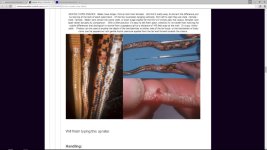
Nick, hopefully this pic and the following information helps with your question. I believe this is true with most if not all colubrids. It is def spot on with my hondurans. When you are visually sexing colubrids it is important to note that they should be adults when using this method. Good luck!
 

Attachments

  • Screenshot (55).jpg
    Screenshot (55).jpg
    123.6 KB · Views: 124
I dont have an issue when it comes to hogs or garters as the tail is very easy to differentiate, but what about something like a ringed python where visual sexing isn't possible? I certainly don't want to have to probe them every single time I pair them.

Like I mentioned, right now I'm simply pairing snakes with completely different patterns but this obviously eliminates any chance of line breeding for specific traits. There has to be an easier way.
 
I'm sure others have their own methods, but I just examine each for distinctive marks and make a note so I don't forget. With my bull snakes, I actually do look at their tails, not for length, but because that's where their pattern is simplest. So working from the tip, I may see two clean bars and then one half-stripe that doesn't reach all the way around or else I might see three clean bars and then one that branches into a Y-shape. I just write that down.

Their head or the beginning of their neck can sometimes have a distinct pattern as well, it should be something you can just glance at without having to count blotches.

Along the same lines, you can snap a picture of each snake separately and name the files so you don't forget which is which. This has the added bonus of letting you inspect their patterns carefully without dealing with a squirmy animal!

You can also weigh them with a gram scale to see if they're off by an amount that can't be attributed to food or water consumption. Then just weigh one again when it's time to separate them.

I haven't personally had snakes be so identical that the above wouldn't work YET, but I can easily see it happening. In such a case, I think a dot of nontoxic paint on one would be the easiest route.

Good luck~ :thumbsup:
 
Do you label the tubs? With animals that look identical, I would think that keeping little office clips with an ID number would help. For example, when you move one male to a tub with a female, you would move his clip to that tub, so you know who's who, and can put him back in the proper tub when you're done? Barring that, a little dab of paint, like what I see breeders do with bearded dragons, may work well.
 
I write directly on the tubs with sharpie so that nothing gets mixed up. I have the males and females right next to each other in the rack systems, so basically at the beginning of the week I move the male to the next tub over, then move him over again after a few days to a new female, then move him back to his tub for a break.

The problem is that with the rings, I have to keep them in specific pairs (the three types I have are solid rings, washed, and reduced pattern). Basically I only pair ringed with washed or reduced , washed with reduced or ringed, and so on, but like I mentioned, that completely removes the possibility of line breeding. I would love to be able to put ringed with ringed but would have to probe them every week if I did that as is.

I had a vet mention using white-out to mark snakes for another reason, I suppose that would be a possible solution. I'll see how that works and come back with my findings :p
 
Does a Sharpie's ink adhere? I would try that directly on an orange-brown segment before trying the White-out. Like a plus sign or something. Potentially faster.

Better yet, mark both sexes. A circle for one sex. An X for the other sex.
 
I had tried a sharpie on an indigo with no luck, but with black on black I kind of expected it. I'll give the sharpie a shot when I put them together Monday, unless they shed mid-pairing I can't see why it wouldn't work.
 
Yeah, my idea was that, even in some freak scenario where one might shed, if you marked both (on non-black sections) with differing symbols for respective sexes (on the colored section so as to show...assuming it shows), then the chance of both having a freak event should be virtually nonexistent. Since the carrier/medium (I think methanol, but do not worry) is so volatile and the ink itself is so lightweight, nothing will permeate. Avoid the metallic permanent markers and stick to standard black Sharpies if you do this. I knew a guy who marked animals (other species) with a metallic permanent marker and whatever was in that mix harmed their tissues. Not the case with a Sharpie (because the ink is nothing to be concerned by and the tiny bit of methanol vaporizes near-instantaneously as mentioned), which I have seen other people mark various tortoises with if they had light areas for it to show, although most use nail polish on tortoises on a scute.

Let us know how it works out, too. Might be a trick others can use.
 
Back
Top