• Responding to email notices you receive.
    **************************************************
    In short, DON'T! Email notices are to ONLY alert you of a reply to your private message or your ad on this site. Replying to the email just wastes your time as it goes NOWHERE, and probably pisses off the person you thought you replied to when they think you just ignored them. So instead of complaining to me about your messages not being replied to from this site via email, please READ that email notice that plainly states what you need to do in order to reply to who you are trying to converse with.


  • IMPORTANT! PLEASE READ!! About the Google Adsense ads being displayed

    =====================
    Posted 08/15/2025
    =====================


    Yeah, I know. They are a pain in the butt. But they pay the bills to keep my server running. Just a fact of life, I am afraid.

    Want to get rid of them? Simple. Just become a Contributor level member or above and they will be gone. -> Please click HERE."

    Is that too much for me to ask of you to keep this site running? Well, sorry about that. I too wish I could get everything for free. But alas.....

    =====================
    Addendum: 01/10/2026
    =====================


    Google Adsense ad revenue for December, 2025 was just $30 over the cost of the lease for the server running this site. So, in effect, the money providing the incentive for me to continue running this site is coming SOLELY from the paid memberships and sponsorships here. Which honestly ain't much....

Humidty for Incubator

windex

New member
Joined
Nov 15, 2004
Messages
48
Reaction score
0
Points
0
Location
northridge
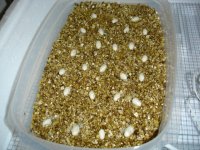
I have a new cluth of Sambava eggs and need to know what that proper humity level for the incubator should be.......... I have the eggs in moist vermiculite and the level is now at 31%.


ANY HELP WOULD BE GREAT
 
is the level of humidity in the container or the incubator? The humidty for my veileds was at 80% but Im not sure if that is the same for panthers.

I can't find anything that has a % only how to mix the incubation medium and use a tight fitting lid.

Hope this helps (http://www.adcham.com/html/taxonomy/species/fpardalis.html):
Egg incubation: The standard technique involves spacing eggs in a vermiculite-filled container with a tight lid to retain moisture. Perlite can be used also. Vermiculite should be at 400 (0.4 to 0.7 parts water to 1 part dry vermiculite). Incubation varies from 6 months to 12 months (or longer) depending on the temperature, moisture content of the incubation medium and perhaps the locale of origin (climatic variation). If the temperature is kept at 65-78ºF hatching can occur in 6-9 months. The eggs are laid before vascularization and a 3-6 month diapause (no embryo development-dormant) is associated with this species. If incubation temperatures are too high in the early stages of incubation, diapause is extended. It is recommended that temperatures in the mid-high 60's to low 70's be used in the first couple of months with a gradual warming if one wishes to break diapause. Candling of the eggs can determine if the eggs are in diapause (yellow light) or are undergoing vascularization (pink color-blood islets). Eggs incubated at over 80ºF in early incubation can remain in diapause for over 12 months in some cases.

Here is some info by locale:
http://www.chameleonnews.com/year2003/july2003/incubation/incubation.html
 
Wish I knew more, hope they all do well and hatch out for you, the waiting on the long term incubation of the veileds drove me crazy but it was so worth it when they started popping out of the eggs a couple weeks ago lol
 
MY treasures

Eggies
 

Attachments

  • Sambava Eggs (1 day).JPG
    Sambava Eggs (1 day).JPG
    155.1 KB · Views: 87
What type of incubator are you using. i have the hova bator that does not have a fan. do you think it is esentioal for humidity. i am also getting ambilobe eggs.
 
Back
Top