• Responding to email notices you receive.
    **************************************************
    In short, DON'T! Email notices are to ONLY alert you of a reply to your private message or your ad on this site. Replying to the email just wastes your time as it goes NOWHERE, and probably pisses off the person you thought you replied to when they think you just ignored them. So instead of complaining to me about your messages not being replied to from this site via email, please READ that email notice that plainly states what you need to do in order to reply to who you are trying to converse with.

  • IMPORTANT! PLEASE READ!! About the Google Adsense ads being displayed

    =====================
    Posted 08/15/2025
    =====================


    Yeah, I know. They are a pain in the butt. But they pay the bills to keep my server running. Just a fact of life, I am afraid.

    Want to get rid of them? Simple. Just become a Contributor level member or above and they will be gone. -> Please click HERE."

    Is that too much for me to ask of you to keep this site running? Well, sorry about that. I too wish I could get everything for free. But alas.....

    =====================
    Addendum: 01/10/2026
    =====================


    Google Adsense ad revenue for December, 2025 was just $30 over the cost of the lease for the server running this site. So, in effect, the money providing the incentive for me to continue running this site is coming SOLELY from the paid memberships and sponsorships here. Which honestly ain't much....

I need some help

Drakan79720

New member
Joined
Apr 1, 2006
Messages
11
Reaction score
0
Points
0
Age
39
Location
Texas
I recently adopted a Cuban Knight Anole from a pet store,he has bad burn scars on his stomache from a heat rock, and has a severe case of mouth rot, they just gave him to me, they didn't even know what breed of lizard he was! I know alot about reptiles, and i've seen his condition before, but the mouth rot he has is extremely hard to get rid of. Every day I clean the mouth rot with water and then put peroxide on him, then I mix a little iodine and water together, and rub on it. The only problem is that the black crusty stuff around his mouth keep coming back! I have already took him to the veterinarian, she prescribed him some baytril, he's been taking it, but his condition isn't getting any better. Any suggestions? :bawling:
 
I just wanted to add that his (Slim, his name) humidity level is at 85, and the approxamate temperature is 90 F, he isn't drinking or feeding right, so I have to help him along, I give him a nightcrawler/cricket/calci powder slurry, I give him alot of water through an eye dropper, and spray him down with warm water constantly to hydrate him.
 
wow, if there were only more people like you in this world who loved reptiles!!

the only thing i could think of, if your worried about black icky stuff around the mouth, is to drop the humidity a little, this could be stressfull on the little guy though. peroxide, iodine, and batryl sounds like a pretty good arsenal for treatment.

but that sounds like the least of the little guys problems... I'd say follow through with your vet and antibiotics... keep doing what your doing and wait it out.

good luck with the little guy!
 
cuban knight anoles are highly arboreal, so (if you haven't already) set him up accordingly. the 90 degrees is ok for now, but you will want to let him have some access to a cooler area (too hot for too long = stress). He will probably never drink out of a bowl, so don't expect that - he should drink off the foliage and the sides of the enclosure when you mist, but what I always preferred to do was drip water onto their heads...they're shaped perfectly for this, and the water running down stimulates them to drink :D. Don't push the feeding right now unless he is grossly underweight - give the mouth a chance to heal. Stop using the peroxide - it damages healthy tissue in the process of cleaning the injured area. Messing with it too much lengthens the healing time because you continually refresh the injury. If you don't see caseation, leave it alone. If you are still finding caseous matter, cleaning it out every other day is sufficient. After removing it, dab lightly with a dilute (tea colored) betadine solution. The black crusty stuff is likely the injured area trying to scab. Like any other scab, when you remove it prematurely it causes bleeding, which clots & forms another scab. It sounds like you have the right ideas, but are just being a bit too aggressive with treatment
 
Mouth rot (infectious stomatitis) is generally considered to be a secondary infection...that is to say that it is usually not the main problem. While certainly things such as direct injury can lead to the development of a primary case; the usual avenue is stress, illness, suboptimal conditions, etc weakening the immune system & allowing the ulceration(s) to form & progress. When caught early, correcting the base problem and instituting corrective and supportive therapy are usually sufficient (fix the problem, increase temps, minimize stress, and treat the wounds as needed). However, as it progresses a few things happen: Frequently systemic infection builds which requires antibiotic therapy. The ulcerations advance and deepen, affecting more and more healthy tissue, and (in extreme cases) sometimes affecting bone or muscle structure. Old school treatment was varied, but often included household items such as Listerine and/or hydrogen peroxide. Both were actually of some benefit, but there are much better ways. As previously stated, the old standby - peroxide - actually damages healthy tissue as it works to slough the dead/injured cells, thus lengthening the healing process. Certain oral care solutions, dilute betadine, dilute chlorhexidine (use with care over an open wound), or antibiotic flushes are all better options. When removing caseous matter, care should be taken to ensure that neither it, or any flushing solutions are allowed to pass the glottis (go down the trachea). Personally, I recommend against letting it go down the esophagus as well.
Keep in mind that the treatment process is very stressful, and can often aggravate the condition (think: prying the mouth open generally involves putting pressure on weakened tissue, even if you avoid the injured area...AND cleaning out the wound typically means reopening it)

 
Esoteric lizard thanks for the compliment i'll try to drop the humidity slightly that might just help enough to get rid of it, probably drop it 5 or 10 degrees. HHmoore well the veterinarian said I should keep it 90 degrees all around, (it helps with the healing process.) He dousn't drink out of a bowl, or off of the plants I have in there, the way the vet put it is that the wound has somewhat traumatized him into not eating or using his mouth, I spoke with his vet this morning and she said just to keep feeding him and giving him water like i've been doing and he'll eventually snap out of it and eat and drink on his own. I will stop using peroxide, I was unaware of the damage I was doing, the black crusty stuff isn't a scab, it's ... Here i'll describe it to you, it's black kind of crusty, and kind of sticky. It dousn't make him bleed when i pull it off, the vet said to keep it off or it will just make the mouth rot worse, I talked to the pet store, and they said he has had the black stuff on his snout since they got him and that was over 3 years ago! So I'm pretty sure it is not a scab. I will start doctoring him everyother day, your probably right, I am probably over reating him. Caliscot What kind of antifungal should I use, or what do you recommend?
 
don't worry about me prying his mouth open he's an aggressive species and it just takes a finger rub on the head and he's open and ready to bite! He hasn't swallowed any caseous matter, or flushing solution, the mouth rot hasn't gotten far enough to get all the way inside the mouth it is only on the outside and on the inner gums in the front of his mouth.
 
If you smear the black stuff on white tissue or paper or thin it with water what does it look like, what color is it when it is thinned?
 
getting some oral antifungal solution from your vet might be a good idea.

...definatly sounds like mold or some kind of fungus.
 
I don't know, but it's really hard to keep it off and from coming back. I don't have a camera or i'd post a pic, i clean it really good, and have started to do it everyother day instead of everyday, it just keeps coming back. it's not mites, i don't know. i'll talk to my vet about getting some antifungal for it.
 
it's kinda weird, it's not inside his mouth it's right on the outside on the tip of his nose and on the tip of his bottom jaw, it looks like its starting to eat away his skin, he's even missing some of his front teeth on the tip of his bottom jaw
 
instead of trying to get some antifungal stuff for it, why not try to figure out what it is and treat it accordingly (I am not saying that an antifungal agent is inappropriate, just that it makes more sense to identify the problem vs just jumping blindly from treatment to treatment). The greenish black coloration does make me think of molds/fungi, but it is very difficult to say without seeing it in person. If that is the case, I would definitely drop the humidity a bunch.
 
well i don't think it is fungus or mold, because it's not fuzzy, and it's more blak than green, and it's more crusty
 
Drakan79720 said:
well i don't think it is fungus or mold, because it's not fuzzy, and it's more blak than green, and it's more crusty

is on the outside or coming from the inside... like drainage of some sort?

1) your reptile is already on antibiotics.

2) your using antiseptic to clean... which kills molds, fungus, virus, and bacteria.

... your herps immune system is probably already compimised. i would suspect some opportunistic pathogen (such as a highly resistant mold).

mold = fungus.

fungus doesnt have to bee fuzzy... there are literally thousands of different types of fungi flouting around - almost all of these require some level of humidity.

hhmoore is right... you must find the cause of something before you treat it.

maybe you can look around online and see if you can find any pics of molds or fungi.... go to the library too.

also, you mentioned lost teeth and abrasions on the front of the top and bottom jaw.... this sounds like it could be nosebubbing. call your vet... but i would at least irrigate it with saline solution everyday...

what are you keeping it in?

i would put the animal in a clean container that doesnt have any dirt at all... you might want to try a rubbermaid container with high sides.
 
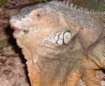
if i put him in a bare container that woud stress him,right now he's in a 5ft long 3ft wide and 4ft tall terrarium. here is a pic of what it looks like (I know it's an iguana, but try to picture it on a cuban anole)
 

Attachments

  • 841949216.jpg
    841949216.jpg
    2.4 KB · Views: 73
he has zoo meds rainforest bedding on the bottom and some fake leaves so he can make an effort to drink from. I've already been to a vet, she said mouth rot, they lose teeth and scales from it. i already know what he has I was just looking for ideas on how other people wih pets that have the same problem have handled it. and no it's not nose rubbing that is causing the abrasions and teeth loss. thanks for the ideas anyway. as for the fungus your probably on to something, i'll continue regular treatment until I hear from the vet and talk to her about it
 
The thing is, I have never seen anything like what you describe--the crusty black/green stuff.

As has been suggested, putting some of it under a quality microscope to get a look at it and culturing some of it for identification and antimicrobial sensitivity might be very enlightening.

One of the consequences of antibiotic use is that once the large numbers of bacteria are killed off, it opens up opportunities for other pathological organisms to take over. Mold and yeasts are some of these. Still, there would have to be significant immunosuppression to open this door. If so, treating infections without addressing the immune disorder can only go so far.
 
Back
Top