• Responding to email notices you receive.
    **************************************************
    In short, DON'T! Email notices are to ONLY alert you of a reply to your private message or your ad on this site. Replying to the email just wastes your time as it goes NOWHERE, and probably pisses off the person you thought you replied to when they think you just ignored them. So instead of complaining to me about your messages not being replied to from this site via email, please READ that email notice that plainly states what you need to do in order to reply to who you are trying to converse with.

  • IMPORTANT! PLEASE READ!! About the Google Adsense ads being displayed

    =====================
    Posted 08/15/2025
    =====================


    Yeah, I know. They are a pain in the butt. But they pay the bills to keep my server running. Just a fact of life, I am afraid.

    Want to get rid of them? Simple. Just become a Contributor level member or above and they will be gone. -> Please click HERE."

    Is that too much for me to ask of you to keep this site running? Well, sorry about that. I too wish I could get everything for free. But alas.....

    =====================
    Addendum: 01/10/2026
    =====================


    Google Adsense ad revenue for December, 2025 was just $30 over the cost of the lease for the server running this site. So, in effect, the money providing the incentive for me to continue running this site is coming SOLELY from the paid memberships and sponsorships here. Which honestly ain't much....

Is this color normal?

shmeh

New member
Joined
Sep 4, 2006
Messages
7
Reaction score
0
Points
0
Age
42
Location
Chicago
I just purchased my first veiled chameleon, and its color is clay brown. Every picture I've seen shows juveniles to be a lime green with the exception of discomfort. Mine remains this brown, sometimes getting a little darker when threatened. Does this mean it is unhealthy? Will it change to green?

my.php


Thanks, I'm still learning and appreciate any help I get.
 
Actually

Thanks but I've actually already read that. What i'm looking for is more reassurance that yes, infact, this chameleon looks perfectly healthy, even if it remains brown all the time. I also want to know if and when it will likely grow out of the bland color?

I just want to make sure that I didn't get an unhealthy lizard.

Thanks
 
Ok

Well that brown color could be that is he really happy, or he is stressed, lets assume he is stressed. I take it that you have all the things it needs, UVB, humidity and temp iis right. So lets try wrapping the outside of its cage in typing paper and making sure that it is in a low traffic room with out alot of distractions (music, TV, basically noise).

Mine would turn brown like that when the kids were nearby and the paper trick helped out alot.
 
Also

As pictured, I have the UV fixture and a heat lamp with a zoo-med 75W bulb. If it is too cold, would I up the 75W to a 100W, maybe add another 75W fixture, or something else? Again, thanks for all help.
 
Hi shmeh,
I've never seen an enclosure quite like that. Is it screen on all sides? If the top is glass it isn't good, but all sides of screen would work for him periodically, but he will grow out of it before you know it. You will have to have something lined up for him in the future. Is your flourescent bulb a full spectrum? The way to tell if you heat bulb is hot enough is to purchase a thermometer and place it in the spot where he will be basking. You want a cooler area for him to be able to get away from the heat too so the larger the enclosure the better and you don't want to heat the entire cage, just the basking spot. They use thermoregulation for food digestion which means that he will move into the heat for a period of time and move out of it when he needs to.
 
Your chameleon looks healthy to me . His eyes are very alert.I have a lot of veiled chameleons several cluthes that hatched in June and JUly. One of my Mammas kind of stay dark. She blends in with the color of her cage. As long as it is eating and drinking I would not worry about it. Because the eyes are very alert.
 
Howdy,

Jeremy is right about temperatures. Either use a dedicated wire external probe type thermometer ($10-$20) and/or get a http://www.tempgun.com/order.html#pe2 PE-2 Temp Gun $45 for measuring, among other things, the actual skin/body temperature when measured between about 0" to 8" away from the chameleon.

Part of figuring out what is "wrong" with a chameleon is eliminating as many things that have been known to create problems in the past with other keepers. One of the things that you are trying to do is reduce what stresses-out your chameleon. It may be discovered that what was a problem with one keeper's chameleon isn't a problem or doesn't bother your chameleon. BUT eliminating as many of these things is what offers the best chance of ending-up with a healthy, stress-free critter.

Potential issues:

It looks like you are using an ESU fluorescent tube and fixture. Did you remove the plastic lens? Don't feel bad if you didn't. We, of the UVB_Meter_Owners Group, "beat-up" the mfgr about this lens and its filtering of ALL of the healthful UVB thus leading to the slow, painful death of many a chameleon. They are looking into providing a type of screen cover for the tube. If you still have the lens in place, just unscrew the two screws holding the clear plastic cover and remove it (just like the rest of us do!)

When you feel that you have $14-$20 available, replace that tube with a Reptisun 5.0 tube made by ZooMed. (Online pricing as low as $14 per tube.)

I am familiar with your type of enclosure. 90% of successful USA chameleon keepers will recommend that you not use any substrate on the floor of the enclosure. This allows for all of the water that is dripped and misted (easily a quart per day) to be drained out through small drain holes eliminating the potential for dangerous bacteria build-up. Your situation is complicated by the fact that you have a glass bottom. If you want to follow what works for most people, with buy a new screen enclosure that has a PVC bottom that you can drill and let the dirty water drain into a catch pan. You can also bust-out the glass bottom and insert a PVC (plastic...) bottom that can also be drilled with many ~1/8" holes. I've actually busted out glass from those exact same enclosures (tough glass!) helping a friend modify his enclosures for "full misting".

Your chameleon needs to be able to get within 6"-12" of the UVB source otherwise the UVB effect will be minimal - not good. Your 75W heat source is likely to be sufficient when positioned to meet the basking temperature spot. You may find that you need to raise it above the screen top to get the temps set properly.

Look into adding some live plants. Try Ficus and Dwarf Schefflera. Raise them at least 1" off the bottom to allow for proper drainage and floor drying. Many chameleons seek out dense plantings for a sense of security. Less stress! Add more climbing structures that are smaller diameter for full grasping. The live will fix a lot of that but also add things that are about the diameter of a pencil too.


Chameleons are often more comfortable looking down at their keepers, so if you are able to raise the enclosure, the higher the better! Less stress!

Glass sides have been found to stress-out some chameleons from seeing their reflection. Put your chameleon in front of a mirror once to see the effect. Also chams have had tongue injuries trying to shoot flies on the outside of the glass!

That's it for now...

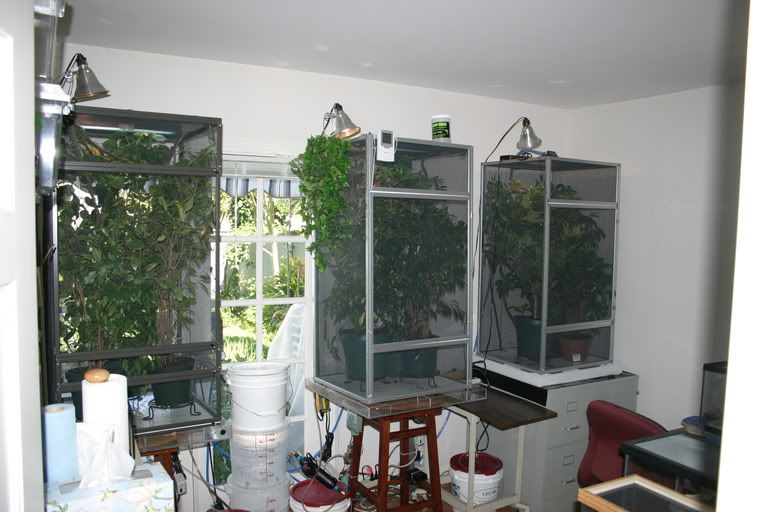
Oh, an old photo of my setup as what I mean about plants. These are 24x24x48 enclosures at about $100-$150 each.

Dave Weldon

 
Thanks

Thanks a ton for all of your responses, I am looking into everything and bought a thermometer. Just one last question, on about.com it says that veileds start out brownish and gain new colors at 5 months. Since mine is about 2 months old I believe, is this a possible explanation?
 
shmeh said:
...says that veileds start out brownish and gain new colors at 5 months. Since mine is about 2 months old I believe, is this a possible explanation?
Howdy,

If you had a panther then I could see it being brownish for a few months, but I have found that veileds seem to be green from the beginning and will go brown when things aren't to their liking (a bit stressed...) or there is a health issue... Your critter may be just fine or it may be trying to tell you that something isn't up to its liking. That's where eliminating possible trouble spots come into play.

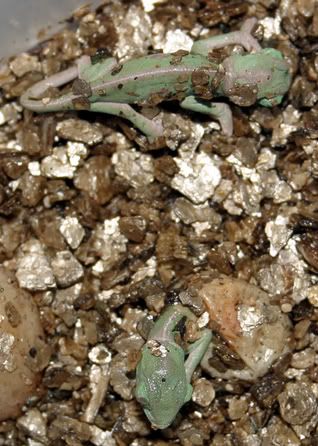
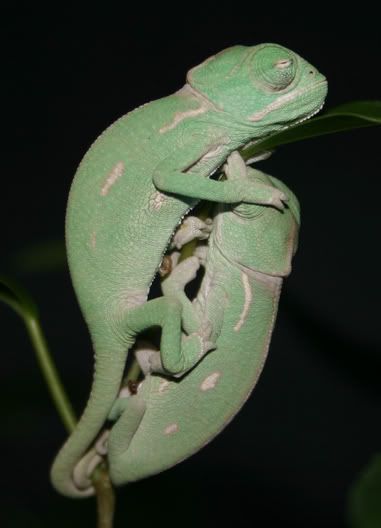
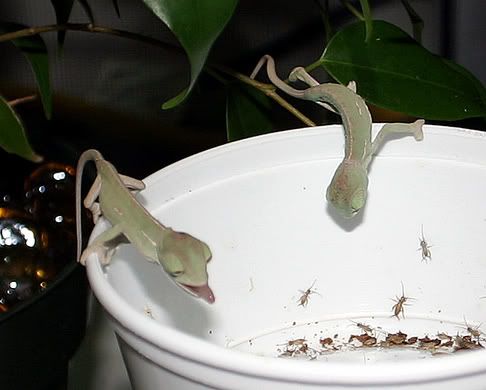
Here are some shots of a batch of 57 veileds that I hatched for a friend last year.

Day 1:
8.jpg


~Day 2:
10.jpg


~Day 3:
7.jpg
 
Well I replaced the 75W with a 100W bulb, and I also replaced the fake plants and wood chips with some newspaper and a live sephelera plant. After 2 days, he remains virtually the same. Next stop, I'm placing a towel on the sides of the cage and see if he calms down by toning down the visual stimuli. He looks perfectly alert and healthy otherwise, so I'm guessing that he isn't sick. I'm on a mission now to turn this thing green...
 
My baby chameleons are green from the very beginning. A few were brown after they hatched but after they got in the screened cage they lightened up. I have some more available if you are interested in getting a mate for you new chameleon. The picture of the mom and dad are in the fauana classifieds chameleons for sale under Tejas ranger Bob and Sandy England.
 
Mission Accomplished

Well some how or another, my veiled slowly began turning green. After my initial posting, I made the changes that I mentioned, and sure enough, he's a vibrant green most of the time. No clue whether it was just the stress of transportation, pet store malnourishment, or heating, but he looks quite healthy. Thanks for your help.
 
I am glad to see your little is guy is turning green. They are such a joy to watch. I spend a lot of time just watching my baby chameleons. It is a real joy to see my parents offspring. I purchased the parents when they were just babies. Enjoy
 
Back
Top