Sexing Day Part II
I probed almost all of the holdbacks, as well as T3 and, for the second time, T1. I also took the opportunity to get weights for everyone who was probed today. It was a fairly simple procedure. I just weighed the entire tube with the snake inside and subtracted the weight of the tube after the fact. I wish I had thought of that last week. I skipped E2 because he appears to be having some shedding issues, and I did not want to exacerbate them. I also did T1 for the second time to double check my count from before, now that I have more experience with them. The numbers are as follows.
T1 weighed in at 28 grams and probed to 7 scales this time, making him a clear male. I think the combination of not having my technique down and T1's tensed up muscles is what caused the misprobing at 4 last time. I have noticed that if I get three or more, I can usually adjust the angle and try again and get more. None of the animals thus far have probed more than 3 consistently without eventually probing higher. Generally, they are very clearly bottoming out at 2-3 or going beyond that, and the more ambiguous ones tend to be at least 6 or more when another attempt is made by adjusting the angle or allowing the snake to relax a little. It is also worth pointing out that despite being one of the "troublemaker" group and getting a late start, T1 has caught up to most of his siblings in size.
T3, on the other hand, is still one of the smaller animals. Still at a healthy 22 grams, I am not worried about her. She probed to 2 subcaudals, and was about average to deal with.
E1 probed to 2.5 subcaudals, a clear female, and weighed 28 grams. This is slighly over the average weight of 26 grams for the 11 animals weighed today.
E3 probed to 2 subcaudals and weighed in at a whopping 34 grams. She was the largest and one of the more cantankerous of the bunch.
E4 probed to 6 subcaudals and weighed in at 30 grams.
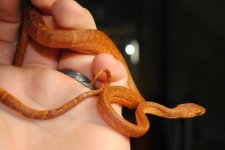
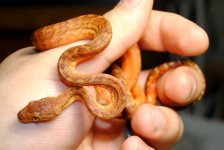
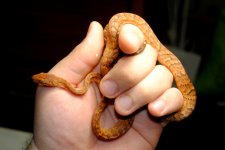
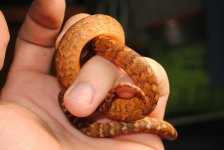
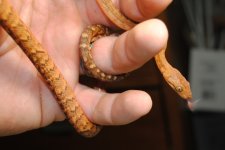
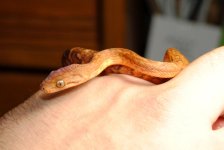
The "H" group was noticeably easier to work with than the "E" or "T" group, presumably because many of these animals were selected for their lower anxiety levels and better handleability. The only exception was H6, which surprised me at first, until I remembered that H6 was added to the holdback group after the fact, and that this was due to color considerations, not tameness. This suggests that a general anxiety level can be expected to remain consistent (at least from the age of 2-3 weeks to the age of 6+months). I will be interested to see if this continues through adulthood and into the next generation, as I would be very interested in producing lines of lower-anxiety animals that were less susceptible to stress and easier to handle. Many of the H group likely could have been probed without the use of the restraint tube (or even the hemostat to put them in it, for that matter), and the three that I tried with were still docile enough AFTER the procedure to perch calmly on my hand for a few photos.
H1 weighed 28 grams and probed to 6 subcaudals. A definite male.
H2 weighed 26 grams and probed to 2 subcaudals. A definite female.
H3 weighed 30 grams and probed to 5 subcaudals. I am confident that H3 is a male, which is somewhat disappointing, as H3 is one of my favorites. I may have to make an exception to the idea of holding back all females. Either way, I intend to hold on to the entire H and E groups for at least the first year before making any final decisions.
H4 weighed in at 26 grams and probed to 2 subcaudals. A definite female.
H5 weighed 32 grams (one of the largest) and probed to 3 subcaudals. I'm fairly confident this one is female, but a second attempt in the future may be warranted.
H6 weighed 30 grams and probed to 7 subcaudals. The definitive male probing and lack of tameness may override the exceptional color quality of H6, but again, none of those decisions will be made any time soon.
So, to sum it up, out of 14 probings, I have a ratio of 6.8. This does not include the non-holdback group or the scented pinkie eater, who I have no real reason to sex at this time. Out of 11 weights, we have a range of 22-34 grams, with an average of 26. You will also notice that there does not appear to be much of a correlation between sex and size at this age, though a cursory look does show a difference between sex and appetite, as E1, E3, H4, and H5 are probably some of the best eaters, though there are clear exceptions to this observation as well.
One final bit of news. At almost the one year anniversary of the start of this thread, which began with a picture of two Jamaican Boas locked up, my other two, Kingston and Lucia have locked up as well. After a few months of half-hearted interest, this last re-introduction of Kingston, the male, to Montego, the other male, has apparently given him a little more of a sense of urgency. I put Kingston back in with Lucia (the female) yesterday, and they have been locked up all day. Hopefully, this means unrelated offspring in August.
Pictured are the newly paired adults, H2, H3, and H4.