• Responding to email notices you receive.
    **************************************************
    In short, DON'T! Email notices are to ONLY alert you of a reply to your private message or your ad on this site. Replying to the email just wastes your time as it goes NOWHERE, and probably pisses off the person you thought you replied to when they think you just ignored them. So instead of complaining to me about your messages not being replied to from this site via email, please READ that email notice that plainly states what you need to do in order to reply to who you are trying to converse with.

  • IMPORTANT! PLEASE READ!! About the Google Adsense ads being displayed

    =====================
    Posted 08/15/2025
    =====================


    Yeah, I know. They are a pain in the butt. But they pay the bills to keep my server running. Just a fact of life, I am afraid.

    Want to get rid of them? Simple. Just become a Contributor level member or above and they will be gone. -> Please click HERE."

    Is that too much for me to ask of you to keep this site running? Well, sorry about that. I too wish I could get everything for free. But alas.....

    =====================
    Addendum: 01/10/2026
    =====================


    Google Adsense ad revenue for December, 2025 was just $30 over the cost of the lease for the server running this site. So, in effect, the money providing the incentive for me to continue running this site is coming SOLELY from the paid memberships and sponsorships here. Which honestly ain't much....

Jamaican Boas Breeding

I would also like to describe one other anomaly that I have noticed. Escapee #4 has done something unusual two separate times now. Both Week 1 and Week 3, I have come downstairs to find a chick bone with skin attached on the floor of Escapee #4's cage. Thorough inspection shows that there is nothing but the bone and skin left, and inspection of Escapee #4 shows a clear bulge in the middle, where presumably, the meat alone lies. .

I'm fascinated by the possible mechanisms of this - how does it physically do it? Digest the meat and regurgitate the bone? Time for a time lapse camera in that container! :D
 
I'm fascinated by the possible mechanisms of this - how does it physically do it? Digest the meat and regurgitate the bone? Time for a time lapse camera in that container! :D

I find it considerably confusing as well, and was also tempted to try to set up some sort of camera. Haha. The best I can figure, I think the snake is striking the thigh, wrapping it up, and pulling on it. Because the teeth would be latched to the meat, but the body would still be able to push and pull against the bone, the meat is ripped off in the exchange, and gets swallowed separately. It would be in keeping with the behavior that I have seen from many of the adults. The sire of the clutch, for instance, has a habit of striking the head of his food, wrapping his body around the rest, and pulling and twisting the head and neck. Presumably, this would help with constriction and/or neck-breaking, but I have definitely seen him do some serious damage to a prey item in the process. This is what I think the one hatchling might be doing to his or her food. this is, however, all speculation on my part.
 
OK, so Feeding Week #4 is not the greatest in terms of numbers. Moving the three non-feeders to screen cages appears to have had no effect so far. None of those three ate this week either. I'm still hoping that more time in the screen cages will have an effect next week. If they do not eat next week, I will attempt to get them feeding via other methods (different scenting, different foods, etc)

In addition, three of the previously feeding animals chose not to eat this week as well. Of these three, one of them was Escapee #4, who was recently moved from a screen cage, and could have been responding to the stress of the move. Another snake that skipped was one that I spooked taking a picture (more details below). As for the third, I'm not sure why that one did not eat, but it could be a number of details. I am not especially concerned about these three, as they have all eaten at least two meals previously. I know the adults can be a bit temperamental when it comes to feeding regularly (one of my adult females just decided she wasn't going to eat this week, either) and it doesn't seem to effect them too much, so as long as the youngsters pick up the feeding again next week, I'm sure it won't be an issue.

One good bit to report, is that there was a drastic increase in the number of animals who ate immediately. I would say more than 75% of the snakes that ate had already eaten their food within two hours, which is significantly more than previously. I take this as a good sign with regard to the snakes' development and security.

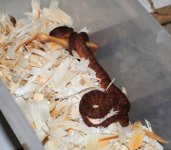
One other quick note, I managed to spot some constriction behavior for one of the snakes in the feeding process. I haven't had many opportunities to witness feeding directly (as I'm trying to avoid disturbing them) so this could be an isolated incident, or it could be the norm, but I thought I'd include a picture here. This snake was one of the three that refused its meal last night, though, so the picture process may have spooked it off of eating. You'd think I would learn, but if the last time is any indicator, this one should not have any trouble next week.

 

Attachments

  • DSC_0001.jpg
    DSC_0001.jpg
    180.3 KB · Views: 220
How long after eating are they defecating? Is it possible that they simply may not need to eat that frequently?

Hard to say. Usually about 4 or 5 days would be my best guess, but I try not to disturb them any more than necessary, so I haven't been checking all of them every day. It wouldn't really apply to the three trouble feeders, though, as none of those three have eaten even their first meal yet.
 
This is a great thread. Nice work. How long have you been keeping the species? Have you been keeping track of your parameters - both parents and offspring - such as temperatures, light cycles, humidity, etc? Perhaps you will see a pattern that can help both with your current feeding issues and future husbandry.
 
This is a great thread. Nice work. How long have you been keeping the species? Have you been keeping track of your parameters - both parents and offspring - such as temperatures, light cycles, humidity, etc? Perhaps you will see a pattern that can help both with your current feeding issues and future husbandry.

Ambient temperatures are a 72-78 range with an 85-90 degree hot spot for all animals. Humidity is a steady 65%. For breeding adults, I shut off the hotspot heat and decrease light by one hour per month until it is down to eight hours of light per day, then bring it up by the same increments until it is back to 12 in the spring.

Because there are only three left not eating, it is difficult to determine any differences for them, but any minor differences should be rectified by moving them into my best feeders' cages, assuming that the problem is environmental. If that doesn't work, I am forced to assume that the problem is these indiclvidual snakes. Perhaps these three are just pickier eaters and will need lizards after all.
 
Looks like we have a few working on their second sheds. This may have something to do with the three eaters who skipped last week. We'll see if it has any effect on this week's feeding numbers.
 
Chick Thigh Prep

I have had a couple of people ask me about how I specifically prepare the chick thighs for these guys, so I figured I'd put together a quick how-to for demonstration purposes. Fair warning, these are pictures of a chick being cut up, so if you are particularly squeamish, you might want to skip the next few posts. For the record, this is a frozen thawed chick that was humanely killed with CO2.

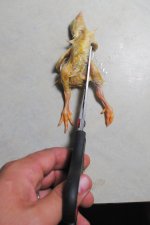
Step One: After properly thawing the chick(s) to an appropriate temperature, place the scissors directly along the edge of the leg where it meets the body, taking care to get as much of the leg as possible without cutting into the abdomen itself. If you accidentally cut too deep, it is a bit messy.
 

Attachments

  • DSC_0002.jpg
    DSC_0002.jpg
    162.4 KB · Views: 179
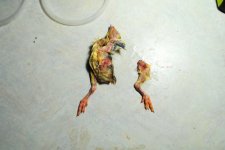
This will give you as much of the leg as possible. The end result should look like this. There is about half of the femur, followed by the rest of the leg. If you did it right, the rest of the chick is still intact and can be fed to a larger animal with no effect.
 

Attachments

  • DSC_0016.jpg
    DSC_0016.jpg
    118.7 KB · Views: 173
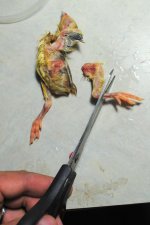
Step Two: Place the scissors just below the ankle, so that the whole of the joint is included with the thigh, and the rest of the foot and toes will be removed.

I cut below the ankle, because if you cut above it, you sever a lot of the tendons and ligaments that hold the meat to the bone. This makes the end product a bit less compact and presumably, a little harder for the snake to maneuver.

I am not certain that the feet need to be removed, but in my experience feeding other snakes, the feet tend to be the hardest part to digest. I don't imagine that there is a ton of nutritional value in the feet that will be missed out on, and I feel that this makes the end product easier to swallow (as now the snake can swallow it from either end, if it so chooses) and probably easier to digest.
 

Attachments

  • DSC_0019.jpg
    DSC_0019.jpg
    192.6 KB · Views: 169
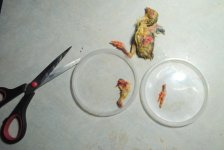
And here we have the end result. The chick, with legs removed, ready to be fed to an adult, the thigh, with complete joints on each end, and the foot, which can be discarded or fed to a third animal (make sure you know who you are feeding this to, as the animal should be large and have a strong stomach) I generally feed the feet to a yearling tegu.

Take the now prepared thigh and place it somewhere in the animal's vivarium. There does not seem to be any advantage to placing the food near the animal or in any other particular location within the viv. They don't seem to have any trouble finding the food, nor do they seem especially enticed by it being nearby. After placing the food in the enclosure, and I can not stress this enough, leave the animal alone with its food for as long as possible, preferably until the next morning. The slightest interruption in the process can cause the snake to go off feed for an extended period of time. Be strong.

If you have done everything right, the final product thigh should be an appropriately sized, nutritional, and easily managed (both for you and the snake) food item. I do have some concerns about the lack of organs (and thus potential lack of vitamins, minerals, or other nutrition) in the thigh, so I recommend stepping up as soon as possible to some sort of whole food item such as juvenile mice, quail chicks, etc. I don't know for sure that the lack of a whole food item will cause long term issues, but I see no reason to chance it, and will be upgrading my own animals as soon as they are ready.

I hope this has been informative, and please feel free to ask any clarifying questions.
 

Attachments

  • DSC_0025.jpg
    DSC_0025.jpg
    111.3 KB · Views: 182
Back
Top