• Responding to email notices you receive.
    **************************************************
    In short, DON'T! Email notices are to ONLY alert you of a reply to your private message or your ad on this site. Replying to the email just wastes your time as it goes NOWHERE, and probably pisses off the person you thought you replied to when they think you just ignored them. So instead of complaining to me about your messages not being replied to from this site via email, please READ that email notice that plainly states what you need to do in order to reply to who you are trying to converse with.

  • IMPORTANT! PLEASE READ!! About the Google Adsense ads being displayed

    =====================
    Posted 08/15/2025
    =====================


    Yeah, I know. They are a pain in the butt. But they pay the bills to keep my server running. Just a fact of life, I am afraid.

    Want to get rid of them? Simple. Just become a Contributor level member or above and they will be gone. -> Please click HERE."

    Is that too much for me to ask of you to keep this site running? Well, sorry about that. I too wish I could get everything for free. But alas.....

    =====================
    Addendum: 01/10/2026
    =====================


    Google Adsense ad revenue for December, 2025 was just $30 over the cost of the lease for the server running this site. So, in effect, the money providing the incentive for me to continue running this site is coming SOLELY from the paid memberships and sponsorships here. Which honestly ain't much....

Jamaican Boas Breeding

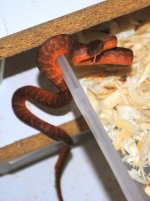
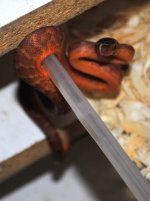
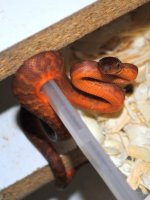
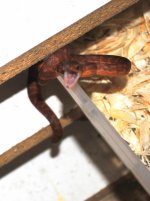
I know it's been a while since I posted some pics, so here's a few. This is my most aggressive baby. He's also my messiest. I've had to completely swap out his tub three times now. (I usually spot clean the others). Today, he decided that instead of going into his new tub, he was going to perch on the rim of it and take pot-shots at me. Let me tell you, these guys have an impressive striking distance. He managed to graze me from about 12 inches when I got a little too careless filling his water bowl (which is impressive considering he's probably only about 20 inches long). I imagine that kind of reach comes in handy when you're trying to pick anoles off in the trees.
 

Attachments

  • DSC_0003.jpg
    DSC_0003.jpg
    227.6 KB · Views: 142
  • DSC_0012.jpg
    DSC_0012.jpg
    207.2 KB · Views: 138
  • DSC_0013.jpg
    DSC_0013.jpg
    204.2 KB · Views: 146
  • DSC_0014.jpg
    DSC_0014.jpg
    207.4 KB · Views: 133
Feeding update for this week. Today, the 9 holdbacks were fed their usual chick thigh, as were 6 of the others. The 4 remaining pinky-eaters (one was sold last week) and 3 random others were fed chick-scented pinkies. We will see if the switch over to pinkies from fuzzies entices the 3 who passed on last week's offering. I'll update tomorrow with results.
 
Everyone who was offered a chick thigh ate it with no issues.

Of the 4 "pinky eaters", 3 of them ate the scented pinky. This is a considerable increase in rate of consumption from last week, where fuzzies were used. In addition, one can see that the bulge formed by even "extra small" pinkies is quite substantial. I would say it is easily as wide as the bulge formed by the chick thighs and anoles, though it is considerably shorter. This indicates to me that the girth of the food item can be a major factor in both willingness to consume, as well as potentially regurging. My thoughts are that because these snakes are so long and slender, and are evolved to eat other long, slender things, they may have trouble with shorter, wider food items, such as fuzzie mice. I suspect they could handle three or four small pinkies over one fuzzie, though I have no intention of testing that theory.

The three random "others" who were offered scented pinkies declined to eat. No big deal there. They will be offered chick thighs at next feeding.

As for the three troublemakers, I have had a bit of a tough time finding them anoles. The order that I had made a few weeks ago never arrived (seller put me off a few times and is now not returning emails) so I have arranged for a new shipment that will be arriving tomorrow. These will be live, brown anoles, and since I'm purchasing 100 of them, I'm hoping that there will at least be a few smaller ones that I can offer to the two that still have not eaten yet. If that works, my intention is to wean them up to larger anoles, and hopefully anole-scented pinkies, or chick thighs, but I'm getting ahead of myself here. I have to get them eating first. If nothing else, it's good information to know that they can survive this long without food.

I will update with regard to the troublemakers after they have been offered their food.
 
Even if the anoles are too large you can freeze and split them in half lengthwise. Granted, live would probably elicit a better feeding response, but freezing would kill parasites. Anoles would be a better diet than the chick thighs, those have to be lacking some nutrients.
 
Even if the anoles are too large you can freeze and split them in half lengthwise. Granted, live would probably elicit a better feeding response, but freezing would kill parasites. Anoles would be a better diet than the chick thighs, those have to be lacking some nutrients.

I will most likely freeze many of the anoles, if for no other reason than the fact that I can not humanely house and care for all 100. My concern with splitting them, though, is that most of these guys, especially early on, were waiting a considerable time before consuming their food, presumably because they prefer to eat in privacy at night. A split anole could cause problems if it dried out or started to decompose, both with eliciting a feeding response, and with digestion/health issues. With live anoles, they can simply be left in the enclosure for however long is necessary. Hopefully size will not be an issue.

I mentioned earlier that I do have some concerns regarding chick thighs and missing nutrients, but these concerns are largely long-term, and I do not have any reason to believe that issues will arise before whole quail chicks are an option. I do have serious concerns about converting regular bird-eaters onto anoles, which could not only cause unnecessary stress and inappetence, but also could cause the snakes that did convert to anoles to reject birds in the future. Considering the problems that I have had locating feeder anoles just for these three troublemakers, I am completely unwilling to risk converting otherwise regular feeders to a largely unavailable food item, similar to my concerns with anole-scented pinkies. Basically, I see it as causing an actual problem in order to avoid a potential one. If I begin to see signs of malnutrition or if feeding becomes less regular, I always have the option of addressing it, but I see no reason to address problems that I do not have, especially considering the tremendous success so far.
 
A baby snakes can go an impressivelt long time without food. I t always sowwries me when they do...but they can.

(I have one baby Brazilian from my last litter that also does not "get" the food idea. The baby passed on a frozen/thawed rat pink...another rat pink...then a mouse hopper...then, when I finally broke down and offered a live rat pink...I found the baby hiding from the rat pink on top of its water bowl. Sigh....)
 
Yeah, that's always frustrating. It makes me wish I could just explain things to them. You're an apex predator. This is your food. You're supposed to eat it. Go on, eat it.

The anoles arrived today. I have placed a small one with one non-feeder, a medium one with the other non-feeder, and a fully grown one with the one who has already eaten three adult anoles. Fingers crossed that I wake up to three fat snakes tomorrow. Even the medium anole is noticeably smaller than the adult anoles I was feeding before, so if it was a size issue, this should take care of it. If the two non-feeders still refuse to eat even the small, live anoles, then the future does not look good for these two.

I have separated out about 40 live anoles to keep alive for the time being, just in case these guys start eating anoles but give me trouble transitioning to frozen ones. The rest I have frozen for future use. With 100 anoles, I should be able to keep these three going for some time, and hopefully more than long enough to get them switched onto something more available.
 
Alright, some good news this morning.

The anole-eater ate with no issues. In retrospect, that adult male anole was probably a little larger than is to be recommended. The snake is too fat right now to climb up into the branches, so he's just curled up on the ground looking like a reticulated python that just finished off an adult pig. Future feedings will need to be a little more moderate until he gets up to size. I will make it a point to freeze most, if not all, of the extra large male anoles.

The really good news is that one of the non-feeders ate an anole last night. It is the one that was given the "small" anole. The one that was offered the medium anole declined to eat. There are three notable differences here. First, let me give some quick background on the housing situation for the troublemakers, in case it is unclear.

All three of the troublemakers are housed in arboreal, screen cages that I normally use for small geckos (mourning geckos, lygodactylus, hemidactylus, etc.) The cages are furnished with hanging, fake plants and numerous branches. They are also misted several times per day (automatically) and heated with 50 watt halogen lamps (temp range 75-85 with a 100 degree hotspot). The original theory behind putting the non-feeders into these cages was that the "escapees", who were originally in screen cages out of space necessity, all ate at statistically higher and faster rates than the average, which led me to believe that the extra exercise of roaming the reptile room and climbing the branches led to a stronger appetite. I have since learned that this was likely not true. I believe that I was assuming a reversed causation. Instead of assuming that escape promoted appetite, I should have considered that both escape and appetite would be linked, due to both being caused by higher energy, strength, alertness, etc. Bottom line, the Escapees were always destined to be good eaters, regardless of whether they managed to find their way out of the birthing cage and go walkabout.

Anyway, back to the troublemaker group. At this time, the reliable feeder and the former non-feeder are currently in a cage that is divided in half with a divider, so their space is approximately 9x12x20h. The remaining non-feeder is in a whole cage, which is 18x12x20h. This makes the differences between the former and current non-feeders as such:

1) the former non-feeder was offered a smaller anole, so offering a smaller anole to the other non-feeder could prove productive

2) the current non-feeder is in a larger cage than the other. This could prove to make seeking and catching the anole at night more difficult for the snake.

3) yesterday, when I was sorting out the anoles, an extra large adult anole got loose and ran into the cage with the former non-feeder. Knowing that I had already struck out with adult anoles on this guy, I opted to simply switch him over to the cage with the reliable anole eater (which had no anoles in it yet) and move the reliable one to the cage that already had an adult anole in it. I believed this would be less stressful to everyone than tearing the cage up trying to catch the adult anole. The possible theory here is that being placed into a new environment may have encouraged exploration, which in turn may have encouraged the seeking out and consumption of food.

The best way I can think of to test this theory is by first adding a smaller anole to the cage with the non-feeder and seeing if that does the trick. If it does, we know it was just a food size issue. If, after several days, this smaller anole has still not been eaten, I will move the non-feeder to one of the smaller cages (most likely the one that houses the reliable anole-eater) and see if that helps. If this prompts a feeding, it will be hard to determine if it is the cage size or simply the cage change that helps, but the important thing is to get them eating.

The other nice thing about all of this is that it goes back to the earlier discussion we had regarding picky eaters vs non-eaters. This shows that at least 2 of the 3 that would not take chick thighs were in fact "picky" and not somehow lacking in the ability to eat. The former non-feeder, it turns out, was just even more picky than the reliable anole-eater. Not only did he insist on live anoles, but they had to be small ones to boot. I'm hoping the last remaining non-eater feels the same way. I will add a small anole to the non-feeder's cage and update if it disappears.

 
Excellent update (as always!). Fingers crossed that the last one eats for you.

On a related note, what kind of survival instinct drives you to "escape" to the only place in the house that holds an animal who regards you as its favorite meal? I say that was just weeding the gene pool.... ;-)
 
Excellent update (as always!). Fingers crossed that the last one eats for you.

On a related note, what kind of survival instinct drives you to "escape" to the only place in the house that holds an animal who regards you as its favorite meal? I say that was just weeding the gene pool.... ;-)

To be fair, he was running from me. The baby boa probably wasn't noticeable next to what an anole must perceive as Godzilla. Plus, he did have the sense to hide in the cage with the snake that wouldn't have eaten him, I just managed to foil his plan with the ol' switcharoo.
 
Checking on everybody today yielded the information that almost everyone is in blue. Hopefully this will warrant update photos in the near future. Stay Tuned.
 
Quick update- The reliable anole feeder has been moved to a tub in the hatchling rack. I will attempt to feed a frozen anole next week at regular feeding time. The Former non-feeder has been given a medium anole, and the non-feeder has been moved to a half cage and offered the small anole again. Fingers crossed

Otherwise, it's business as usual. Chick thighs for the holdbacks and most others, scented pinkies for the "pinkie eaters" and randomly selected others. I will follow up tomorrow with results.
 
Today was a good day. Everyone who was offered a chick thigh ate it with no issues. Most of these guys have shed in the last day or two, so they're looking pretty great. I'll try to get some updated pictures soon (when they're not so full and the risk of stress is a little lower).

3 of the 4 remaining "pinky eaters" ate their scented pinkies, as did 1 of the 4 randomly selected others, meaning there are now 5 "pinky eaters" and 8 "others" (non holdbacks that are still eating chick thighs).

Now for the REALLY good news. The non-feeder has eaten the small anole. This was the same small anole that had spent the last few days in the large cage with him, but I had moved them both over to the half cage that was previously holding the reliable anole feeder. The switch to the half cage apparently did the trick. Now, I can't be sure if it was the move itself that sparked the feeding, or if it was the fact that the snake was now in a smaller cage, which may have made it feel more secure, and made catching its prey an easier task. Possibly, it was a combination of the two. However, the important thing is that he has now eaten.

In addition, the snake that ate the small anole last week ate a medium anole this week, so hopefully, the need for small anoles will only be to get these two started, as I do not have many. I am hoping they will both at least transition into medium anoles, now that they have started eating.
 
Wow GREAT news! Sounds like you've urned the corner on feeding -- congrats on a job well done!

:iagree: Awesome, the last tough nut finally cracked. :thumbsup:

Thanks, guys. It's areal weight off my shoulders to have everyone eating. Now I can focus on growing them out and getting them switched onto easier food items.
 
Back
Top