• Responding to email notices you receive.
    **************************************************
    In short, DON'T! Email notices are to ONLY alert you of a reply to your private message or your ad on this site. Replying to the email just wastes your time as it goes NOWHERE, and probably pisses off the person you thought you replied to when they think you just ignored them. So instead of complaining to me about your messages not being replied to from this site via email, please READ that email notice that plainly states what you need to do in order to reply to who you are trying to converse with.

  • IMPORTANT! PLEASE READ!! About the Google Adsense ads being displayed

    =====================
    Posted 08/15/2025
    =====================


    Yeah, I know. They are a pain in the butt. But they pay the bills to keep my server running. Just a fact of life, I am afraid.

    Want to get rid of them? Simple. Just become a Contributor level member or above and they will be gone. -> Please click HERE."

    Is that too much for me to ask of you to keep this site running? Well, sorry about that. I too wish I could get everything for free. But alas.....

    =====================
    Addendum: 01/10/2026
    =====================


    Google Adsense ad revenue for December, 2025 was just $30 over the cost of the lease for the server running this site. So, in effect, the money providing the incentive for me to continue running this site is coming SOLELY from the paid memberships and sponsorships here. Which honestly ain't much....

Jamaican Boas Breeding

Are you sure those feeders didn't die from starvation? They look absolutely emaciated.


Yes, I'm sure. Ive been feeding the feeders small Dubia nymphs regularly. The reason they are so emaciated is the fact that I did not find them until late the next day. Presumably, they were killed overnight, but I did not check on the cage until 7pm. The emaciation is from dehydration. All of the live feeders are clearly in well fed condition. I feel very strongly about taking care of all animals in my charge, including feeders.
 
Did a little cleaning and re-organization today. For the sake of posterity, here are some minor details:

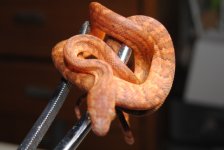
There is one non-holdback that I have been eyeing for some time now. He/she didn't make the original holdback cut, and I have been debating it since I noticed some serious color development a few weeks later. I have changed my mind, and added that one to the holdbacks, so there are now 10 holdbacks. That animal's current designation is H6 (Holdback #6), as the first four holdbacks are the escapees: E1-E4. H6 was one of the non-holdbacks that had taken a couple of scented pinkies, but recently had stopped. He/she will be offered chick thighs and eventually quail chicks, just like all the other holdbacks, from here on out. I have included a photo of H6 curled up in his/her tub (Photo #1) so you can see why the addition was made. I've been consistently impressed with both the brightness of color and boldness of markings of H6. This brings the total numbers to 10 holdbacks, 3 unscented pinkie eaters, 7 scented pinkie eaters, 2 stubborn non-holdbacks, and 2 anole eaters.

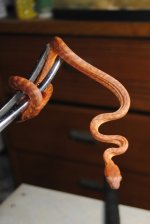
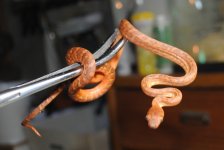
T1 was moved back to his tub. I took the opportunity to snap a few pictures, but T1 is not one of the friendlier babies. haha. These are the three best (Photos 2, 3, and 4). Not sure if you can tell from the photos, but T1 is starting to catch up with some of the smaller littermates. He is now approximately 18 inches long, and the head is starting to develop away from that guppy-faced neonate shape. Not sure if there's a technical term for that, haha. T1 will be back on f/t anoles come next week, and will begin to be offered anole-scented pinkies shortly after that.
 

Attachments

  • Dh6SC_0004.jpg
    Dh6SC_0004.jpg
    136.5 KB · Views: 115
  • Dt1C_0002.jpg
    Dt1C_0002.jpg
    105.7 KB · Views: 105
  • Dt1SC_0005.jpg
    Dt1SC_0005.jpg
    145.9 KB · Views: 117
  • Dt1SC_0011.jpg
    Dt1SC_0011.jpg
    102.6 KB · Views: 116
Yes, I'm sure. Ive been feeding the feeders small Dubia nymphs regularly. The reason they are so emaciated is the fact that I did not find them until late the next day. Presumably, they were killed overnight, but I did not check on the cage until 7pm. The emaciation is from dehydration. All of the live feeders are clearly in well fed condition. I feel very strongly about taking care of all animals in my charge, including feeders.

I didn't mean the question to be inflammatory. Reading it in the light of a new day I can see where the wording could be accusatory, and for that I apologize.
From your detailed posts I have no doubts your animal's receive the best care possible.
 
I didn't mean the question to be inflammatory. Reading it in the light of a new day I can see where the wording could be accusatory, and for that I apologize.
From your detailed posts I have no doubts your animal's receive the best care possible.

No offense taken. It was a legitimate question. I actually considered the possibility myself when first noticing them and that's why I may have come off a little defensive. No hard feelings. Haha.
 
Also none killed last night. Seems odd that he would kill three in one night, eat only one, and then fast two nights in a row. I'll keep checking and updating.
 
Hello again and Happy New Year!

Just thought I'd give a quick update on Harper (T2), as there is finally something to report - he finally decided to eat! Or, more likely, I finally figured out what cocktail of scents would entice him to opt for survival. But before I get to that, I thought I might give some details about the past few weeks of him settling in.

As I stated in my first post, he did not eat the first meal offered a few days after his move. This was no real surprise to anyone, but after the initial refusal I decided to weigh and photograph him before leaving him as alone as possible for the next week or so. His new accommodations (a tall plastic tub) were more sparsely decorated than Chris's enclosure, but I did catch him out climbing and exploring after dark. At this point I offered him a live anole-scented pinky, which he again refused to eat - still not a big concern. I decided I would give him more cover by attaching Tillandsia to the sides of his enclosure, particularly at the ends of his climbing branches. A small feeding platform was also attached to a climbing branch, to give him a stable place to eat while elevated. After his cage renovation, I left him again for a few days to de-stress before offering another f/t anole-scented pinky. No dice. At this point I had been scenting with a pair of live anoles that I had successfully used to entice a juvenile G. oxycephalum to eat, but it seemed like Chris's approach using frozen anoles had resulted in a higher success rate. I dug through the freezer and was happy to find a few that I could use. So last night I thawed a pinky and one of the anoles, slit open the belly of the anole and rubbed the pinky in zombie lizard juice, decided to cut a sliver of anole skin to stick to the pinky just for good measure, and left it on the feeding platform overnight. This morning, success!

So quick summary, Harper refused 3 pinkies that had been scented with live anole, but finally decided to eat a zombie scented pinky. I hope to have the same success in a few days when I try again!

I'll describe my husbandry a bit more when I post pictures of his set-up.
 
Glad to hear harper is eating for you. I have noticed that a 2 week hunger strike is pretty standard for any major changes, so your husbandry must be quite good to have him eating already. If I had moved him over to the next cage it would likely have taken this long to start eating again. Haha. Keep us posted. Thanks for the update.
 
That's very comforting to know, actually. I've been doing my best to keep him as calm and undisturbed as possible. He's definitely on the timid side - hasn't struck at me at all, but will musk if he gets stressed during handling. That being said, I've only had him out twice.

I put him in a "Hefty 29-Quart Clear Tote with Latching Lid" (available at Lowe's) with holes drilled in the lid.


Here you can see the Tillandsia (T. juncea, T. aeranthos, and T. victoriana) in the corners of the enclosure. I attached them using twine, although I imagine wire could also be used (I just couldn't find any and decided twine would suffice). You could also glue them onto the side of an enclosure, but that would make them more difficult to remove if they die or need watering. This is a bit of an experiment, since I've never actually put Tillandsia in this kind of environment, but I'm hoping they'll take daily spraying in place of soaking every few days.


As I alluded to above, the enclosure is sprayed daily (usually once, in the morning). Temps range from 85-89 on the warm side to about 74 on the cool side.
 
Drilling holes in the sides of the tub instead of the top/lid makes a world of difference in retaining the humidity IME.
 
Drilling holes in the sides of the tub instead of the top/lid makes a world of difference in retaining the humidity IME.

I had initially intended to do that, but the particular tool I was using at the time made it virtually impossible. I've modified my method since then, but it seems to be retaining humidity fairly well, using the measurement of how long water droplets are visible on the sides of the enclosure.
 
It looks like a good setup. My only concern would have been that the large size might have made him feel a bit lost, but if he's eating, that is clearly not the case. No doubt the ample decor goes a long way toward making him feel secure. The nice thing about snakes that go off feed so easy is that you know when you're doing things right. Haha.
 
It looks like a good setup. My only concern would have been that the large size might have made him feel a bit lost, but if he's eating, that is clearly not the case. No doubt the ample decor goes a long way toward making him feel secure. The nice thing about snakes that go off feed so easy is that you know when you're doing things right. Haha.

Thanks. It took him a little while to come out and explore, but I have seen him out on most nights. I think he liked the plant additions, since the next day I found him curled up asleep in one. I'll probably add more once I see if they do well under those conditions. Until then, I just have to see if he'll keep eating. I'd love to get him comfortable enough that he can actually be handled sometimes without fear of a hunger strike.
 
Thanks. It took him a little while to come out and explore, but I have seen him out on most nights. I think he liked the plant additions, since the next day I found him curled up asleep in one. I'll probably add more once I see if they do well under those conditions. Until then, I just have to see if he'll keep eating. I'd love to get him comfortable enough that he can actually be handled sometimes without fear of a hunger strike.

There could be some significant validity to that theory, as all three of the troublemaker group, as well as the 4 in the escapee group, have all been observed by me curled up inside the plastic plants that make up the decor inside the screen cages. It seems to be one of their preferred positions in open cages. It certainly follows logically that baby subflavus in the wild would seek out vegetative cover, as it would provide both protection from predators and ambush positions for hunting while simultaneously being more exposed to sunlight and thus a better basking position than the imagined alternatives (log hollow, for instance).
 
T3 experiment Update:

Night 1- Anole # 1 eaten
Night 2- Anole # 2 eaten, with 2 additional kills
Nights 3-5- Nothing
Night 6- Anole # 3 eaten

There are 7 anoles remaining. I am interested to see if now that T3 has started up again, if it will be a short burst of feeding or another long pause of several days.

Also, with regard to feeding the others for this week and next, I will not be feeding the babies. I will be out of town for a decent chunk of that time and feel it would be best to simply let them be, rather than make attempts at feeding without the ability to properly monitor them. They have long since proven that fasting a couple of weeks will do them no harm, and I feel the attempt to switch up a feeding schedule without being around to monitor the progress has much higher risks than simply allowing them to get hungry. Hopefully, it will also have the added benefit of enticing the less avid feeders to eat when I get back.
 
Sounds like excellent logic. And good to hear that T3 has decided not to go all Krueger on the anole population this time. ;-)
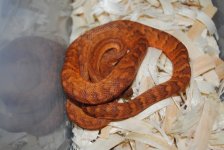
 
Some bad news today. I lost another one. Nothing major pointing to any kind of cause, so I assume that this is another congenital defect. The deceased was one of the stubborn non-holdbacks. He (probed and dissected for verification) ate fine last week, and aside from having his tub moved to a different shelf, there was no change to his husbandry. I'm disheartened to have lost another one, but looking at the numbers, three out of 28 dead over the course of 5 months seems to be a fairly miniscule number. I'll double check all husbandry stats to make sure, and keep a close eye on the others, but I don't expect there are any environmental contributors to this death.
 
I'm sorry you've had another loss, although as you said it does sound like it was probably a congenital defect. Not sure if it'll cheer you up any, but Harper ate again tonight - seems to be settling in quite well.
 
Back
Top