• Responding to email notices you receive.
    **************************************************
    In short, DON'T! Email notices are to ONLY alert you of a reply to your private message or your ad on this site. Replying to the email just wastes your time as it goes NOWHERE, and probably pisses off the person you thought you replied to when they think you just ignored them. So instead of complaining to me about your messages not being replied to from this site via email, please READ that email notice that plainly states what you need to do in order to reply to who you are trying to converse with.

  • IMPORTANT! PLEASE READ!! About the Google Adsense ads being displayed

    =====================
    Posted 08/15/2025
    =====================


    Yeah, I know. They are a pain in the butt. But they pay the bills to keep my server running. Just a fact of life, I am afraid.

    Want to get rid of them? Simple. Just become a Contributor level member or above and they will be gone. -> Please click HERE."

    Is that too much for me to ask of you to keep this site running? Well, sorry about that. I too wish I could get everything for free. But alas.....

    =====================
    Addendum: 01/10/2026
    =====================


    Google Adsense ad revenue for December, 2025 was just $30 over the cost of the lease for the server running this site. So, in effect, the money providing the incentive for me to continue running this site is coming SOLELY from the paid memberships and sponsorships here. Which honestly ain't much....

Lanthanotus borneensis -- Borneo Earless Monitor

Socratic Monologue

Well-known member
Joined
Jan 15, 2014
Messages
1,279
Reaction score
134
Points
63
Location
Oxford, WI
This is just an informational reference for anyone who searches this species here.

Lanthanotus borneensis, the Borneo Earless Monitor, is listed as endangered by the IUCN, is CITES Appendix II, and is additionally fully protected by legislation in its native range. No specimens have been legally exported from its home range, and none have been recorded by CITES as imported into the US from any country. Because of these facts all specimens are illegal to possess in the US.

https://www.traffic.org/site/assets/files/3010/traffic_pub_bulletin_27_2_earless_monitor_lizards.pdf

https://trade.cites.org/

https://reptile-database.reptarium....eensis&search_param=((taxon='Lanthanotidae'))
 
This is just an informational reference for anyone who searches this species here.

Lanthanotus borneensis, the Borneo Earless Monitor, is listed as endangered by the IUCN, is CITES Appendix II, and is additionally fully protected by legislation in its native range. No specimens have been legally exported from its home range, and none have been recorded by CITES as imported into the US from any country. Because of these facts all specimens are illegal to possess in the US.

https://www.traffic.org/site/assets/files/3010/traffic_pub_bulletin_27_2_earless_monitor_lizards.pdf

https://trade.cites.org/

https://reptile-database.reptarium....eensis&search_param=((taxon='Lanthanotidae'))


Thank you very much for this information you posted, people interested in this specie needs to know.


It would probably be a good idea to post a link to this page/post on the ad....


John, Thanks again!
 
Another interesting but slightly complicated update: in 2021, some L. borneensis entered the US with CITES export permits (note that the CITES database doesn't get updated until October 31 of the following year -- so 2021 data isn't available until Oct 31, 2022). These were:

Ten live animals, listed as CB, from Czech Republic for zoological use;
Seventeen live animals, listed as CB, from Italy for commercial use.

This is all academic, though, since because no live specimens left their native range with the permission of the countries in that range, all these imported specimens are prohibited under Lacey (which prohibits both illegally acquired specimens and offspring of illegally acquired specimens).

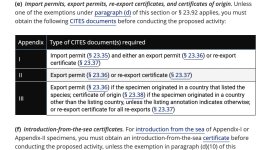
It is also worth noting that since L. borneensis is CITES Appendix II, and the specimens were listed as CB, no import permit is required for entry into the US (per 50 CFR § 23.20). So, any claim that purported CB animals were "cleared" (or similar wording) for entry into the US can be misleading.
 
I am Giacomo Ceccarelli CCCGCM79C10E256T, the exporter of those from Italy .
You are clearLY speaking about things you totally ignore ,
1) Cites II species required a 3-177 customs clearance
2) Range states DID export those Animals before they have been cites listed.
2a) I can state that because usfws at First set them on hold , asking me and my importer to provide all paper Trail back from 7 years ago . I did

Bottom line: if you have a solkd bullef proof record , you can clear earless monitor


PS: pogona has never been exported from Australia , nor Egernia or Nephrurus and a ton of others ( snakes, geckos, turtles). Write a monologue about that too .��
 
2) Range states DID export those Animals before they have been cites listed.

"None of the three actual and potential range States has permitted legal export of Earless Monitor Lizards, therefore by extension parent stock have been illegally obtained, taken from their natural habitat." -- TRAFFIC article linked above, p. 57.

"It is, however, a totally protected species (meaning that any trade is prohibited) in its potential range States, i.e. in Malaysia since 1971, in Brunei Darussalam since 1978 and in Indonesia since 1980. Penalties for trading the species range from a fine of USD1600 and one year’s imprisonment (Brunei Darussalam) to USD7850 and three years’ imprisonment (Malaysia), to USD8600 and five years’ imprisonment (Indonesia)." -- ibid, p. 55.

Without further evidence, it looks like this point is 'he says, she says'. Readers might have to decide who they're going to believe. Posting copies of the relevant paperwork might help your case, though we all know that a copy of a form doesn't guarantee that it isn't faked, or purchased.

Quoting myself: "It is also worth noting that since L. borneensis is CITES Appendix II, and the specimens were listed as CB, no import permit is required for entry into the US (per 50 CFR § 23.20). "

My sloppy wording. I meant (of course, given the content of the link to US regs) no CITES import permit was required. Sorry for the misunderstanding -- totally my fault.

PS: pogona has never been exported from Australia , nor Egernia or Nephrurus and a ton of others ( snakes, geckos, turtles). Write a monologue about that too .��

Yes, I understand that of course. A few points that make that bit of snark irrelevant:

1) Most of those were well established in captivity before their CITES listing, thus making their trade hard to track down.
2) None of those are currently being trafficked in numbers that are likely to lead to their extinction.
3) Many/most of these are established in captivity to an extent that attempts to undermine the illegal market in them will not make any difference.
4) The fact that other animals are trafficked doesn't make this one not trafficked (a version of the 'tu quoque' fallacy, I think). Would that it were so.

You clearly don't appreciate resistance to illegal trade in reptiles. No problem, lots of people don't, virtually all of whom have financial reasons for this. I get it. It isn't those people who I'm trying to get information to. :)
 
I edited my comment. Its meaningless to argue with persons that think that an old Bro or some website are The Law.

Earless monitors are such a boring species , I wouldnt buy It if It was 1$
 
John Zilmer,
To say the legitimately cleared borneensis needed no CITES permit for entry is not true. No where in CFR § 23.20 does it say CB specimens need no CITES permit. I’ve never heard such a thing and I’m surprised you wrote that. CITES 1,II,III cb specimens need to be listed as Source C. You can’t import a CB ball python without a CJTES permit.

The simple truth of the matter is, which some of you fail to get a grip with. Is some of these animals lineage have a paper trail going back, exported under permit from a state of origin. CITES permits where issued. This paperwork and CITES permits where inspected by our government authorities . Government authorities who have more rescources than faunaclassifieds and Articles from Google, which are only Mostly accurate.
 
Here is the passage I was referring to:

permit regs.jpg

CITES itself also doesn't require an import permit for Appendix II, but only an export permit. Appendix I requires both export and import permits. It isn't really a major point, though.

The claim that no L. borneensis have been exported from range states is made in the linked report from TRAFFIC. This isn't an 'article from Google', but from an organization that is basically a part of Cambridge University. In other words, a credible source.

If anyone has any actual documentation -- not simple denial and disparagement, but documentation -- that disputes any claims please post that documentation here. This is an informational thread, and the more actual information the better.

Shifting gears a bit: there is also a lot of discussion that could be had about the problem with inserting even a little bit of perceived legitimacy into the trade in a very widely smuggled endangered species. This is the same sort of discussion that is had with elephant ivory: carving out a small amount of the trade and legally legitimating it (in ivory, material that is antique/pre-ban, or confiscated and stockpiled by authorities) can and does serve to enable increased laundering of illegally trafficked material and thus undermine conservation goals.

Given that worry, it is hard to give a charitable interpretation to the eagerness to convince people that some few of these animals are of legal origin. It is something that certainly requires at the very least conclusive evidence, and a solid plan for ensuring that lineage gets traced accurately (perhaps something akin to the stud books for some chelonian species). None of that has been offered with this species, nor others in similar circumstances.
 
All the “conclusive evidence” I assume one is would need , the current state of the subject matter is. CITES issued permits, and USFWS cleared certain animals with verifiable accompanying documentation to prove legitimacy of parent stock. I mean, what more does one need?
 
If you are asking for exporters to share rare and extremely hard to acquire paperwork on a website like this. Free for any smuggler to get a format to use and give the appearance of legitimacy of his animals. I don’t think that’s going to be helpful.
 
In this situation, I think that a responsible sale would involve, at the very least, (a) documentation of the legal export of specimens from a range country, and (b) a credible account establishing that the specimens for sale are descended from the legally exported stock.

Simply having import permits into the US doesn't establish that the animals are legal under Lacey, nor that they're not of smuggled lineage. Mr. Ceccarelli has pointed that out himself:

PS: pogona has never been exported from Australia , nor Egernia or Nephrurus and a ton of others ( snakes, geckos, turtles).

Because these mentioned genera were listed only recently or not at all, there aren't any CITES import permits on record into the US, but the fact that smuggled lineage specimens are granted import into the US can be confirmed with other species. Adelphobates galactonotus has never been exported live from Brazil for commercial use, per CITES and per their own government's claim (the only CITES permit on record is in 2014 to Australia for scientific use; Australia hasn't exported any since then). But nonetheless the US imports them regularly -- mostly from Germany, Belgium and the Netherlands if that gives any clues as to their origin.
 
I think the point Mr Ceccarelli was making us that it’s common knowledge Egernia, Nephrurus, and others where never exported from AU. He is saying that under certain circumstances the L. Borneensis where granted paperwork to leave one of the range states. So the point is these LB have more a right to be here than the Pagona that have been here for decades.


Also just for the record I have no affiliation with the current seller of the Borneensis on fauna, Nor have I imported any from Mr Ceccarelli. However I am happy to see that Legal avenues are being explored, and successful. And I for one look forward to the advancement of this species in USA Herpetoculture.
 
All the “conclusive evidence” I assume one is would need , the current state of the subject matter is. CITES issued permits, and USFWS cleared certain animals with verifiable accompanying documentation to prove legitimacy of parent stock. I mean, what more does one need?

If you ask USFW if "cleared to enter the US" means that the animal in question is thereby legal, they will tell you that is not the case. If an animal is found to have paperwork that has been issued contrary to CITES etc after it has been imported then USFW considers it illegal and potentially subject to seizure and prosecution. You don't even have to take my word for it, you can do what I did was ask USFW.

Ed
 
Edward,

Yes I agree with you. If you ask them if it’s okay to do something wrong, they will say you aren’t supposed to do that. I agree 100%.
 
Links to more information from legitimate sources:

PROPOSAL TO LIST LANTHANOTUS BORNEENSIS IN APPENDIX I IN MALAYSIA -- reiterates claims of protected status in range states, and discusses known trafficking countries. Discusses details of protections, including:

"Some Indonesian companies have permission to keep protected species for captive- breeding and are allowed to export a set quota each year (Partono, 2014). Earless Monitor Lizards are not, and never have been included on this list; therefore no Earless Monitor Lizards may be removed from the wild for commercial purposes, including removal for use in commercial breeding operations."

https://cites.org/sites/default/files/eng/com/ac/28/E-AC28-22-05.pdf

German national arrested in Indonesia on suspicion of smuggling Earless Monitor Lizards -- discussion of common laundering of smuggled specimens: "International investigations are essential to debunk the myth that reptiles are being ‘captive bred’, whereas in reality claims of captive breeding are frequently used as a cover to enable the animals to be traded internationally, unchallenged"

https://www.traffic.org/news/german...spicion-of-smuggling-earless-monitor-lizards/
 
If you are asking for exporters to share rare and extremely hard to acquire paperwork on a website like this. Free for any smuggler to get a format to use and give the appearance of legitimacy of his animals. I don’t think that’s going to be helpful.

I totally agree with you.

in my personal opinion is totally illogical, that they ask to show the paperworks in public ,That would put the tools to forge the documents in the hands of smugglers. .

We legally work with different imports, and it is our duty as a company to deliver all documentation to the costumer.

I have not seen any part of the law that says that we must share the paperworks in public or to anyone who asks to see them. The paperworks are a private document and should only be shared with the buyer of the animal.
 
Of course, other reasons to refuse to publicly show the legitimacy of specimens is (a) that the purported documentation doesn't exist, and (b) there are holes in it that could be uncovered with enough eyes on it (e.g. the person who the paperwork actually belongs to could speak up).

The notion that this information is being withheld for concerns of promoting trafficking isn't credible, since these sales themselves are promoting trafficking; everyone who digs at all is aware that even animals claimed to be CB are virtually certainly WC when coming out of certain countries (Indonesia, for example).

People who are honestly skeptical of the legitimacy of these animals aren't going to be fooled by this sort of hand waving, and the people who don't care about the legal and (more importantly) conservation issues aren't going to care about the permit one way or another anyway.

Besides, there's more to a paper trail than having a permit in hand; to show that the animals for sale are the ones on the permit, there are financial documents to be considered -- payments made to the importer/exporter listed on the permit, FedEx tracking numbers to show the movement of animals from the importer to the seller, an accounting of numbers of animals on the permit vs how many are alleged to be covered under that permit. The import permit itself is just one small part of showing that animals that can be very reasonably assumed to be trafficked or descended from smuggled stock are legitimate. The fact that this little bit of the paper trail isn't shared with those who request it strongly implies that there is a lot more being hidden.
 
As far as legitimate paper trial from the original source is concerned, you have a point. What you fail to address is the consequence of once it is confiscated, what then?
Typically it is given to some authorised person for disposal since the Gov does not facilitate confiscated animals.
These include zoos, museums and even reptile dealers. I personally know one wholesale dealer that is regularly given confiscated shipments/animals by FWC.
At this point, when he sells these animals, are they illegal to own?
Is the paperwork that FWC gives him to claim them inappropriate?
Who's authority trumps who?
Can FWC legally give him authority to posses and then sell?
 
Back
Top