

• Responding to email notices you receive.
    **************************************************
    In short, DON'T! Email notices are to ONLY alert you of a reply to your private message or your ad on this site. Replying to the email just wastes your time as it goes NOWHERE, and probably pisses off the person you thought you replied to when they think you just ignored them. So instead of complaining to me about your messages not being replied to from this site via email, please READ that email notice that plainly states what you need to do in order to reply to who you are trying to converse with.

  • IMPORTANT! PLEASE READ!! About the Google Adsense ads being displayed

    =====================
    Posted 08/15/2025
    =====================


    Yeah, I know. They are a pain in the butt. But they pay the bills to keep my server running. Just a fact of life, I am afraid.

    Want to get rid of them? Simple. Just become a Contributor level member or above and they will be gone. -> Please click HERE."

    Is that too much for me to ask of you to keep this site running? Well, sorry about that. I too wish I could get everything for free. But alas.....

    =====================
    Addendum: 01/10/2026
    =====================


    Google Adsense ad revenue for December, 2025 was just $30 over the cost of the lease for the server running this site. So, in effect, the money providing the incentive for me to continue running this site is coming SOLELY from the paid memberships and sponsorships here. Which honestly ain't much....

leucistity...little help please

Iridophores are a color production cell (Chromatophore) that doesn't actually involve a pigment... They are responsible for blue coloration in reptiles and that irridescent shine that many species display (Like rainbow boas just usually not as strongly).

I think we've all got an understanding of that yellow plus blue make green, red plus yellow make orange color mixing that causes us to see non-basic colors in herps and a pretty decent understanding of the cells that are responsible (our earlier discussion aside)... there's also factors caused by the color of the underlying tissue when the "normal" color production cells aren't functional.

Sort of the way that albino mice have red eyes... you might be seeing blood vessels underneath the skin of the neonates for that pink, a condition that would lessen as the animals age and the intervening tissue becomes thicker... The grey/blue in the eyes might be light reflecting off the curved surface of the lens of the eye...

Got any pictures of the specific animals, nice clear closeups that show the color in the eyes or in the neonates?

And how about that more specific description of what will be produced when crossing adults?
 
And how about that more specific description of what will be produced when crossing adults?
Well regardless of whether there are multiple recessives at work my cross of a leucistic to a normal will produce all hets for leucistic right? Now as far as crossing the hets back to the leucistic my theory is that I will get 1/4 leucistic, 1/4 hypo het for anery. 1/4 anery het for hypo and 1/4 normal hets. But I guess I won't know for a few years. What do you think?
 
cross of a leucistic to a normal will produce all hets for leucistic right?

Also I think the patternless trait almost has to be involved and from what I've heard about that trait I might get some in my first cross. I've heard of records showing that this trait could not possibly be simple recessive or simple dominant.

ie.:two patternlesses crossed and produced no patternless babies....simple recessive? no
:two regulars produceing patternless babies...simple dominant? no
I've never heard any evidence to show this to be sex linked either.
 
Well regardless of whether there are multiple recessives at work my cross of a leucistic to a normal will produce all hets for leucistic right?

If it's a simple dom/rec trait, yup...

Now as far as crossing the hets back to the leucistic my theory is that I will get 1/4 leucistic, 1/4 hypo het for anery. 1/4 anery het for hypo and 1/4 normal hets.

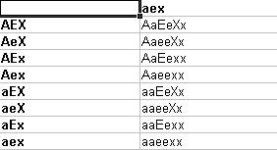
Well... if you're guessing that it's three reccessive color traits; amel, anery and axanthic... The Punnet would look like this... (Attached at Bottom) When crossing an animal that's het for all three traits with one that's homozygous for all three recessive...

Using:

A- Normal Melanin
a- Amel
E- Normal Erythrin
e- Anery
X- Normal Xanthin
x- Axanthic
 

Attachments

  • three trait.jpg
    three trait.jpg
    10.2 KB · Views: 115
So is that your official guess for the genotype?: aaeexx
If that's true I might not even get a leucistic when I cross back to the parent. Bummer. So what do you think patternless has to do with it, if anything?
 
Now...

AaEeXx- Het for all three traits
AaeeXx- Anery, het for amel and axanthic
AaEexx- Axanthic, het for amel and anery
Aaeexx- Axanthic and Anery, het for amel
aaEeXx- Amel, het for axanthic and anery
aaeeXx- Amel and Anery, het for axanthic
aaEexx- Amel and axanthic, het for anery
aaeexx- Amel, Anery, Axanthic

The above listed conditions should theoretically be about even if there were multiple crosses with hundreds of neonates produced... But what it means in terms of an individual breeding is a way of gauging the odds for each fertile egg produced. In this instance, there exists about a one in eight chance that any individual neonate will have the above traits...

The problem is that a chance isn't always the same as dividing up a clutch evenly and there's no guarantee that any individual match up would be produced at all, or that there couldn't be more than 1/8th of the clutch displaying any individual match up...

With this particular match up it's a bit easier because the displayed trait would be homozygous, any "normal" trait for an individual color, you know it's at least a het...

It becomes tricker if you did a het to het crossing...

No offense intended, but from the ease with which it seems the morph is produced, I really doubt it is a combination of multiple simple recessive traits... look at snow boas and ball pythons, those are each only two recessive traits and it's nearly impossible to produce them. Colubrids have been bred for longer but it takes a lot more work to produce an animal with three mutations than the price and avaliability of these animals would support.

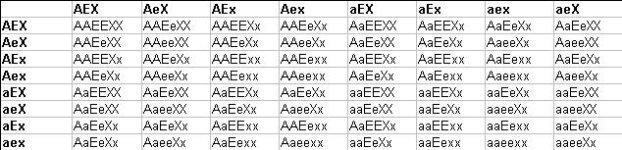
The punnet for crossing a het to a het for the three recessive traits is posted at the bottom of this one...

I would like to mention that it was two-thirty A.M. when I found this post, so it's safest to double check for mistakes before trusting the punnets I've posted tonight...

As you can see with the number of possible outcomes on a het to het breeding, producing animals that would breed true seems nearly impossible, even with large clutch sizes.

You mentioned that there can be Leucistic to Leucistic breedings that don't produce leucistic offspring? And that there can be seeimingly normal crosses that do produce leucistic neonates? If that's true, it indicates most strongly that it may be a codominant gene, which just leaves any breeding as a bit of a craps shoot... but also makes it much easier to produce the animal displaying the desired trait.

I'm a bit surprised that nobody who has successfully bred out this phenotype for multiple generations has shown up to describe the likely genetics or at least the makeup of their individual clutches...

And... I couldn't really see the eyes in those pics, but the pink coloration looked a lot like just a tint from underlying tissue than an actual pigment...

At any rate... as I've said a few times, leucisity is a trait that can be caused by different factors in different species, there are multiple ways of producing a white animal (biologically anyway) and the trick is determining what the cause is and... ::shudders:: how to reproduce it in the specific species in question... It's even possible that there could be multiple causes that won't breed true with one another within a single species (Tyrosinase positive and tyrosinase negative albinism for example).

Just... I really really really doubt it's a combination of three recessive traits...
 

Attachments

  • threetraithet.jpg
    threetraithet.jpg
    39.7 KB · Views: 105
So is that your official guess for the genotype?: aaeexx

Nope... sorry if it was unclear but...

My guess is that there is another causitive agent that's totally unrelated to specific pigment cells... Either a mutation that renders them ALL non-functional or some other physiological mutation that prevents pigment production long before the actual pigment cells or pigment types would come into play.
 
First of all leucism is an overly used and often misused term to describe a color phase. It is also one of the least understood conditions, on which I do not claim to be an authority.
A leucistic snake is white with dark colored eyes, or such is the accepted definition. The eyes are normally considered blue, but I often have a hard time discerning blue from black in these cases.
Any pink coloration on hatchlings and juviniles cannot be taken into consideration. Just as in amelanistic cal kings for example, hatchlings are normally pink in the areas that will eventually become white.

If indeed the snake you are referring to is displaying three seperate traits, then it should not be considered leucistic.
The better way to tell in my opinion is not to restrict your breeding to producing "double hets", but to breed the supposed leucistic animal to another which is homozygous for one of the traits you presume is involved. If the resulting offspring are homozygous for that trait, then it is being displayed by the "leucistic" parent.


ie.:two patternlesses crossed and produced no patternless babies....simple recessive? no

Not entirely true. Each patternless parent might be displaying a seperate simple recessive mutation resulting in patternless, and the two are not compatible.
An example of this would be the Kahl and Sharp strains of albino boas constrictors. Both are amelanistic, but if you breed two together, you get normal colored offspring which are carrying the recessive gene for both types of albinism.
This has been demonstrated in other species whith other morphs as well.

The fact is the production of any of the colors is not a one step process, it is fairly complex and involves multiple enzymes, as well as being affected and controlled by multiple genes.
If the process is interrupted at a given point, the production of that color is arrested. The same result can come from an interruption at another point, which gives you the seperate incompatible strains of a single trait.
 
Thank you...

The fact is the production of any of the colors is not a one step process, it is fairly complex and involves multiple enzymes, as well as being affected and controlled by multiple genes.
If the process is interrupted at a given point, the production of that color is arrested. The same result can come from an interruption at another point, which gives you the seperate incompatible strains of a single trait.

I was trying to say exactly that for the last two pages but didn't manage it as accurately and succinctly as you did.

Next time I can't express a concept well, I'll be e-mailing Clay to give me the words I want.
 
So Mendelian genetics is virtually useless. Great, now what am I going to do? A phenotype is just a vague reference point in finding out the genotype. Crap!!

I think you've got me convinced on the single non-specific pigment related gene theory. And until someone has a better idea or my breeding outcomes imply differently, it's the theory I'm going to go by...I guess.

BTW
You mentioned that there can be Leucistic to Leucistic breedings that don't produce leucistic offspring? And that there can be seeimingly normal crosses that do produce leucistic neonates?

Actually I was just talking about the patternless trait when I said that.
 
No, Mendelian genetics works perfectly to describe what is happening. The confusion lies not in the ability to describe the method of inheritance, but the in the inability to accurately determine the nature of what is being inherited.

At this point you don't know what the snake is, whether you are referring to the phenotype or the genotype. Test breedings will help determine that.
You can only apply Mendelian principles after you have determined what you are dealing with.
A phenotype is just a vague reference point in finding out the genotype. Crap!!
Unfortunatly this is essentially true, especially in reference to reptiles. The problem is with the complexity involved in each process.
Take each pigment and prefix it with an "a", with "hypo", or with "hyper", then realize that each of these conditions are controlled at multiple loci and involve the participation or inhibitance of several enzymes. Then throw into the mix such conditions as leucism, piebaldism, calico, etc, and you see the extreme complexity of the subject matter. There also exists many traits in snakes particularly that remain misunderstood.
Gene mapping would be most helpful in furthering our understanding of the processes, but the probability of that being pursued anytime in the forseeable future is unlikely.
Only test breedings can shed light on the underlying causes of what you are dealing with.

I think you've got me convinced on the single non-specific pigment related gene theory. And until someone has a better idea or my breeding outcomes imply differently, it's the theory I'm going to go by...I guess.

I tend to agree with this theory. I believe leucism is controlled by a genetic process with much wider governing ability that those which control single pigments. I also believe that the genetic process responsible for this is not as complex as the processes it controls involving individual colors and patterns. This assumption would be supported by the fewer instances of the trait being expressed.
However, if your breeding outcomes imply differently, it does not automatically mean that this theory of leucism is inaccurate. It may also mean that you are not dealing with true leucism at all.
Remember, just because a breeder labels an animal leucistic does not mean that is what it is, look at the original "leucistic" leopard geckos.
 
So far as I know, Mark Bell is who originally produced these out of a captive collection and coine the term "leucistic" for them. I have never heard of anyone agreeing ith this term but for some reason we keep using it. Unfortunately, Mark Bell is MIA. If anyone knows how to contact him, let me know.
 
actual leucism vs. "just calling it that"

Hi ppl... I have kept quite a few Pituophis and other colubrids and boids and I think there's "marketing" forces at work here when it comes to names given to a strain..which can be very misleading... for example I bought a pair of "snow" cal kings off BHB a few years back but before I did, I asked is this genuine snow? (i.e. amelanism combined with anerythrism) or is it just a case of taking the blackest like, baja capes or something and crossing it with amelanistic and therefore getting a very white snake (that otherwise would be solid black) and he condifed "yes" it was a melanistic that was amelanistic genetically..
well I just bought a pair of mark bell leucistic s. pines and I wonder where they stand in this sense...they certainly don't seem to have alot of pigment in their eyes (not bluish like the texasrats) is it true leucism or just a albino patternless?
if the latter then i would be very disappointed..because leucistic to me means leucistic.. in the texas ratsnake sense..not some marketing term to butter ppl up with...(not that this has happened, I just want to know what they carry genetically)

as well with the tyrosinase pos. blk ratsnakes ("red phase" as opposed to "white phase") some called them lavendar black rat, which is alot more innocent than calling a patternless albino a leucistic eh?

anyway I'd be interested in hearing of the provenance of the so-called leucistic pines (mark bell strain or otherwise) and whether there are true leucistics or not (and whether his are or aren't)
 
Patrick Dring said:
I bought a pair of "snow" cal kings off BHB a few years back but before I did, I asked is this genuine snow? (i.e. amelanism combined with anerythrism) or is it just a case of taking the blackest like, baja capes or something and crossing it with amelanistic and therefore getting a very white snake (that otherwise would be solid black) and he condifed "yes" it was a melanistic that was amelanistic genetically..

He said melanistic and not anery right? That would actually make them blizzards. There is no genuine snow cal king, how would you know if you had an anery? They are black and white already. Ive seen snow advertised which are just high white, very high white, so it could also be an amelanistic high white, but I dont think there is any anery traits in that snake.
 
Back
Top