Clay Davenport
Cerebral Nomad
I'll give a little background about these mice, but for those that may lose interest I'll ask the question first.
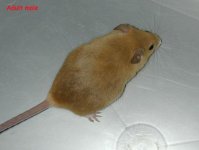
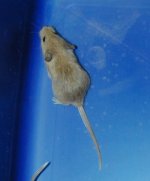
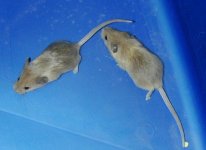
Does any of the mice fanciers out there know what this coat coloration is refered to as? It is a predominately light brown body with dark edges to the ears and a patch of darker hair on the rump. The darker patch is much more pronounced when they are young and gradually fades somewhat with age, but remains visible into adulthood.
I know others have had to have produced this coat color, so I figure the mice community has a term for it.
I've never paid much attention to types of mice and am completely unfamiliar with any of the terms for the different varietes.
I'll relate how this color popped up in my colony.
I keep a fairly decent sized colony of mice, 125 breeders or so normally, but they are all white. I was fortunate in acquiring a strain of mice that routinely has large litters, 18-20 being common.
Since I do have snakes periodically, usually a hatchling ball, that refuses white mice, I also keep one or two tubs with a colored male to produce some brown offspring to have on hand.
Any babies produced by the brown males are kept strictly segregated from the main colony so as not to introduce outside genes and potentially interfere with the production of the large litters.
The original colored mice were the standard dark brown or black, and all the colored young produced were these colors as well. Colored young were raised to replace the older breeders, and this resulted in a generation of inbreeding. During this generation two of these light colored males were produced.
I raised them up because I liked their color and thought I'd play with the genes a little just for fun since I needed to breed a few colored ones anyway.
The two males were placed with 3 white females each. The idea was that a white female wouldn't interfere with the light colored male passing on his colored genes. At this point I assumed that any colored offspring produced would look like the fathers.
After 6 or 8 litters from each male, no young had been produced that looked like the fathers. All the colored young were either black or very dark brownish.
I then fed off all the white females in these groups and raised some of their dark colored daughters to breed back to the males. The second litter produced 3 babies with the coloration of the fathers. Black babies were also produced.
So it appears at this point that the light coat with dark highlights is a recessive trait.
The original light males as well as their dark daughters are all carrying the albino gene as well, so white babies are still being produced.
I've never taken a particular interest in the feeders before, but I think I'll play with these genes a little further until I can isolate it and breed out the albino genes so that all the offspring will be colored as these are.
Here is a picture of one of the adult males. The flash washed out some of the dark patch on his rump, but you can still tell it's there. His patch seems to have faded a little more than his brother.
Does any of the mice fanciers out there know what this coat coloration is refered to as? It is a predominately light brown body with dark edges to the ears and a patch of darker hair on the rump. The darker patch is much more pronounced when they are young and gradually fades somewhat with age, but remains visible into adulthood.
I know others have had to have produced this coat color, so I figure the mice community has a term for it.
I've never paid much attention to types of mice and am completely unfamiliar with any of the terms for the different varietes.
I'll relate how this color popped up in my colony.
I keep a fairly decent sized colony of mice, 125 breeders or so normally, but they are all white. I was fortunate in acquiring a strain of mice that routinely has large litters, 18-20 being common.
Since I do have snakes periodically, usually a hatchling ball, that refuses white mice, I also keep one or two tubs with a colored male to produce some brown offspring to have on hand.
Any babies produced by the brown males are kept strictly segregated from the main colony so as not to introduce outside genes and potentially interfere with the production of the large litters.
The original colored mice were the standard dark brown or black, and all the colored young produced were these colors as well. Colored young were raised to replace the older breeders, and this resulted in a generation of inbreeding. During this generation two of these light colored males were produced.
I raised them up because I liked their color and thought I'd play with the genes a little just for fun since I needed to breed a few colored ones anyway.
The two males were placed with 3 white females each. The idea was that a white female wouldn't interfere with the light colored male passing on his colored genes. At this point I assumed that any colored offspring produced would look like the fathers.
After 6 or 8 litters from each male, no young had been produced that looked like the fathers. All the colored young were either black or very dark brownish.
I then fed off all the white females in these groups and raised some of their dark colored daughters to breed back to the males. The second litter produced 3 babies with the coloration of the fathers. Black babies were also produced.
So it appears at this point that the light coat with dark highlights is a recessive trait.
The original light males as well as their dark daughters are all carrying the albino gene as well, so white babies are still being produced.
I've never taken a particular interest in the feeders before, but I think I'll play with these genes a little further until I can isolate it and breed out the albino genes so that all the offspring will be colored as these are.
Here is a picture of one of the adult males. The flash washed out some of the dark patch on his rump, but you can still tell it's there. His patch seems to have faded a little more than his brother.