• Responding to email notices you receive.
    **************************************************
    In short, DON'T! Email notices are to ONLY alert you of a reply to your private message or your ad on this site. Replying to the email just wastes your time as it goes NOWHERE, and probably pisses off the person you thought you replied to when they think you just ignored them. So instead of complaining to me about your messages not being replied to from this site via email, please READ that email notice that plainly states what you need to do in order to reply to who you are trying to converse with.

  • IMPORTANT! PLEASE READ!! About the Google Adsense ads being displayed

    =====================
    Posted 08/15/2025
    =====================


    Yeah, I know. They are a pain in the butt. But they pay the bills to keep my server running. Just a fact of life, I am afraid.

    Want to get rid of them? Simple. Just become a Contributor level member or above and they will be gone. -> Please click HERE."

    Is that too much for me to ask of you to keep this site running? Well, sorry about that. I too wish I could get everything for free. But alas.....

    =====================
    Addendum: 01/10/2026
    =====================


    Google Adsense ad revenue for December, 2025 was just $30 over the cost of the lease for the server running this site. So, in effect, the money providing the incentive for me to continue running this site is coming SOLELY from the paid memberships and sponsorships here. Which honestly ain't much....

NSA - Prism Bigger than just Verizon

Dennis Hultman

New member
Joined
Nov 10, 2004
Messages
9,174
Reaction score
594
Points
0
Location
Santa Barbara, CA
NSA taps in to internet giants' systems to mine user data, secret files reveal

• Top secret PRISM program claims direct access to servers of firms including Google, Facebook and Apple
• Companies deny any knowledge of program in operation since 2007

http://www.guardian.co.uk/world/2013/jun/06/us-tech-giants-nsa-data

The National Security Agency has obtained direct access to the systems of Google, Facebook, Apple and other US internet giants, according to a top secret document obtained by the Guardian.

The NSA access is part of a previously undisclosed program called PRISM, which allows officials to collect material including search history, the content of emails, file transfers and live chats, the document says.

The Guardian has verified the authenticity of the document, a 41-slide PowerPoint presentation – classified as top secret with no distribution to foreign allies – which was apparently used to train intelligence operatives on the capabilities of the program. The document claims "collection directly from the servers" of major US service providers.

Although the presentation claims the program is run with the assistance of the companies, all those who responded to a Guardian request for comment on Thursday denied knowledge of any such program.

In a statement, Google said: "Google cares deeply about the security of our users' data. We disclose user data to government in accordance with the law, and we review all such requests carefully. From time to time, people allege that we have created a government 'back door' into our systems, but Google does not have a back door for the government to access private user data."

Several senior tech executives insisted that they had no knowledge of PRISM or of any similar scheme. They said they would never have been involved in such a program. "If they are doing this, they are doing it without our knowledge," one said.

An Apple spokesman said it had "never heard" of PRISM.

The NSA access was enabled by changes to US surveillance law introduced under President Bush and renewed under Obama in December 2012.

The program facilitates extensive, in-depth surveillance on live communications and stored information. The law allows for the targeting of any customers of participating firms who live outside the US, or those Americans whose communications include people outside the US.

It also opens the possibility of communications made entirely within the US being collected without warrants.

Disclosure of the PRISM program follows a leak to the Guardian on Wednesday of a top-secret court order compelling telecoms provider Verizon to turn over the telephone records of millions of US customers.

The participation of the internet companies in PRISM will add to the debate, ignited by the Verizon revelation, about the scale of surveillance by the intelligence services. Unlike the collection of those call records, this surveillance can include the content of communications and not just the metadata.

Some of the world's largest internet brands are claimed to be part of the information-sharing program since its introduction in 2007. Microsoft – which is currently running an advertising campaign with the slogan "Your privacy is our priority" – was the first, with collection beginning in December 2007.

It was followed by Yahoo in 2008; Google, Facebook and PalTalk in 2009; YouTube in 2010; Skype and AOL in 2011; and finally Apple, which joined the program in 2012. The program is continuing to expand, with other providers due to come online.

Collectively, the companies cover the vast majority of online email, search, video and communications networks.
 
NSA - Prism

Phone Sex, Banks & Google for Emails: The NSA Spying Is Bigger Than Verizon

http://www.theatlanticwire.com/politics/2013/06/nsa-spying-verizon-analysis/65963/
The National Security Agency's warrant for metadata on every single Verizon call for three months is jaw-dropping in its scope. Except, well, the NSA's surveillance of our communications is most likely much, much bigger than that. Technology has made it possible for the American government to spy on citizens to an extent East Germany could only dream of. Basically everything we say that can be traced digitally is being collected by the NSA. We're supposed to trust that our government will be much better behaved, but they're not, and the White House almost admits it. That doesn't mean they're admitting everything.

"On its face, the document suggests that the U.S. government regularly collects and stores all domestic telephone records," The Week's Marc Ambinder writes of Glenn Greenwald's scoop last night. "My own understanding is that the NSA routinely collects millions of domestic-to-domestic phone records. It does not do anything with them unless there is a need to search through them for lawful purposes." Previous reporting from many outlets suggests that's true. In 2006, USA Today's Leslie Cauley reported the NSA was secretly collecting call records with data from AT&T, Verizon, and BellSouth. A source told Cauley, "It's the largest database ever assembled in the world" and that the NSA wanted "to create a database of every call ever made" within U.S. territory. Likewise, in 2011, The New Yorker's Jane Mayer spoke to former NSA crypto-mathematician Bill Binney, who "believes that the agency now stores copies of all e-mails transmitted in America, in case the government wants to retrieve the details later." He thinks the NSA wants all emails to be searchable, the same way we search with Google. "The agency reportedly has the capacity to intercept and download, every six hours, electronic communications equivalent to the contents of the Library of Congress," Mayer said. As Mark Rumold, a staff attorney at the Electronic Frontier Foundation, told The Atlantic Wire last night, "This is confirmation of what we've long feared, that the NSA has been tracking the calling patterns of the entire country." Update: In defending the program, California Sen. Dianne Feinstein seems to indicate that the court order is a regular, quarterly thing. "There is nothing new in this program. The fact of the matter is, that this was a routine three-month approval under seal that was leaked," Feinstein said on Thursday.

And the NSA isn't just collecting the things we say. It's also tracking what we buy and where we go. In 2008, The Wall Street Journal's Siobhan Gorman reported that the NSA's domestic data collection "have evolved to reach more broadly into data about people's communications, travel and finances in the U.S. than the domestic surveillance programs brought to light since the 2001 terrorist attacks." That means emails records, bank transfers, phone records, travel records.

As Ambinder explains, there's a difference between collecting the call data, analyzing the data, and eavesdropping on the calls. The government's talking points defend the program by noting the NSA might know the length and location of your phone calls, but at least they weren't listening in. "On its face, the order reprinted in the article does not allow the Government to listen in on anyone's telephone calls," the talking points say. The "senior government official" does not directly confirm the court order is real, but says that "Information of the sort described in the Guardian article has been a critical tool in protecting the nation from terrorist threats to the United States, as it allows counterterrorism personnel to discover whether known or suspected terrorists have been in contact with other persons who may be engaged in terrorist activities, particularly people located inside the United States."

That sounds so noble. And the NSA would never abuse its awesome surveillance power, right? Wrong. In 2008, NSA workers told ABC News that they routinely eavesdropped on phone sex between troops serving overseas and their loved ones in America. They listened in on both satellite phone calls and calls from the phone banks in Iraq's Green Zone where soldiers call home. Former Navy Arab linguist, David Murfee Faulk described how a coworker would say, "Hey, check this out… there's good phone sex or there's some pillow talk, pull up this call, it's really funny, go check it out." Faulk explained they would gossip about the best calls during breaks. "It would be some colonel making pillow talk and we would say, 'Wow, this was crazy.'"
 
Verizon

U.S. Is Secretly Collecting Records of Verizon Calls

WASHINGTON — The Obama administration is secretly carrying out a domestic surveillance program under which it is collecting business communications records involving Americans under a hotly debated section of the Patriot Act, according to a highly classified court order disclosed on Wednesday night.


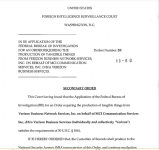
The order, signed by Judge Roger Vinson of the Foreign Intelligence Surveillance Court in April, directs a Verizon Communications subsidiary, Verizon Business Network Services, to turn over “on an ongoing daily basis” to the National Security Agency all call logs “between the United States and abroad” or “wholly within the United States, including local telephone calls.”

The order does not apply to the content of the communications.

Verizon Business Network Services is one of the nation’s largest telecommunications and Internet providers for corporations. It is not clear whether similar orders have gone to other parts of Verizon, like its residential or cellphone services, or to other telecommunications carriers. The order prohibits its recipient from discussing its existence, and representatives of both Verizon and AT&T declined to comment Wednesday evening.

The four-page order was disclosed Wednesday evening by the newspaper The Guardian. Obama administration officials at the F.B.I. and the White House also declined to comment on it Wednesday evening, but did not deny the report, and a person familiar with the order confirmed its authenticity. “We will respond as soon as we can,” said Marci Green Miller, a National Security Agency spokeswoman, in an e-mail.

The order was sought by the Federal Bureau of Investigation under a section of the Foreign Intelligence Surveillance Act, the 1978 law that regulates domestic surveillance for national security purposes, that allows the government to secretly obtain “tangible things” like a business’s customer records. The provision was expanded by Section 215 of the Patriot Act, which Congress enacted after the 9/11 terrorist attacks.

The order was marked “TOP SECRET//SI//NOFORN,” referring to communications-related intelligence information that may not be released to noncitizens. That would make it among the most closely held secrets in the federal government, and its disclosure comes amid a furor over the Obama administration’s aggressive tactics in its investigations of leaks.

The collection of call logs is set to expire in July unless the court extends it.

The collection of communications logs — or calling “metadata” — is believed to be a major component of the Bush administration’s program of surveillance that took place without court orders. The newly disclosed order raised the question of whether the government continued that type of information collection by bringing it under the Patriot Act.

The disclosure late Wednesday seemed likely to inspire further controversy over the scope of government surveillance. Kate Martin of the Center for National Security Studies, a civil liberties advocacy group, said that “absent some explanation I haven’t thought of, this looks like the largest assault on privacy since the N.S.A. wiretapped Americans in clear violation of the law” under the Bush administration. “On what possible basis has the government refused to tell us that it believes that the law authorizes this kind of request?” she said.

For several years, two Democrats on the Senate Intelligence Committee, Senator Ron Wyden of Oregon and Senator Mark Udall of Colorado, have been cryptically warning that the government was interpreting its surveillance powers under that section of the Patriot Act in a way that would be alarming to the public if it knew about it.

“We believe most Americans would be stunned to learn the details of how these secret court opinions have interpreted Section 215 of the Patriot Act,” they wrote last year in a letter to Attorney General Eric H. Holder Jr.

They added: “As we see it, there is now a significant gap between what most Americans think the law allows and what the government secretly claims the law allows. This is a problem, because it is impossible to have an informed public debate about what the law should say when the public doesn’t know what its government thinks the law says.”

A spokesman for Senator Wyden did not respond Wednesday to a request for comment on the Verizon order.

The senators were angry because the Obama administration described Section 215 orders as being similar to a grand jury subpoena for obtaining business records, like a suspect’s hotel or credit card records, in the course of an ordinary criminal investigation. The senators said the secret interpretation of the law was nothing like that.

Section 215 of the Patriot Act made it easier to get an order from the Foreign Intelligence Surveillance Court to obtain business records so long as they were merely deemed “relevant” to a national-security investigation.

The Justice Department has denied being misleading about the Patriot Act. Department officials have acknowledged since 2009 that a secret, sensitive intelligence program is based on the law and have insisted that their statements about the matter have been accurate.

The New York Times filed a Freedom of Information Act lawsuit in 2011 for a report describing the government’s interpretation of its surveillance powers under the Patriot Act. But the Obama administration withheld the report, and a judge dismissed the case.
 
Congress is full of hypocrites. Liberals who criticized Bush are less incensed with Obama. Republicans who bowed to Bush are now blasting Obama. The next time your congressional representative criticizes Obama for curbing civil liberties, ask if he or she would vote to repeal the Patriot Act, the post-911 law that handed unfettered power to the intelligence and military bureaucracies. Most won't.

http://www.nationaljournal.com/poli...ama-white-house-they-re-spying-on-us-20130606
Welcome to the era of Bush-Obama, a 16-year span of U.S. history that will be remembered for an unprecedented erosion of civil liberties and a disregard for transparency. On the war against a tactic—terrorism—and its insidious fallout, the United States could have skipped the 2008 election.

It made little difference.

Despite his clear and popular promises to the contrary, President Obama has not shifted the balance between security and freedom to a more natural state—one not blinded by worst fears and tarred by power grabs. If anything, things have gotten worse.

Killing civilians and U.S. citizens via drone.

Seizing telephone records at the Associated Press in violation of Justice Department guidelines.

Accusing a respected Fox News reporter of engaging in a conspiracy to commit treason for doing his job.

Detaining terrorist suspects at Guantanamo Bay, despite promises to end the ill-considered Bush policy.

Even the IRS scandal, while not a matter of foreign policy, strikes at the heart of growing concerns among Americans that their privacy is government's playpen.

And now this: The Guardian newspaper reports that the National Security Agency is collecting telephone records of tens of millions of customers of one of the nation's largest phone companies, Verizon.

If the story is accurate, the action appears to be legal. The order was signed by a judge from a secret court that oversees domestic surveillance. It may also be necessary; U.S. intelligence needs every advantage it can get over the nation's enemies.

But for several reasons the news is chilling.

Verizon probably isn't the only company coughing up its documents. Odds are incredibly strong that the government is prying into your telephone records today.
Issued in April, the NSA order "could represent the broadest surveillance order known to have been issued," according to The Washington Post. "It also would confirm long-standing suspicions of civil liberties advocates about the sweeping nature of U.S. surveillance through commercial carries under laws passed after the Sept. 11, 2001, terrorist attacks."
This appears to be a "rubber stamp," order, reissued every few months since 2001. As is the case with all government programs, the systematic snooping into your telephone records is unlikely to ever expire without public outcry.
Congress is full of hypocrites. Liberals who criticized Bush are less incensed with Obama. Republicans who bowed to Bush are now blasting Obama. The next time your congressional representative criticizes Obama for curbing civil liberties, ask if he or she would vote to repeal the Patriot Act, the post-911 law that handed unfettered power to the intelligence and military bureaucracies. Most won't.
The Bush-Obama White House hates transparency. President George W. Bush and his vice president, Dick Cheney, were justifiably criticized by Democrats (none more successfully so than Obama himself) for their penchant for secrecy. Obama promised that he would run history's most transparent administration. By almost any measure, on domestic and well as foreign policies, Obama has broken that promise.

It is the lack of transparency that is most galling about the security versus civil liberties debate under Obama, because it shows his lack of faith in the public. Americans know a high level of secrecy and dirty work is needed to keep them safe. Most trust their president. Many approve of his job performance.

Still, they expect and deserve an open discussion about how to fight terrorism without undermining the Constitution.

Obama started that conversation with a recent address on the drone program, media leaks and the need to move American off a constant war footing. It was a compelling and well-considered argument for the balance he is claiming to strike.

But he made the speech under pressure, and reluctantly. It only came amid new revelations about the drone program and the disclosure of newsroom spying (the Guardian may well be in Obama's sights next). Under Bush, the warrantless-wiretap program only stopped after it was publicly disclosed. In that way, the Guardian story is not a surprise, so why didn't Obama long ago acknowledge, explain, and justify such an intrusion into privacy?

Obama has promised to adjust the drone and leaks investigation policies, essentially acknowledging that his administration had gone too far in the name of security. Do you believe him?

One thing we've learned about the Bush-Obama White House is that words don't matter. Watch what they do.
 
NSA's Verizon Spying Order Specifically Targeted Americans, Not Foreigners

http://www.forbes.com/sites/andygre...ecifically-targeted-americans-not-foreigners/
The National Security Agency has long justified its spying powers by arguing that its charter allows surveillance on those outside of the United States, while avoiding intrusions into the private communications of American citizens. But the latest revelation of the extent of the NSA’s surveillance shows that it has focused specifically on Americans, to the degree that its data collection has in at least one major spying incident explicitly excluded those outside the United States.

In a top secret order obtained by the Guardian newspaper and published Wednesday evening, the FBI on the NSA’s behalf demanded that Verizon turn over all metadata for phone records originating in the United States for the three months beginning in late April and ending on the 19th of July. That metadata includes all so-called “non-content” data for millions of American customers’ phone calls, such as the subscriber data, recipients, locations, times and durations of every call made during that period.

Aside from the sheer scope of that surveillance order, reminiscent of the warrantless wiretapping scandal under the Bush administration, the other shocking aspect of the order its target: The order specifically states that only data regarding calls originating in America are to be handed over, not those between foreigners.

“It is hereby ordered that [Verizon Business Network Services'] Custodian of Records shall produce to the National Security Agency…all call detail records or ‘telephony metadata’ created by Verizon for communications (i) between the United States and abroad; or (ii) wholly within the United States, including local telephone calls,” the Guardian’s copy of the order reads. “This Order does not require Verizon to include telephony metadata for communications wholly originating and terminating in foreign countries.”

Though the classified, top secret order comes from the FBI, it clearly states that the data is to be given to the NSA. That means the leaked document may serve as one of the first concrete pieces of evidence that the NSA’s spying goes beyond foreigners to include Americans, despite its charter specifically disallowing surveillance of those within the United States.

“In many ways it’s even more troubling than [Bush era] warrantless wiretapping, in part because the program is purely domestic,” says Alex Abdo, a staff attorney with the American Civil Liberties Union’s National Security Project.”But this is also an indiscriminate dragnet. Say what you will about warrantless wiretapping, at least it was targeted at agents of Al Qaeda. This includes every customer of Verizon Business Services.”

The leaked document, in fact, is labelled as an order from the Foreign Intelligence Surveillance Court, a body whose powers were created under the Foreign Intelligence Surveillance Act of 1978 and then broadened after the September 11th, 2001 attacks, with the purpose of intercepting communications between foreign agents and those between enemies abroad and their agents within the U.S. Similarly, the NSA’s charter states that it focuses on interception and analysis of foreign communications, not those within the United States.

But the Verizon order seems to show that the NSA, using FISA, has specifically gathered communications data that both begins and ends with Americans. That domestic surveillance may be allowed under FISA’s low standard for the “relevance” of the data demanded from Internet companies and telephone carriers in the investigations of foreigners, says Julian Sanchez, a research fellow with the CATO Institute focused on privacy and civil liberties. ”The overall purpose of this program is to identify foreign terrorists,” says Julian Sanchez. “But in fact it extends well beyond whether the individual you’re investigating is foreign. If you think an American citizens’s email has information about what a foreign power or individual is doing, that’s ‘relevant.’ The purpose of the investigation is not a constraint on the target or the people from whom the information is sought.”

“If they data mine huge blocks of call records, they’re getting lots of innocent Americans’ data,” adds Sanchez, “But the argument, I imagine, is ‘we’re doing data mining to look for suspicious patterns to help us identify foreign terrorists.’”

My colleague Kashmir Hill has contacted the NSA and Verizon for comment, and I’ll update this post if we hear back from either of the two. Update: Verizon has declined to comment.

In fact, the Verizon order may be just a glimpse of a much larger surveillance program. It’s unclear whether other carriers, not to mention Internet giants like Google, Microsoft and Facebook, have been caught up in similar domestic surveillance, or how long that surveillance has been taking place. But as the Guardian notes, Senators Ron Wyden and Mark Udall have issued cryptic warnings for the last two years that the Obama administration has engaged in widespread surveillance of Americans.

Other phone carriers including AT&T, T-Mobile and Sprint all responded to a congressional inquiry on government surveillance last year, stating that they had turned over hundreds of thousands of users’ records to law enforcement agencies, though that inquiry didn’t focus on intelligence agency requests.

In a congressional hearing in March of last year, the NSA’s Director Keith Alexander responded to questions from Georgia Congressman Hank Johnson, who brought up allegations of the NSA’s domestic spying made in a Wired magazine article earlier that month, denying fourteen times that the NSA intercepted Americans’ communications.

“What judicial consent is required for NSA to intercept communications and information involving American citizens?” Johnson asked at the time.

“Within the United States, that would be the FBI lead,” responded Alexander. “If it were a foreign actor in the United States, the FBI would still have to lead. It could work that with NSA or other intelligence agencies as authorized. But to conduct that kind of collection in the United States it would have to go through a court order, and the court would have to authorize it. We’re not authorized to do it, nor do we do it.”

In light of this latest leak and the surveillance it’s exposed, the NSA may have some more explaining to do.

Read the full FISA court order sent to Verizon here.
 

Attachments

  • Capture.PNG
    Capture.PNG
    125.8 KB · Views: 100
So, what exactly is the definition of "national security purposes"?
 
go ask bush since he signed the patriot act into law giving this power to the NSA, FBI

Go ask Obama since he signed it again in 2011.

If you want to be a partisan hack, go right ahead. Who just gave it a four year extension? Obama.

Who in the congress just voted for the extension?

The Senate voted 72-23 The House 250-153

Who authorized it in congress the first time? Seems like Dems voted for it then too.

Senate Democrats who Voted FOR the Patriot Act in 2011 for Obama to sign.

Bennet (D-CO)
Boxer (D-CA)
Cardin (D-MD)
Carper (D-DE)
Casey (D-PA)
Conrad (D-ND)
Feinstein (D-CA)
Gillibrand (D-NY)
Hagan (D-NC)
Inouye (D-HI)
Johnson (D-SD)
Kerry (D-MA)
Klobuchar (D-MN)
Kohl (D-WI)
Landrieu (D-LA)
Levin (D-MI)
Lieberman (ID-CT)
Manchin (D-WV)
McCaskill (D-MO)
Mikulski (D-MD)
Nelson (D-FL)
Nelson (D-NE)
Pryor (D-AR)
Reed (D-RI)
Reid (D-NV)
Rockefeller (D-WV)
Shaheen (D-NH)
Stabenow (D-MI)
Warner (D-VA)
Webb (D-VA)
Whitehouse (D-RI)

Which ones didn't?

Akaka (D-HI)
Baucus (D-MT)
Begich (D-AK)
Bingaman (D-NM)
Brown (D-OH)
Cantwell (D-WA)
Coons (D-DE)
Durbin (D-IL)
Franken (D-MN)
Harkin (D-IA)
Lautenberg (D-NJ)
Leahy (D-VT)
Merkley (D-OR)
Murray (D-WA)
Tester (D-MT)
Udall (D-CO)
Udall (D-NM)
Wyden (D-OR)

That was in 2011


So don't start that BS party crap. They are both the same.

I'll stick with the quote from the fourth post.

Congress is full of hypocrites. Liberals who criticized Bush are less incensed with Obama. Republicans who bowed to Bush are now blasting Obama. The next time your congressional representative criticizes Obama for curbing civil liberties, ask if he or she would vote to repeal the Patriot Act, the post-911 law that handed unfettered power to the intelligence and military bureaucracies. Most won't.
 
Author of Patriot Act says NSA phone records collection 'never the intent' of law

It never is. Is it? :rolleyes:

The author of the Patriot Act said Thursday that a secret program under which the Obama administration was collecting phone records from millions of Americans is "excessive" and beyond the scope of the law.

Rep. Jim Sensenbrenner, R-Wis., who wrote the 2001 law, was among a host of lawmakers on both sides of the aisle who raised alarm over the practice.

The Guardian newspaper first reported the National Security Agency had been collecting records under a court order from millions of Verizon customers in the U.S. Defenders of the program tried to ease the furor by assuring the public this is "nothing new" -- and in fact has been going on for seven years. But the acknowledgement that the program is long running only fueled the outrage from civil liberties groups and lawmakers who described it as a blatant overreach.

"This is a big deal, a really big deal," Sensenbrenner told Fox News, adding that such a broad seizure was "never the intent" of the law. He floated the possibility of amending the Patriot Act before its 2015 expiration to stop this.

In a separate statement, he called the program "excessive and un-American."

The Republican lawmaker also fired off a letter to Attorney General Eric Holder -- who would not comment on the program when asked about it Thursday -- explaining why he thinks the records collection goes astray of the law. He noted that the key section of the law that allows the government to obtain business records requires the information to be relevant to an authorized investigation.

"How could the phone records of so many innocent Americans be relevant to an authorized investigation?" he asked in the letter.

He said the order "could not have been drafted more broadly," and said he does not think it's "consistent" with the law's requirements.

A handful of in-the-know lawmakers lined up to defend the program, while acknowledging the need to protect privacy.

Rep. Mike Rogers, R-Mich., chairman of the House intelligence committee, said the effort is not "data mining," and has helped quash a terrorist attack on U.S. soil in the past few years. He would not elaborate.

The leaders of the Senate intelligence committee also defended the program, saying it is "nothing new." Republican Georgia Sen. Saxby Chambliss said it's been going on for seven years.

Chairwoman Sen. Dianne Feinstein, D-Calif., said these orders are actually renewed every three months through the court. She said the records are there for investigators to access if there is suspicion of terrorist activity.

"The threat from terrorism remains very real and these lawful intelligence activities must continue, with the careful oversight of the executive, legislative and judicial branches of government," Feinstein and Chambliss said in a joint statement.

Speaking later in the day, Senate Democratic Leader Harry Reid said "everyone should just calm down."

Administration officials, while not directly acknowledging the order, defended their authority to collect records and stressed they're not listening in on conversations.

However, civil liberties groups and some lawmakers sounded the alarm over the collection effort.

"The National Security Agency's seizure and surveillance of virtually all of Verizon's phone customers is an astounding assault on the Constitution," Sen. Rand Paul, R-Ky., said.

One civil liberties group called this the "broadest surveillance order to ever have been issued."

"It requires no level of suspicion and applies to all Verizon subscribers anywhere in the U.S.," the Center for Constitutional Rights said in a statement.

Sen. Bernie Sanders, I-Vt., who has historically opposed the Patriot Act, said the effort "is not what democracy is about."

The report in the Guardian newspaper follows revelations that the Justice Department was seizing the phone records of journalists, including at Fox News, in the course of leak probes.

The order, a copy of which apparently was obtained by The Guardian, reportedly was granted by the secret Foreign Intelligence Surveillance Court on April 25 and is good until July 19.

It requires Verizon, one of the nation's largest telecommunications companies, on an "ongoing, daily basis" to give the NSA information on all telephone calls in its systems, both within the U.S. and between the U.S. and other countries.

The text of the order, as published by The Guardian, says that "the Custodian of Records shall produce to the National Security Agency (NSA) upon service of this Order, and continue production on an ongoing daily basis thereafter for the duration of this Order, unless otherwise ordered by the Court, an electronic copy of the" the records in question.

The newspaper claims the document shows for the first time that under the Obama administration the communication records of millions of U.S. citizens were being collected indiscriminately and in bulk, regardless of whether they were suspected of any wrongdoing.

The Associated Press contributed to this report.
 
Chairwoman Sen. Dianne Feinstein, D-Calif., said these orders are actually renewed every three months through the court. She said the records are there for investigators to access if there is suspicion of terrorist activity.

"The threat from terrorism remains very real and these lawful intelligence activities must continue, with the careful oversight of the executive, legislative and judicial branches of government," Feinstein and Chambliss said in a joint statement.

Speaking later in the day, Senate Democratic Leader Harry Reid said "everyone should just calm down."

--------

I don't see anything different from most on either side.
 
British intelligence mining data from nine U.S. Internet companies


http://www.washingtonpost.com/inves...0c0da8-cebf-11e2-8845-d970ccb04497_print.html


U.S., British intelligence mining data from nine U.S. Internet companies in broad secret program


The National Security Agency and the FBI are tapping directly into the central servers of nine leading U.S. Internet companies, extracting audio and video chats, photographs, e-mails, documents, and connection logs that enable analysts to track foreign targets, according to a top-secret document obtained by The Washington Post.

The program, code-named PRISM, has not been made public until now. It may be the first of its kind. The NSA prides itself on stealing secrets and breaking codes, and it is accustomed to corporate partnerships that help it divert data traffic or sidestep barriers. But there has never been a Google or Facebook before, and it is unlikely that there are richer troves of valuable intelligence than the ones in Silicon Valley.

Equally unusual is the way the NSA extracts what it wants, according to the document: “Collection directly from the servers of these U.S. Service Providers: Microsoft, Yahoo, Google, Facebook, PalTalk, AOL, Skype, YouTube, Apple.”

London’s Guardian newspaper reported Friday that GCHQ, Britain’s equivalent of the NSA, also has been secretly gathering intelligence from the same internet companies through an operation set up by the NSA.

According to documents obtained by The Guardian, PRISM would appear to allow GCHQ to circumvent the formal legal process required in Britain to seek personal material such as emails, photos and videos from an internet company based outside of the country.

PRISM was launched from the ashes of President George W. Bush’s secret program of warrantless domestic surveillance in 2007, after news media disclosures, lawsuits and the Foreign Intelligence Surveillance Court forced the president to look for new authority.

Congress obliged with the Protect America Act in 2007 and the FISA Amendments Act of 2008, which immunized private companies that cooperated voluntarily with U.S. intelligence collection. PRISM recruited its first partner, Microsoft, and began six years of rapidly growing data collection beneath the surface of a roiling national debate on surveillance and privacy. Late last year, when critics in Congress sought changes in the FISA Amendments Act, the only lawmakers who knew about PRISM were bound by oaths of office to hold their tongues.

The court-approved program is focused on foreign communications traffic, which often flows through U.S. servers even when sent from one overseas location to another. Between 2004 and 2007, Bush administration lawyers persuaded federal FISA judges to issue surveillance orders in a fundamentally new form. Until then the government had to show probable cause that a particular “target” and “facility” were both connected to terrorism or espionage.

In four new orders, which remain classified, the court defined massive data sets as “facilities” and agreed to certify periodically that the government had reasonable procedures in place to minimize collection of “U.S. persons” data without a warrant.

In a statement issue late Thursday, Director of National Intelligence James R. Clapper said “information collected under this program is among the most important and valuable foreign intelligence information we collect, and is used to protect our nation from a wide variety of threats. The unauthorized disclosure of information about this important and entirely legal program is reprehensible and risks important protections for the security of Americans.”

Clapper added that there were numerous inaccuracies in reports about PRISM by The Post and the Guardian newspaper, but he did not specify any.

Jameel Jaffer, deputy legal director of the American Civil Liberties Union, said: “I would just push back on the idea that the court has signed off on it, so why worry? This is a court that meets in secret, allows only the government to appear before it, and publishes almost none of its opinions. It has never been an effective check on government.”

Several companies contacted by The Post said they had no knowledge of the program, did not allow direct government access to their servers and asserted that they responded only to targeted requests for information.

“We do not provide any government organization with direct access to Facebook servers,” said Joe Sullivan, chief security officer for Facebook. “When Facebook is asked for data or information about specific individuals, we carefully scrutinize any such request for compliance with all applicable laws, and provide information only to the extent required by law.”

“We have never heard of PRISM,” said Steve Dowling, a spokesman for Apple. “We do not provide any government agency with direct access to our servers, and any government agency requesting customer data must get a court order.”

It is possible that the conflict between the PRISM slides and the company spokesmen is the result of imprecision on the part of the NSA author. In another classified report obtained by The Post, the arrangement is described as allowing “collection managers [to send] content tasking instructions directly to equipment installed at company-controlled locations,” rather than directly to company servers.

Government officials and the document itself made clear that the NSA regarded the identities of its private partners as PRISM’s most sensitive secret, fearing that the companies would withdraw from the program if exposed. “98 percent of PRISM production is based on Yahoo, Google and Microsoft; we need to make sure we don’t harm these sources,” the briefing’s author wrote in his speaker’s notes.

An internal presentation of 41 briefing slides on PRISM, dated April 2013 and intended for senior analysts in the NSA’s Signals Intelligence Directorate, described the new tool as the most prolific contributor to the President’s Daily Brief, which cited PRISM data in 1,477 items last year. According to the slides and other supporting materials obtained by The Post, “NSA reporting increasingly relies on PRISM” as its leading source of raw material, accounting for nearly 1 in 7 intelligence reports.

That is a remarkable figure in an agency that measures annual intake in the trillions of communications. It is all the more striking because the NSA, whose lawful mission is foreign intelligence, is reaching deep inside the machinery of American companies that host hundreds of millions of American-held accounts on American soil.

The technology companies, whose cooperation is essential to PRISM operations, include most of the dominant global players of Silicon Valley, according to the document. They are listed on a roster that bears their logos in order of entry into the program: “Microsoft, Yahoo, Google, Facebook, PalTalk, AOL, Skype, YouTube, Apple.” PalTalk, although much smaller, has hosted traffic of substantial intelligence interest during the Arab Spring and in the ongoing Syrian civil war.

Dropbox, the cloud storage and synchronization service, is described as “coming soon.”

Sens. Ron Wyden (D-Ore.) and Mark Udall (D-Colo.), who had classified knowledge of the program as members of the Senate Intelligence Committee, were unable to speak of it when they warned in a Dec. 27, 2012, floor debate that the FISA Amendments Act had what both of them called a “back-door search loophole” for the content of innocent Americans who were swept up in a search for someone else.

“As it is written, there is nothing to prohibit the intelligence community from searching through a pile of communications, which may have been incidentally or accidentally been collected without a warrant, to deliberately search for the phone calls or e-mails of specific Americans,” Udall said.

Wyden repeatedly asked the NSA to estimate the number of Americans whose communications had been incidentally collected, and the agency’s director, Lt. Gen. Keith B. Alexander, insisted there was no way to find out. Eventually Inspector General I. Charles McCullough III wrote Wyden a letter stating that it would violate the privacy of Americans in NSA data banks to try to estimate their number.

Roots in the ’70s

PRISM is an heir, in one sense, to a history of intelligence alliances with as many as 100 trusted U.S. companies since the 1970s. The NSA calls these Special Source Operations, and PRISM falls under that rubric.

The Silicon Valley operation works alongside a parallel program, code-named BLARNEY, that gathers up “metadata” — technical information about communications traffic and network devices — as it streams past choke points along the backbone of the Internet. BLARNEY’s top-secret program summary, set down in the slides alongside a cartoon insignia of a shamrock and a leprechaun hat, describes it as “an ongoing collection program that leverages IC [intelligence community] and commercial partnerships to gain access and exploit foreign intelligence obtained from global networks.”

But the PRISM program appears to more nearly resemble the most controversial of the warrantless surveillance orders issued by President George W. Bush after the al-Qaeda attacks of Sept. 11, 2001. Its history, in which President Obama presided over exponential growth in a program that candidate Obama criticized, shows how fundamentally surveillance law and practice have shifted away from individual suspicion in favor of systematic, mass collection techniques.

The Obama administration points to ongoing safeguards in the form of “extensive procedures, specifically approved by the court, to ensure that only non-U.S. persons outside the U.S. are targeted, and that minimize the acquisition, retention and dissemination of incidentally acquired information about U.S. persons.”

And it is true that the PRISM program is not a dragnet, exactly. From inside a company’s data stream the NSA is capable of pulling out anything it likes, but under current rules the agency does not try to collect it all.

Analysts who use the system from a Web portal at Fort Meade, Md., key in “selectors,” or search terms, that are designed to produce at least 51 percent confidence in a target’s “foreignness.” That is not a very stringent test. Training materials obtained by The Post instruct new analysts to make quarterly reports of any accidental collection of U.S. content, but add that “it’s nothing to worry about.”

Even when the system works just as advertised, with no American singled out for targeting, the NSA routinely collects a great deal of American content. That is described as “incidental,” and it is inherent in contact chaining, one of the basic tools of the trade. To collect on a suspected spy or foreign terrorist means, at minimum, that everyone in the suspect’s inbox or outbox is swept in. Intelligence analysts are typically taught to chain through contacts two “hops” out from their target, which increases “incidental collection” exponentially. The same math explains the aphorism, from the John Guare play, that no one is more than “six degrees of separation” from any other person.

A ‘directive’

In exchange for immunity from lawsuits, companies such as Yahoo and AOL are obliged to accept a “directive” from the attorney general and the director of national intelligence to open their servers to the FBI’s Data Intercept Technology Unit, which handles liaison to U.S. companies from the NSA. In 2008, Congress gave the Justice Department authority for a secret order from the Foreign Surveillance Intelligence Court to compel a reluctant company “to comply.”

In practice, there is room for a company to maneuver, delay or resist. When a clandestine intelligence program meets a highly regulated industry, said a lawyer with experience in bridging the gaps, neither side wants to risk a public fight. The engineering problems are so immense, in systems of such complexity and frequent change, that the FBI and NSA would be hard pressed to build in back doors without active help from each company.

Apple demonstrated that resistance is possible when it held out for more than five years, for reasons unknown, after Microsoft became PRISM’s first corporate partner in May 2007. Twitter, which has cultivated a reputation for aggressive defense of its users’ privacy, is still conspicuous by its absence from the list of “private sector partners.”

Google, like the other companies, denied that it permitted direct government access to its servers.

“Google cares deeply about the security of our users’ data,” a company spokesman said. “We disclose user data to government in accordance with the law, and we review all such requests carefully. From time to time, people allege that we have created a government ‘back door’ into our systems, but Google does not have a ‘back door’ for the government to access private user data.”

Microsoft also provided a statement: “We provide customer data only when we receive a legally binding order or subpoena to do so, and never on a voluntary basis. In addition we only ever comply with orders for requests about specific accounts or identifiers. If the government has a broader voluntary national security program to gather customer data we don’t participate in it.”

Yahoo also issued a denial.

“Yahoo! takes users’ privacy very seriously,” the company said in a statement. “We do not provide the government with direct access to our servers, systems, or network.”

Like market researchers, but with far more privileged access, collection managers in the NSA’s Special Source Operations group, which oversees the PRISM program, are drawn to the wealth of information about their subjects in online accounts. For much the same reason, civil libertarians and some ordinary users may be troubled by the menu available to analysts who hold the required clearances to “task” the PRISM system.

There has been “continued exponential growth in tasking to Facebook and Skype,” according to the PRISM slides. With a few clicks and an affirmation that the subject is believed to be engaged in terrorism, espionage or nuclear proliferation, an analyst obtains full access to Facebook’s “extensive search and surveillance capabilities against the variety of online social networking services.”

According to a separate “User’s Guide for PRISM Skype Collection,” that service can be monitored for audio when one end of the call is a conventional telephone and for any combination of “audio, video, chat, and file transfers” when Skype users connect by computer alone. Google’s offerings include Gmail, voice and video chat, Google Drive files, photo libraries, and live surveillance of search terms.

Firsthand experience with these systems, and horror at their capabilities, is what drove a career intelligence officer to provide PowerPoint slides about PRISM and supporting materials to The Washington Post in order to expose what he believes to be a gross intrusion on privacy. “They quite literally can watch your ideas form as you type,” the officer said.

Poitras is a documentary filmmaker and MacArthur Fellow. Julie Tate, Robert O’Harrow Jr., Cecilia Kang and Ellen Nakashima contributed to this report.

Graphic: NSA slides explain the PRISM data-collection program Special Report: Top Secret America

 
So, I just listened to Obama address the Verizon issue. What he stated was nobody was listening to content of the phone calls. They are only looking at numbers called and length of calls. That there is a lot of hype.

Well that was followed by (as to dismiss the hype) that if NSA or investigators then decide to listen to the content they would have to go back to the court and explain why to obtain permission.

So that makes it alright? The very simple point that was glossed over was all the content was recorded, NO? That is what I heard. Did I get this wrong?

Every single phone call anyone has made with Verizon has been recorded? But rest assured were not going to listen to it without approval from the court.

Who wants to bend over and say that is perfectly fine?

1:50- 4:04


If you are with Verizon are you perfectly OK that the content of your phone calls is sitting somewhere just in-case someone wants to listen to them?

If the majority are, this idea of freedom is done.
 
Seecrypt

New app claims to prevent government eavesdropping on cell phones

http://dailycaller.com/2013/06/06/n...t-eavesdropping-on-cell-phones/#ixzz2VXyj8PeR

The developers of a new mobile app may have just caught a break — and found a new group of potential customers — with the revelation that government is secretly snooping on Verizon cell phone users.

Developers in South Africa have developed an app called Seecrypt, which they say protects cell phone users from having their calls and texts tracked.

It was revealed Wednesday that the National Security Agency has forced Verizon to turn over phone records of customers inside the United States in the name of fighting terrorism.

But the developers of Seecrypt say you can get around the NSA with their app.

Users, according to the developers, don’t have to worry about the government knowing who they are talking with.

For the app to work, both people wanting to text or call each other must have the application. But when the application is used, the phone company will not know the identity or phone number of the other person on the line. It will only know that the caller used Seecrypt.

Once the communication begins, it becomes encrypted and private.

According to a release at the company’s launch last month, the app is available for Apple and Android smartphones.

“Creating a scalable encrypted voice-over-data application that can operate with minimal latency anywhere in the world is not easy,” said Mornay Walters, the CEO and co-founder of Seecrypt, at the company’s launch. “Seecrypt met and surpassed this challenge by using a set of proprietary protocols and a carrier grade back-end infrastructure that operates on a privately controlled and globally deployed network.”
 
Almost every political post is BS party crap. lol Will be 100 years from now.
 
Hey dennis, just to let you know I am not a liberal and this bull with what's coming out bothers me just has much as you I blame bush and Obama for not saying no to it.
 
It seems in any political post if you say something bad about a politician then you just have to be an extreme Liberal or Teapartier. Old crap. Heaven forbide that some people can actually have views outside the lines. That said there are a lot of people who are targeting Obama on this. It's been going on for a long time and all the other carriers have been turning over data for a long time. All of a sudden Verizon makes a statement and it's OMG! It's old news people. Dems and Rep except for some on both sides have ok'ed this and will continue to.
 
All of a sudden Verizon makes a statement and it's OMG! It's old news people. Dems and Rep except for some on both sides have ok'ed this and will continue to.

It's not old news. Maybe for those on intelligence committees. I'm pretty sure most Americans didn't believe that the government had 100 percent data collection on all their activities already without seeking a warrant to extract it from the company.

I'm also 100 percent certain that a overwhelming amount of the general population had no idea that the content of their phone calls are stored both by the private company and the government.
 
Back
Top