• Responding to email notices you receive.
    **************************************************
    In short, DON'T! Email notices are to ONLY alert you of a reply to your private message or your ad on this site. Replying to the email just wastes your time as it goes NOWHERE, and probably pisses off the person you thought you replied to when they think you just ignored them. So instead of complaining to me about your messages not being replied to from this site via email, please READ that email notice that plainly states what you need to do in order to reply to who you are trying to converse with.

  • IMPORTANT! PLEASE READ!! About the Google Adsense ads being displayed

    =====================
    Posted 08/15/2025
    =====================


    Yeah, I know. They are a pain in the butt. But they pay the bills to keep my server running. Just a fact of life, I am afraid.

    Want to get rid of them? Simple. Just become a Contributor level member or above and they will be gone. -> Please click HERE."

    Is that too much for me to ask of you to keep this site running? Well, sorry about that. I too wish I could get everything for free. But alas.....

    =====================
    Addendum: 01/10/2026
    =====================


    Google Adsense ad revenue for December, 2025 was just $30 over the cost of the lease for the server running this site. So, in effect, the money providing the incentive for me to continue running this site is coming SOLELY from the paid memberships and sponsorships here. Which honestly ain't much....

Please Do Not Kill the Snake

Re: Re: Please Do Not Kill the Snake

luchadora_5245 said:
Hi i agree with wat u say coz i own several poisonous snake and they have never bitten me b4 coz i respect them and if they come to my house i will feed them and killing snake coz u are afraid of it is stupid and a way to identify a coral to another harmless breed is a rymth it gos like this ( red touches black friend of jack red touches yellow kills a fellow ) it really works

hey kid i have been nailed by king cobras and black mamdas for more then 20 times and coral snakes are just desserts and handling snakes are my forte so if u don't trust my rymth don't touch any kind of snakes

Anyone see the contradiction?

luchadora: You my friend, are a complete idiot.

Now please stop posting harmful lies, and go do something constructive...like shooting yourself.
 
luchadora_5245 said:
Seamus Haley
since u say the rymth doesn't ok which snake goes against that rymth or which harmless snake has a red touches yellow colour if u can show me the picture i will study it asap

Since Seamus hasn't answered yet, I'll do it for him.

Take a look at the photos he posted on his last post...can YOU tell what is deadly and what is harmless? I bet not, and your obviously not as educated on venomous as you let on, as there are over 80 distinct species of Micrurus, only 3 of which live in N.A, and many of those 80 or so coral snakes do NOT fit with the rhyme...
 
Good looking out Abhishek.

Not only are there corals where the rhymes will call a coral harmless (over a dozen examples that I know of and I am by no means an expert on the genus), there are corals which totally defy the colors and patterns indicated in the rhyme (aren't banded, have different colors, lack one of the three common colors), there are also a huge number of species (Non-elapids) with similar patterning and color to the typical coral banding... There are completely 100% harmless colubrids which will sometimes have banding which the rhymes indicate are dangerous (Literally, I have seen thayeri kings which hatched with a pattern that looked nothing like a coral, but the red/yellow/black ended up with red touching yellow, which the rhyme claims is a coral), there are dozens of rear fanged species of varying toxicity which fall one way or the other in the patterning and there are even north american corals which defy the rhymes... An abberrent coral snake could easily turn someone's day rather bad if they handled it after mumbling some rhyme and checking for a rattle. Heck, reptiles magazine (not exactly a definite authorotative publication or anything but popular and widespread) even published photos of melanistic north american corals that defied the rhymes.

I honestly don't mind much if someone makes the claim about the colors... it's an honest, innocent and very common mistake with some situational truth behind it (In north america (er... well, discounting southern mexico down), discounting phenotypical abberrations it kind of almost works. Once it's been corrected though (Micrurus surinamensis, there's your species and it only takes one to make the rhymes false, even though there are plenty of examples) someone who refuses to let it go... that's kind of irritating.
 
HOT OR NOT?
 

Attachments

  • 1pipesnake.jpg
    1pipesnake.jpg
    16.9 KB · Views: 129
Scott makes an excellent point...if someone who wasn't interested in snakes or hot snakes encountered that snake, and followed the rhyme, they would most likely kill it. Bottom line: If you can't positively (without using kiddie rhymes!) identify a snake as venomous or non, treat it as venomous and LEAVE IT ALONE!
 
All the time on Animal Plant (i spelt it wrong incase more legal stuff comes up again...might as well stay on the safe side from now on). i see Venom ER and people get bit by the snake, and then still have the nerve and the courage to go back and kill it. I know it's for identification purposes, but if you see a rattlesnake you know it's a rattlesnake, ofcourse you need almost the exact species identification,for the antivenom, but i guess they should be more aware..i just don't see how some people could be deadly afraid of a snake and then get bitten to add onto it, and then still be brave enough to go kill it..not saying that they shouldnt kill it...but im not saying that they should either...and if it happened to me, i wouldn't quite be sure what to do...whats someone else's opinion? And no this is not to argue about whether or not to kill it, it's only an opinion. :D
 
Anyone living and enjoying the outdoors should learn the native species they may encounter. This serves to purposes. 1st proper id can save accidents and secound the same ID in the event of a bite can facilitate proper medical care.

Killing an animal for ID is not what we would like but for the Layman it may be the only solution.

Keep in mind however what you see on TV is not always fact. Without the drama there would be no show.
 
I have seen a venom er where they brought the snake (in two halves mind you) with them in the helicopter for identification.

As most of you are well aware (and certainly know better than I do) there are various species of rattler in Southern California...and they cannot be treated the same due to different types of venom.

While I would never advocate killing anything you are not going to use as food (except mosquitos) sometimes it is deemed necessary to aid in the victims (I also use this word loosely...most strikes are provoked in one way or another...some much more deliberate than others) attempted recovery. If none of the people attending the scene can make a positive ID...SOMEONE must in most situations...and since time is critical in an envenomation...the best way to do that is kill the snake and bring it with.

Even the doctor the show is based around made it clear he was disappointed to see this particular snake killed, but sometimes it is a critical part of saving the person that has been envenomated.

They used to cut the heads off of dogs to prove/disprove rabies infections. Now what percentage of THOSE animals do you believe truly had rabies? And how many people did that save?
 
Hognose_311 said:
if you see a rattlesnake you know it's a rattlesnake, ofcourse you need almost the exact species identification,for the antivenom,

No, you don't. There are only three choices of antivenom for North American snakes in hospitals today.

1. Wyeth coral snake antivenom. It's not too hard to tell a coral snake from a rattlesnake.

2. CroFab. This is a polyvalent that is supposed to be effective against all of the North American vipers. Clean product with minimal side effects, but bloody expensive and you tend to need a lot more vials.

3. Wyeth polyvalent. Same as above, only cheaper and with more side effects. A bit outdated but there are still current stocks in place.

There is generally going to be a hospital wide policy about which antivenom gets used or stocked, so the patient is not going to have any choice of antivenoms. If it's a viper bite, you're going to get either CroFab or Wyeth. Which one is likely to depend on which drug companies and distributors the hospital is dealing with and/or what historical stocks they still have around.

No, you don't need species identification in North America to treat venomous snake bite, except to differentiate between a coral snake and everything else.

It's nice to know in advance whether the patient was bitten by one of the more neurotoxic vipers (Mojave green, Georgia canebrake) so the docs can have the ventilators ready, but the obvious clue of the early signs of neuromuscular paralysis should make it a pretty clear picture.

Doctors tend to deal with the symptoms of snakebite as they occur; they really aren't helped all that much by knowing what the species was. Certainly not in terms of antivenom administration.
 
LOL. I missed that one Tanith. I've been ignoring this thread for the most part, but should've realized that our young friend would interject.
 
simple solution

you see a snake in your hosue , call me ( grin) ill take care of it .if its too far for me to drive , fly me there , after all nothign is too expensive when it comes to the safety of your family! :scatter:
 
snakegetters said:
No, you don't. There are only three choices of antivenom for North American snakes in hospitals today.

1. Wyeth coral snake antivenom. It's not too hard to tell a coral snake from a rattlesnake.

2. CroFab. This is a polyvalent that is supposed to be effective against all of the North American vipers. Clean product with minimal side effects, but bloody expensive and you tend to need a lot more vials.

3. Wyeth polyvalent. Same as above, only cheaper and with more side effects. A bit outdated but there are still current stocks in place.

There is generally going to be a hospital wide policy about which antivenom gets used or stocked, so the patient is not going to have any choice of antivenoms. If it's a viper bite, you're going to get either CroFab or Wyeth. Which one is likely to depend on which drug companies and distributors the hospital is dealing with and/or what historical stocks they still have around.

No, you don't need species identification in North America to treat venomous snake bite, except to differentiate between a coral snake and everything else.

It's nice to know in advance whether the patient was bitten by one of the more neurotoxic vipers (Mojave green, Georgia canebrake) so the docs can have the ventilators ready, but the obvious clue of the early signs of neuromuscular paralysis should make it a pretty clear picture.

Doctors tend to deal with the symptoms of snakebite as they occur; they really aren't helped all that much by knowing what the species was. Certainly not in terms of antivenom administration.


Very well stated but one other side fact. Many keepers of the more exotic species also keep a stock of anti venom also which is more species specific as most local hospitals don't have such AV's in stock and most zoo's don't have the same species you might keep. I have found out the best data bank and anti venom bank is in south Florida. Most local poision control folks may be clueless about what you may need for a specific species you keep. this is why it is very inportant to have all information in a easy to read folder or notebook that you can take with you in the event of a bite.

As for North American Species the fact that if you can identify the snake it will help greatly in your recovery. But the average homeowner who knows nothing about snakes will just relay the fact they got bitten by a rattlesnake which really doesn't narrow down species specifics of which species bit them. this is why we must educate the public about what lives in their area, plus it is just good public relations to do so anyway.
 
what i don't get...

Mustangrde1 said:
Please Do Not Kill The Snake

I do not believe in using the old Rhyme of red touches yellow kill a fellow. As that if you run across an aberrant specimen it may not hold true. What I do like to tell people is to think of a stop sign Yellow means Caution, Red Means stop so just like a stop sign if red and yellow touch you better not.

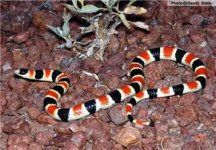
Top is The dangerous Coral Snake. Bottom is the Harmless Scarlet King


ok, first i was right about the top being the coral and the bottom being the kingsnake (as i had once wanted one so i know it well), but...i did use the "rhyme" to tell which is which. i understand that the rhyme may not work on all species of the snake (since that seems to be what you're implying), but it did work here.

so...why are you saying not to use it (esp. in regards to these two) when you did use it but not exactly---this is what you said:

<i>if red and yellow touch, then you better not</i>

isn't that the same as "red and yellow kill a fellow, but red and black don't do jack (or won't hurt jack---you decide)" but re-worded differently???:confused:
 
Back
Top