• Responding to email notices you receive.
    **************************************************
    In short, DON'T! Email notices are to ONLY alert you of a reply to your private message or your ad on this site. Replying to the email just wastes your time as it goes NOWHERE, and probably pisses off the person you thought you replied to when they think you just ignored them. So instead of complaining to me about your messages not being replied to from this site via email, please READ that email notice that plainly states what you need to do in order to reply to who you are trying to converse with.

  • IMPORTANT! PLEASE READ!! About the Google Adsense ads being displayed

    =====================
    Posted 08/15/2025
    =====================


    Yeah, I know. They are a pain in the butt. But they pay the bills to keep my server running. Just a fact of life, I am afraid.

    Want to get rid of them? Simple. Just become a Contributor level member or above and they will be gone. -> Please click HERE."

    Is that too much for me to ask of you to keep this site running? Well, sorry about that. I too wish I could get everything for free. But alas.....

    =====================
    Addendum: 01/10/2026
    =====================


    Google Adsense ad revenue for December, 2025 was just $30 over the cost of the lease for the server running this site. So, in effect, the money providing the incentive for me to continue running this site is coming SOLELY from the paid memberships and sponsorships here. Which honestly ain't much....

Protecting the indigo to death.

thesnakeman

thesnakeman
Joined
Aug 5, 2004
Messages
505
Reaction score
0
Points
0
Location
Missouri, U.S.A.
In Florida, you can't touch an indigo,...period. If you do, you risk jail time, and or serious fines. That's fine for the wild population. But there is no such thing as a captive population in Florida, or Georgia. And yet the Burmese python is sold at every pet shop, and herp show, by the hundreds of thousands. And when these animals grow too large for their keepers to feed, and care for, or when their owners grow tired of the animal, it is released into the wild,...along with any number of other species, i.e,; anacondas, monitors, iguanas, etc. My guess is that soon we will also be seeing other alien species reproducing, and upsetting the natural balance. And yet you cannot obtain a permit to own an indigo down there unless you are a well connected lawyer, like Curt Harbsmeier., the only private citizen I am aware of who has a permit to keep an indigo down there. I tried to obtain such a permit. I was told by the FFWS employee who is in charge of these permits that she does not see why anyone should be allowed to do so. And you can forget the idea of captive breeding, and or sales,...activities which are perfectly legal in other states. But if you are a wealthy land developer, you can obtain permission to bulldoze habitat, and kill, destroy, and entomb indigos, and gopher tortoises, and any other animal that gets in the way. But don't even think about going in ahead of time to remove these animals to help bolster the gene pool of an already weak captive population. To me,...the whole thing does not make sense. In my mind, they should allow a licencing process for collectors to remove these animals for captive breeding. They should allow regular folks to keep, breed, and sell captive bred/born indigos. And they should ban invasive alien species like the Burmese python. In my mind they are literally protecting the indigo to death.

Now lets see what kind of stink this stirs up. Let's hear what everyone thinks about this subject. Personally, I think it's way past time for some serious changes!!!

Right now there is a committee in Florida who is looking into the current laws, and considering recommendations to legislatures for change. Now is the time for all of us to speak up, and put the pressure on them to get it right! So get busy, and send those letters, and e-mails!!! Send them to; [email protected] or phone 850-488-6253, or 850-488-5600 in Tallahassee. Yes,...her name really is Precious Boatwright. Or contact the legislators directly. The group in question is called the Captive Wildlife Technical Assistance Group, or CWTAG.
Thanks a bunch,
T.
 
The other point of view..

One must look at this from the state's point of view, on the macro level.
Most state level wildlife agencies are already over burdened insufficiently staffed and substantially under funded. They simply do not harbor the resources to create a permitting and regulatory entity to over see the captive husbandry or distribution of an endangered species native to their state for which only a minute few are going to be interested in keeping.
The state of Florida has its hands full trying to protect all of the “game” species, both land and aquatic, from poachers and over harvesting by sport fishermen and hunters, not to mention host of marine mammals which inhabit the state that must be monitored and protected.
When you consider the full scope of what a wildlife agency is responsible for, catering to a single species and a minority group, such Dry enthusiasts, is the last thing upon their agenda. This translates to the easiest means, for regulating such an animal within its native state, as enforcing a blanket ban to prevent anyone residing within a state, native to the protected species in question, from keeping, breeding and selling them. This removes all doubt as the legality of the animal/s in question; if you have it, it’s against the law! Much like Arizona, California, Nevada, New Mexico and Utah have done in regards to Heloderma. I’m not crazy about it, but I am not going to bash an overwhelmed agency, trying to do the best they can with what they have, for such, as I believe doing so is also discrediting the biologists and enforcement professionals, who have devoted their education and career to such agencies; and who are we to say we know better than they?
For those who seriously want change, I suggest educating yourself in a capacity to become a part of the organization making the decisions and make your voice heard, or mentor a youngster, or two, and instill upon them the passion and desire to do so.
Well, I am going to get off the soapbox now, but we cannot lay all the blame upon wildlife agencies alone, as they did not cause the demise of wildlife an habitat, but have been afforded to role preventing the further demise of such…

Best regards,

Jeff
 
Jeff,
As usual, I respect, and value your opinion. However, due to my own personal experiences with poachers, the pet trade, and animal control in general, I must disagree. It's simply a matter of supply and demand. And I am not trying to "bash" or "discredit" anyone. But the legislators of the state of Florida should know that what they have done so far has not had the desired effect. Rather quite the opposite. Indigos are declining in the wild, while burmese pythons are on the increase. So common sense tells me that we should be doing the opposite of what we are doing now. Just because the current way is easy, does not mean it is the right way. And after we change the law in Florida, we can get busy with the other states you mentioned. Who are we to say we know better than they???,,,No my friend,...who are they to say they know better than we?! Personally, I don't think they would need to do all of the enforcement you mentioned. And the permitting procedures for incidental take are already in place. It just needs to be slightly modified to allow collectors/breeders to remove the animals in question for the benefit of the captive gene pool, rather than destroying them, with benefit to none. It really would not take that much, once they decided to adopt a beneficial spirit of resolution to a problem which is not getting any better the way it is. Believe me, I know how overburdened they are! Been there,...done dat! Why couldn't volunteers do some of the work like they do with so many other protected species in Florida like with sea turtles, gopher tortoises, and birds and such?? That's just it,...they could! And they would,... if they would allow it. But because I do not posses the PHD to which you alluded, my opinion is not valued, and I am shut out at every door. Had I not been a subscriber to Reptiles Magazine, I am quite certain that I would never have heard of CWTAG. And I think that the state's reluctance to listen to reason mostly reflects the normal human attitude of,..."EEEW, snakes!" And you are correct in that we do desperately need to educate, and fire up the youngsters in order to counter act such attitudes. So now I need you to get your tail up here, and help me with this new powerpoint program that accidentally got into my computer, so I can begin doing just that! Respectfully,
T.
 
Good points to both sides..

Trust me; I too know all too well how the government works, as I have been employed by one level of government, or another, since completing my education and I know all too well; the ultimate decisions, regarding wildlife, do not always come from those well versed in ecology or biology, but rather elected politicians who are most often wealthy attorneys or business proprietors.
I know you are aware that D. couperi specimens seized from poachers are not released back into the wild, but rather given to zoological and educational entities, which is a step in the right direction. However, I believe the key to protecting many of Florida’s endangered flora and fauna, D, couperi included, does not lie in collecting specimens from areas to be developed, but rather stop such developing and the issuance of incidental take permits, as once a specimen is removed from the wild, through collection or incidental take, that specimen becomes ecologically extinct. Also, you have to keep in mind; the primary focus of any wildlife regulatory agency is wildlife in the wild, not wildlife in captivity. Unfortunately, such organizations have been placed at the forefront of such affairs, a place I know most do not wish to be....

Best regards,

Jeff
 
Jeff, Jeff, Jeff,
Stop developing in the most desirable place to live on earth?????? Surely ye jest! It can't be done. I think we both know that.

Now when are we goin fishin?!!!
T.
 
Utopia!

Yeah, I keep wondering what it would be like to live in a land where one could freely keep and breed Drymarchon spp.. A place where the weather will allow us to keep them outdoors, free of pests and pesky people. Hmmm, I can hear Louis Armstrong playing What a Wonderful World!
Oh well, there is much hope for Mississippi!!
Well, it will probably take at least four weeks for my permit to come back and I have a few projects to finish up in the mean time, including that super secret acquisition I told you about! ;0) No worries, I will post pictures here first, once I have them!

Best regards,

Jeff
 
interesting thoughts to ponder

Well its sounds like you both know more on the rules and regs then myself, but it is enjoyable to read. I just wonder has anyone here been able to actually go and participate in a study or on there own accord go and just see what they could stir up in the native habitat. I just wonder if there are more out there then we give credit and the survivors are just more illusive then we know. I for one would love to actually go see a few in the wild, this I have never done.
Does this group hold field trips??
Jeff Jones
 
Well, I only lived there for a couple years 95-97. But I actively searched high and low for indigos during that time, and never found one. As an animal control officer working for the county, I went out on countless snake calls but none of them were indigos either. Although I did catch a 4 ft. diamondback near Ft, Myers Beach, and I was nearly pulled into a canal by a 10 ft. burmese python, but no indigos. I never actually saw one until my first pair arrived at the airport from Dean Alessandrini. Now that's a guy who would have some hard data. And I'm sure epedemic has seen plenty too.

While stationed at Ft. Rucker, in extreme southern Alabama as a G.I., I did find a place where there were obvious gopher tortoise burrows, but I never saw indigos or tortoises there either. And I did look repeatedly. But that does not necessarily mean they aren't there. I hope to re-visit that spot this fall also.

B.W. Smith has invited me to attend a gopher tortoise survey in south Georgia in the fall. But I think we all know that indigos have been totally extrapated from Mississippi, and nearly so, if not completely from Alabama. And it only stands to reason that the available land mass which encompasses indigo habitat is finite, not infinite. And it is being gobbled up by humans at a phenomenal rate. And there is an infinite amount of money, and greed fueling this development, so it will undoubtedly, at some point exhaust nearly all indigo habitat. I have seen the land disapeer overnight. All that will be left, eventually is government land, military bases, and what little we can set aside for preserves. That's where it will eventually end. Then throw in all the environmental changes like global warming, fire ants, etc. and the population which is left will be precarious at best. I'll talk to B.W. and see if anyone else can join us this fall, and let you know. I would not reccomend doing it on your own. The authorities may not be happy with such activity. Or at least, that is the perception I have.

Epedemic made mention of biologists, and enforcement profesionals in the know. Perhaps he could persuade some of them to log on and take part in this discussion. Now THAT would be nice! I have tried many times to no avail. I can't even get them to acknowledge me or this forum. Maby Epedemic would have better luck. He is a better diplomat than I. That's for sure. Go gettem Jeffro!
T.
 
I know why..

I think there are a few reasons many field herpetologists do not post on forums such as this; first, most are field biologist and I know many field herpetologist that are strictly that, as they do not keep or breed any reptiles as a hobby whatsoever; second, they read through some of the threads posted and feel as though they would be bombarded with issues of legality and government regulation; third, time, they simply have very little time to do so, as the job often involves spending a great deal of time within remote locales far and away from modern conveniences like computers and electricity and the free time they do have is often spent with family and/or keeping abreast of new data and working on reports and survey results.
I lived in Homestead for several years and actually found D. couperi to be more common than Elaphe, as it was not uncommon to find several in a single day, when looking for them, and at least one or two when we weren’t. I left Florida during the time I was in high school, but returned upon completing college to attend grad school. While the majority of my work in grad school was focused on Cyclura spp. iguanids, I did manage to make a few trips into the field in search of the beloved D. couperi. While I didn’t find nearly as many as I once did, I wouldn’t say they are all that difficult to find, as I still located four in a single day near the Phantom Lake Refuge on Homestead Air Force Base and I found them, on occasion, around some of the ephemeral pools and canals within one of the campus study sights. A friend of mine recently spotted a baby D. couperi within the greenbelt of a developed area near Ft. Lauderdale and I have family near Lake Placid, who live on an old orange groove surrounded by cattle and horse ranches, that remove them from their back yard on a weekly basis.


Best regards,

Jeff
 

Attachments

  • Pictures 045.jpg
    Pictures 045.jpg
    35.9 KB · Views: 155
Last edited:
Yup. Bummer. You know there are folks out there with TONS of valuable information! I wish like heck that we could get them in here. Maybe you could talk them into doing a live chat, or just get them to visit for one day, like on an appointment basis. I missed out on a good live chat on another website last night with regards to Boelen's python. I think I understand the situation though. I'd probably be the same way.

I once corresponded with Rebbecca Smith, the gal who did quite a bit of tracking work with implanted tracking devices. But before I had a chance to extract much info, she just quit responding. Maybe it was something I said, I don't know. But I know we're losing vital information.

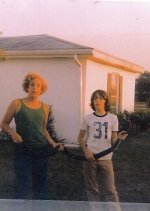
Hey, are you the kid on the right, or left of that pic?
T.
 
Well,

I am the one on the right. I was 10 or 11 in that photo and the other Jeff, we were both named Jeff, had a few years on me, but we were great friends. Sure would like to know what he is up to these days, as we were both really into the herpetofauna scene of South Florida...

Best regards,

Jeff
 
We have pondered this many times as well. Protecting it to the point where they are completely wiped out..Fabulous thinking. We were thinking a captive breeding/release type program though Im sure there are negative points to that perhaps our children and their children could see an indigo in it's native environment. or what is left of it. Florida is a heartbreaking state to live in,really. Our favorite herping sites have almost all been developed now. I have not always been a reptile person until i met Chuck. I saw an indigo a few years back. Or actually it found me. Was walking a ditch enjoying the turtles etc when I heard a rustling in the grass behind me. Something large and fearless, literally following me. Sure enough there was a big beautiful Indigo snake. Even for a complete dolt, it was so obvious this was not your cmmon black racer. He followed me for a bit before heading under a chain link fence and hanging out under someones car in their carport. So confident and non-concerned about me. Now I kick myself for not having had a camera or something to just concrete that moment forever. We've never had another experience like that and we've looked. So sad.
Amber
 
Sad indeed..

The discussion of just how successful repatriation and translocation are as conservation tools comes up quite often. Unfortunately, the largest study dedicated to the topic indicates such are not viable tools for conservation efforts. For more information to this regard, you may wish to review the work of Dodd and Seigel 1991.
The ability of zoological entities to develop species survival plans for all endangered species of herpetofauna is greatly lacking, many have given a great amount of consideration to opening up such programs to herpetoculturist and some private herpetoculturist take part in the AZA’s studbook program.
I often find it ironic that herpetoculturist who push for conservation often criticize the government for not allowing them collect the species being granted protections for conservation efforts. The issue is a double edged sword, but so long as there are viable populations, I do not believe in the removal of specimens in the wild, as doing so, as I have said before, makes the individual removed ecologically extinct. Also, I believe there are enough wild specimens confiscated by G&F officials each year, which are then passed along to zoological and academic entities, to negate the wild collecting of D. couperi for the benefit of the captive gene pool. Trust me, the zoos are willing to work with private herpetoculturist in regards to breeding loans and I have been preaching such for quite some time, but I know of only a single breeder, other than myself, who has taken the initiative to knock on some doors…

Best regards,

Jeff
 
Back
Top