• Responding to email notices you receive.
    **************************************************
    In short, DON'T! Email notices are to ONLY alert you of a reply to your private message or your ad on this site. Replying to the email just wastes your time as it goes NOWHERE, and probably pisses off the person you thought you replied to when they think you just ignored them. So instead of complaining to me about your messages not being replied to from this site via email, please READ that email notice that plainly states what you need to do in order to reply to who you are trying to converse with.

  • IMPORTANT! PLEASE READ!! About the Google Adsense ads being displayed

    =====================
    Posted 08/15/2025
    =====================


    Yeah, I know. They are a pain in the butt. But they pay the bills to keep my server running. Just a fact of life, I am afraid.

    Want to get rid of them? Simple. Just become a Contributor level member or above and they will be gone. -> Please click HERE."

    Is that too much for me to ask of you to keep this site running? Well, sorry about that. I too wish I could get everything for free. But alas.....

    =====================
    Addendum: 01/10/2026
    =====================


    Google Adsense ad revenue for December, 2025 was just $30 over the cost of the lease for the server running this site. So, in effect, the money providing the incentive for me to continue running this site is coming SOLELY from the paid memberships and sponsorships here. Which honestly ain't much....

Questions on supers

MurdocksReptiles

New member
Joined
Dec 1, 2011
Messages
144
Reaction score
3
Points
0
Location
Santa Rosa, Ca, USA
So I got in a chat with a local herp guy about some supers he saw for sale and was going to buy. I didnt want to steer him to much as I myself have never dealt with supers but I did think that what he was buying might have been mis advertised.

Im going to put down some thought segments and would love to get someone to correct me where im wrong

* There is co-dominant and dominant. Both gene types will transfer ( statistically ) to half of the litter. Dominant is different from co-dominant in that a super dominant would look the same as a normal dominant. Hypo for example looks the same with one hypo gene or two hypo genes. Where as co-dominants take a different appearance when a super is created. Motleys for example, super motley being solid black and normal motley being patterned.

* With a Dominant gene type ( super hypos is what i was discussing with my friend ) like hypo, for it to be proven as a super it must be breed to something without a hypo gene and the litter must come out 100% hypo. Then and only then are you sure she is a super.

* The only other way to garuntee a virgin hypo to be a super would be if it came from a litter of 2 proven supers ( proved by the method mentioned above )

* a super hypo x a normal boa ( no hypo gene ) would produce 100% hypos ( one hypo gene ) and zero super hypos
* a super hypo x a hypo ( one hypo gene ) would produce 50% super hypos and 50% hypos. but all would be considered POSSIBLE super hypos because you cant 100% distinctly tell them apart you can only guess.

I only ask to help a friend not over pay for something.
not trying to accuse anyone of mis advertising supers.

Thanks for any knowledge.:yesnod::thumbsup:
 
So I got in a chat with a local herp guy about some supers he saw for sale and was going to buy. I didnt want to steer him to much as I myself have never dealt with supers but I did think that what he was buying might have been mis advertised.

Im going to put down some thought segments and would love to get someone to correct me where im wrong

* There is co-dominant and dominant. Both gene types will transfer ( statistically ) to half of the litter. Dominant is different from co-dominant in that a super dominant would look the same as a normal dominant. Hypo for example looks the same with one hypo gene or two hypo genes. Where as co-dominants take a different appearance when a super is created. Motleys for example, super motley being solid black and normal motley being patterned.

* With a Dominant gene type ( super hypos is what i was discussing with my friend ) like hypo, for it to be proven as a super it must be breed to something without a hypo gene and the litter must come out 100% hypo. Then and only then are you sure she is a super.

Almost correct. When you deal with hypos enough, there are visual ways to tell if a super is a super. It's the non-super looking hypos that must be bred to prove if they are super or not.

* The only other way to guarantee a virgin hypo to be a super would be if it came from a litter of 2 proven supers
( proved by the method mentioned above )

Other than visually knowing the difference, yes.

* a super hypo x a normal boa ( no hypo gene ) would produce 100% hypos ( one hypo gene ) and zero super hypos.

Correct.

* a super hypo x a hypo ( one hypo gene ) would produce 50% super hypos and 50% hypos. but all would be considered POSSIBLE super hypos because you cant 100% distinctly tell them apart you can only guess.

Correct, but you would be able to tell with some of them.

http://www.salmonboa.com/Salmongenetics.htm
 
Almost correct. When you deal with hypos enough, there are visual ways to tell if a super is a super. It's the non-super looking hypos that must be bred to prove if they are super or not.

Other than visually knowing the difference, yes.

What is the visual difference.
and seeing as hypo is defined as a dominant gene doesnt that go against definition? If I remember correctly the visual difference is the fact that supers look cleaner in there patterns, but ive also seen normals look very clean in there pattern?
I dont mean to argue just full understand.


Correct.

Not correct. A super hypo to hypo breeding would yield (roughly) 25% normals and 75% hypos, with 50% of the hypos being regular and 25% being supers. Then you would call ALL hypos possible or probable supers.

And again dont mean to argue but that makes no sense.

why would a super x a normal give 100% normal hypos
and then a super x a hypo only give 75% hypos with 25 % supers

Thank you for sharing your knowledge:thumbsup:
 
What is the visual difference.
and seeing as hypo is defined as a dominant gene doesnt that go against definition? If I remember correctly the visual difference is the fact that supers look cleaner in there patterns, but ive also seen normals look very clean in there pattern?
I dont mean to argue just full understand.


And again dont mean to argue but that makes no sense.

why would a super x a normal give 100% normal hypos
and then a super x a hypo only give 75% hypos with 25 % supers

Thank you for sharing your knowledge:thumbsup:

Had a brain fart, wasn't looking at the question when I answered. I edited my answer, lol. Sorry.
 
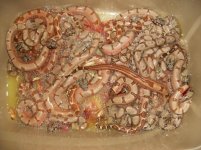
Here is a picture I found here on fauna to show some differences. Look at the overall coloring of all, tails and speckling of others, reduced patterns etc.
 

Attachments

  • 20130601_200830-1.jpg
    20130601_200830-1.jpg
    88.1 KB · Views: 94
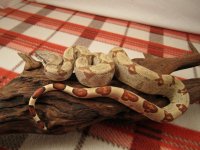
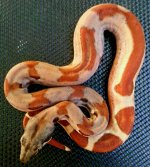
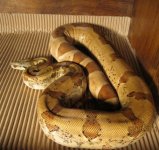
Here is a non-super hypo and super hypo, both produced by me along with an adult hypo and a super hypo of mine.
 

Attachments

  • IMG_0342.jpg
    IMG_0342.jpg
    169 KB · Views: 98
  • 20130612_192004-1.jpg
    20130612_192004-1.jpg
    85.5 KB · Views: 92
  • Feb '11 - March '11 009.jpg
    Feb '11 - March '11 009.jpg
    118.8 KB · Views: 95
  • 63261_136271_Large_HSGqFB5tApIJfr.jpg
    63261_136271_Large_HSGqFB5tApIJfr.jpg
    74.3 KB · Views: 103
When learning to visually tell supers, it also depends on which line it comes from, Jeff Gees hypos have more panamanian blood, thus leading to "orange tail" hypos and Rich Ihle has the more salmon color in his line, which some EBV etc has been added in. Jeffs line can be easier to tell than Richs. Just my 2 cents. I love the G line supers, which is what my female is. My male super has more of the "salmon" influence.
 
Jeff Gees hypos have more panamanian blood, thus leading to "orange tail" hypos and Rich Ihle has the more salmon color in his line, which some EBV etc has been added in.

Rich Ihle's salmon boas are also panamania crosses (here's his write up on the history of the salmon: http://www.salmonboa.com/about.html) . EBV (east bay vivarium, which is a reptile store here in CA) are their selective bred salmons, not the other way around.

I'll try to remember to come back and add more later tonight when I have time.
 
When learning to visually tell supers, it also depends on which line it comes from, Jeff Gees hypos have more panamanian blood, thus leading to "orange tail" hypos and Rich Ihle has the more salmon color in his line, which some EBV etc has been added in. Jeffs line can be easier to tell than Richs. Just my 2 cents. I love the G line supers, which is what my female is. My male super has more of the "salmon" influence.

To clarify, the "G Line" hypos are more central american influenced which is why they stay smaller and have more of the Orange tail coloration. Rich's have more of a colombian mix in them, therefor different coloration and larger size. I have heard and read about the storied on both types, just have heard it put different ways too many times. April, I would love to hear more input on this too. I am sure everyone knows of my love of the hypo by now.
 
Hypo in BCI is in the gray area between Dominant and incomplete dominant but should be classified as Dominant IMO since you cannot consistently tell them apart. Yes, in a litter of Supers and Hypos you can pick out some Probable Supers (even ones I would bet on are Supers) and you can also pick out some that are pretty likely not Supers. The problem is that middle group where you can't tell the Supers from the Hypos.

A true Incomplete Dominant trait will have three distinguishable phenotypes. For example one I am working on with my BRB's that I am calling Candy Stripe. There are three clear phenotypes (although still not fully proven with breeding trials):
Normal - self expanantory
Candy Stripe - Linked dorsal patterns, intense color and side patterns continue onto subcaudal scales.
Super Candy Stripe - Full dorsal and lateral striping, intense pink coloring, black heads and pink tongues.

While I'm at it, Co-Dominant is used way too often incorrectly in reptiles. For example, to my knowledge there is only ONE Co-Dominant trait in BCI - Paradigm. Co-Dominant is where two different morph genes (a and b) work together on one allele to in affect have four possible phenotypes from that one gene pair:
Normal - nn, na or nb
Visual recessive (a) - aa
Visual recessive (b) - bb
Visual Co-Dominant (a+b) - ab
 
Hypo in BCI is in the gray area between Dominant and incomplete dominant but should be classified as Dominant IMO since you cannot consistently tell them apart. Yes, in a litter of Supers and Hypos you can pick out some Probable Supers (even ones I would bet on are Supers) and you can also pick out some that are pretty likely not Supers. The problem is that middle group where you can't tell the Supers from the Hypos.

A true Incomplete Dominant trait will have three distinguishable phenotypes. For example one I am working on with my BRB's that I am calling Candy Stripe. There are three clear phenotypes (although still not fully proven with breeding trials):
Normal - self expanantory
Candy Stripe - Linked dorsal patterns, intense color and side patterns continue onto subcaudal scales.
Super Candy Stripe - Full dorsal and lateral striping, intense pink coloring, black heads and pink tongues.

While I'm at it, Co-Dominant is used way too often incorrectly in reptiles. For example, to my knowledge there is only ONE Co-Dominant trait in BCI - Paradigm. Co-Dominant is where two different morph genes (a and b) work together on one allele to in affect have four possible phenotypes from that one gene pair:
Normal - nn, na or nb
Visual recessive (a) - aa
Visual recessive (b) - bb
Visual Co-Dominant (a+b) - ab

So would you say that you can't 100% call it a super until it's been proven by breeding?

And on Co doms. I always thought Co dominant meant that a and aa look different whereas dominant a and aa look the same. Like motley vs hypo.
 
only way you can know a baby is a Super Hypo for certain is if both parents were proven supers (and/or Hypo Motleys). Yes, Some Supers can be picked out of the litter but still have to be called Probable until proven.

Co dom by definition is two dis-similar genes that blend to produce a different phenotype.

One of the real problems we face is some traits are simple to explain and fit a given model like albinism being simple recessive. But mother nature is not always simple and logical. for example...

Motley by itself is incomplete dominant (a is the incomplete form of aa)
Hypo by itself is dominant
Hypo and Motley when combined show both traits so not fully but kind of co-dominant??

Boa Woman Caramel is recessive
Sharp Albino is also recessive
Boa Woman Caramel and Sharp ALbino are co-dominant when combined ie neither trait fully shows but a blend of the two is shown
 
Back
Top