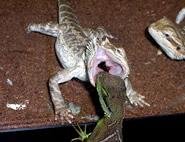
The first thing I would consider if I were thinking of feeding a bearded fish is that they come from the deserts of Australia and in all probability would never see a fish or anything resembling one in their lives. That alone would be reason enough for me.
This leaves the possibility that their digestive systems would not be conditioned to properly process fish, particularly the scales which are for all intents and purposes indigestable much like beaks and fur.
Now you might say that they would never see a domestic cricket, a super worm, or a lobster roach in the wild either, but those are a whole lot closer to the insects they do feed on than a fish.
Having said that we can consider the cons of actually feeding them such a diet.
One problem to consider is an issue with thiamin (vitamin B1) deficiency. Many fish contain the enzyme thiaminase which destroys B1.
Another problem is fish, especially "junk fish" like feeders commonly host parasites that if fed live or fresh killed can be transmitted to the lizard. Garter snakes are known to suffer problems with round worms, tape worms, and other internal parasites when maintained on a diet of live feeder fish.
In the end though you're going to do what you want to do and it looks like you want to feed them fish. Fine, feed them fish. Come back in a year or two and let us know how it worked. I'm sure we'd all be interested in seeing how your lizards fared.
I will address a few of your other questions/comments however.
So, how many babies do crickets have? How long does it take to grow them to a worthy-size (for adult lizards)? How many times do you have to clean their tank in a month?
Crickets lay between 250 and 1000 eggs at a time.
They are fully mature in 4-6 weeks depending on temperature.
Their tub can be cleaned once a month or once per life cycle.
Now I have raised crickets, I prefer not to, it's a pain. But roaches are very different. There's no way raising fish could be easier than raising roaches.
And they diffentitly have a higher moisture content than mice or crickets
Crickets average 76% moisture. They are 17.5% protein and 4.7% fat.
Goldfish may have a higher moisture content I don't know, but how much do you need? Isn't 3/4 of the mass enough? Besides I'd feel confident in saying the fish have a far higher fat content.
Oh yea, and why is it that we dust our feeders? In the wild, the little bugs and rodents (and maybe fish) are not dusted, so how do they get all the vitamins and calcium and all that good stuff when they are in the wild? It can't be the sun, because even with our full spectrum and UVA/UVB lights, we still have to dust.
I would have thought the answer would be obvious, but here are the main reasons. We dust our feeders due to our complete inability to replicate nature. UV lights are a fair substitution to sunlight, but they do not replicate it. Sunlight has nothing to do with the nutritional value of the wild insects though. We cannot raise insects in a tub to equal the nutritional value of a wild bug. Gut loading is fine, but the fact remains we actually have no idea what wild bugs eat in what quantities. They eat wild plants which have different nutritional values that what you pick up at the grocery store. No one knows exactly what goes into a wild insect, so we simply do the best we can and fill in the gaps with supplements.
We can keep our animals healthy in the environments we provide, but those environments including their diets, are not mirror images of nature.
One last note I'll add. Several studies of the gut content of wild dragons have shown that their natural diet is as much as 80% plant matter. In young dragons the ratio was in favor of insects, but the adults show a diet shift toward increased plant matter. I'd be more concerned with what plants I was feeding them in what quantities than I would be with what I could use to replace crickets for whatever reason.




 I just know that nothing I have read about them has been good, so I would never chance it with my animals if I wasnt 100% sure it was good for them. Heck, feeder goldfish arent even good to feed predatory fish either, accourding to fish enthusiasts.